ARTICLE GUIDE
At a Glance
Evaluating the historical and theological development of early Christian devotion requires a precise understanding of the liturgical practices adopted by the first believers.
Read moreShow less
What This Study Explores
Promise-Plan Theology
Direct Answer: Did the earliest Christians worship Jesus while remaining Jewish monotheists?
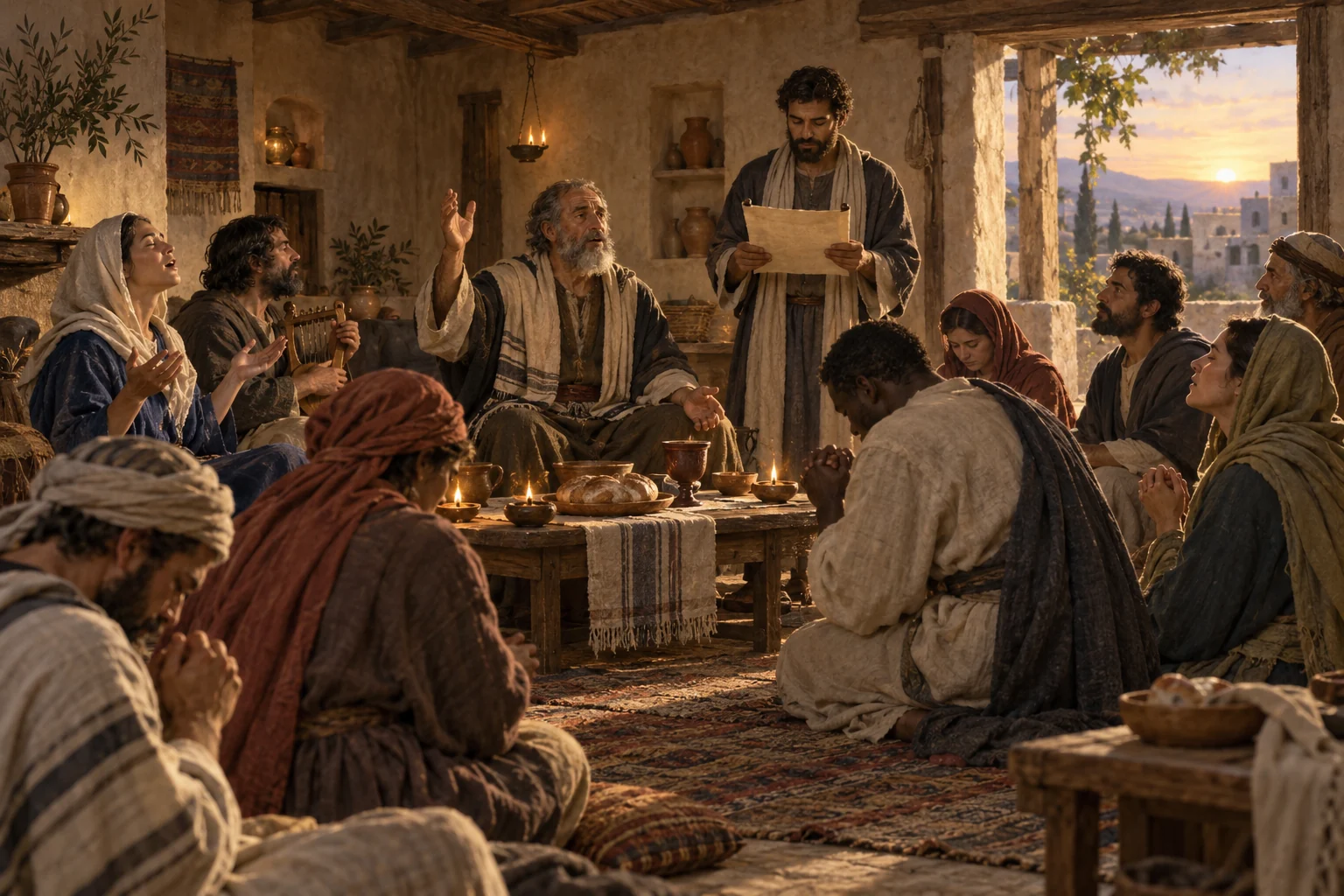
Yes. The earliest Christian communities incorporated Jesus into practices of devotion—prayer, invocation, confession, baptism, sacred meals, hymnic praise, and eschatological petition—while continuing to confess the one God of Israel.
These repeated liturgical acts indicate that high Christology was not merely a late philosophical deduction. Jesus was included within the divine identity and honored in relation to the Father, with worship shaped by Israel’s Scriptures, temple categories, and the conviction that God had exalted the crucified Messiah.
Key Claims
- Early devotion to Jesus appears in communal practices as well as in explicit christological statements.
- Aramaic invocations such as Maranatha point to devotion embedded in very early Jewish-Christian settings.
- The Lord’s Supper places remembrance of Jesus within the sacred rhythm and identity of the assembly.
- Prayer and worship directed to Jesus coexist with differentiated language about the Father and the Son.
- Sacrifice must be understood through covenant, gift, communion, purification, and divine presence rather than reduced to one transactional function.
Interpretive Context
Scholars debate whether devotion to Jesus arose explosively within the earliest circles or developed through stages, and they distinguish cultic worship from honor given to exalted agents. The cumulative pattern of practices is stronger than any isolated proof-text. The absence of animal sacrifice offered directly to Jesus does not settle the question, since early Christ-followers interpreted Jesus himself through sacrificial and temple categories while directing worship within a transformed messianic liturgy.
The HANDS taxonomy is most persuasive here as a cumulative account of patterned devotion: invocation, prayer, sacred meal, confession, and eschatological appeal place Jesus within the worshiping life of earliest communities. The essay supplements that evidence with temple and sacrificial categories, arguing that Jesus can be both the recipient of devotion and the messianic offering through whom access to God is restored.
Selected Scholarship
- Robert M. Bowman Jr. and J. Ed Komoszewski, The Incarnate Christ and His Critics — the HANDS taxonomy and religious honors given to Jesus.
- Larry W. Hurtado, Lord Jesus Christ — early devotional practices and the mutation of Jewish monotheism.
- Richard Bauckham, Jesus and the God of Israel — Jesus’ inclusion in the unique divine identity.
- James F. McGrath, The Only True God — a critical developmental account of early Christian monotheism and Christology.
- David M. Moffitt, Rethinking the Atonement — resurrection, ascension, and heavenly-priestly dimensions of Jesus’ sacrificial work.
Scripture Connections
Genesis 1; Revelation 22:20; Acts 21; Acts 21:20–26; Numbers 6:13–17; Acts 21:26; Acts 24:17–18; Acts 25:8
Continue on Substack
The complete article and its available video material remain on Rabbit Room Apologetics at Substack.
Originally published June 1, 2026. This WordPress page is a discovery guide; the complete article is hosted on Substack.