ARTICLE GUIDE
At a Glance
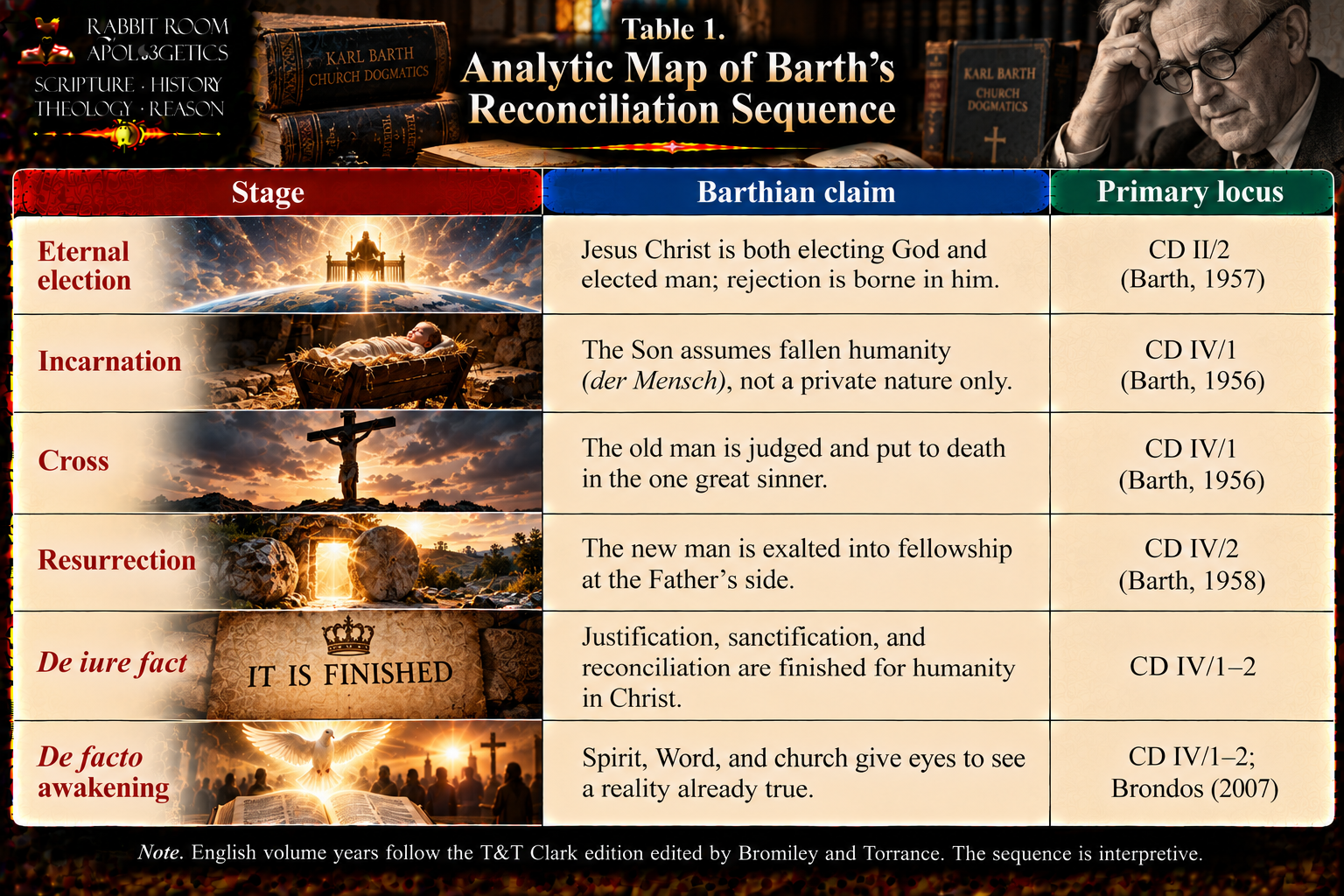
A guide to Karl Barth’s doctrine of reconciliation, its Christ-centered account of objective grace, and its tensions concerning faith, historical inquiry, and universal restoration within the biblical promise-plan.
How does Barth’s account of reconciliation relate to the biblical promise-plan?
The essay examines Barth’s Church Dogmatics alongside David Brondos’s analysis of salvation and the cross. It appreciates Barth’s resistance to reducing salvation to moral progress, while testing his account against the historical resurrection, priestly atonement, and Israel’s enduring place in God’s promise.
Key Claims
- Barth locates election in Jesus Christ as both the electing God and the elected man.
- Objective reconciliation and the believer’s awakening to grace are distinguished in Barth’s account.
- The essay questions how this framework preserves the significance of faith, repentance, and human agency.
- Historical investigation of the resurrection remains essential to the essay’s constructive alternative.
- Priestly cleansing and the high-priestly movement of Hebrews connect death, resurrection, and heavenly presentation.
- The promise-plan frames cosmic reconciliation without erasing Israel’s irrevocable gifts and calling.
Primary Textual Anchors
- Genesis 3:15; 12:1–3 — the unfolding promise and blessing of the nations.
- Jeremiah 31:31–34; Ezekiel 36:26–27 — covenant renewal and transformation.
- Romans 11:17–29 — Gentile inclusion and Israel’s continuing calling.
- Hebrews — the interrelation of priesthood, sacrifice, resurrection, and access to God.
Scripture Connections
Genesis 3:15; 12:1–3 — the unfolding promise and blessing of the nations. Jeremiah 31:31–34; Ezekiel 36:26–27 — covenant renewal and transformation. Romans 11:17–29 — Gentile inclusion and Israel’s continuing calling. Hebrews — the interrelation of priesthood, sacrifice, resurrection, and access to God.
Selected Scholarship
- Karl Barth — Church Dogmatics, particularly election and reconciliation.
- David A. Brondos — Fortress Introduction to Salvation and the Cross (2007).
- Walter C. Kaiser Jr. — The Promise-Plan of God (2008).
- David M. Moffitt — Atonement and the Logic of Resurrection in the Epistle to the Hebrews (2011).
Related Guides
- The Ethical Reign of God and the Re-Engineering of Soteriology
- The Organic Architecture of Salvation
Continue on Substack
Read the complete article on Substack, with Watch and Listen resources where available.
Leave a Reply