ARTICLE GUIDE
At a Glance
Exodus 12 establishes Passover, delivers Israel from Egypt, judges Egypt’s gods, and advances the promise-plan through substitutionary blood and covenant memory.
Read moreShow less
What This Study Explores
This commentary examines Exodus 12’s narrative structure, Hebrew terminology, Passover ordinances, tenth plague, judgment of Egypt’s gods, mixed multitude, New Testament appropriations, and promise-plan significance.
Why Is Exodus 12 the Redemptive Hinge of the Pentateuch?
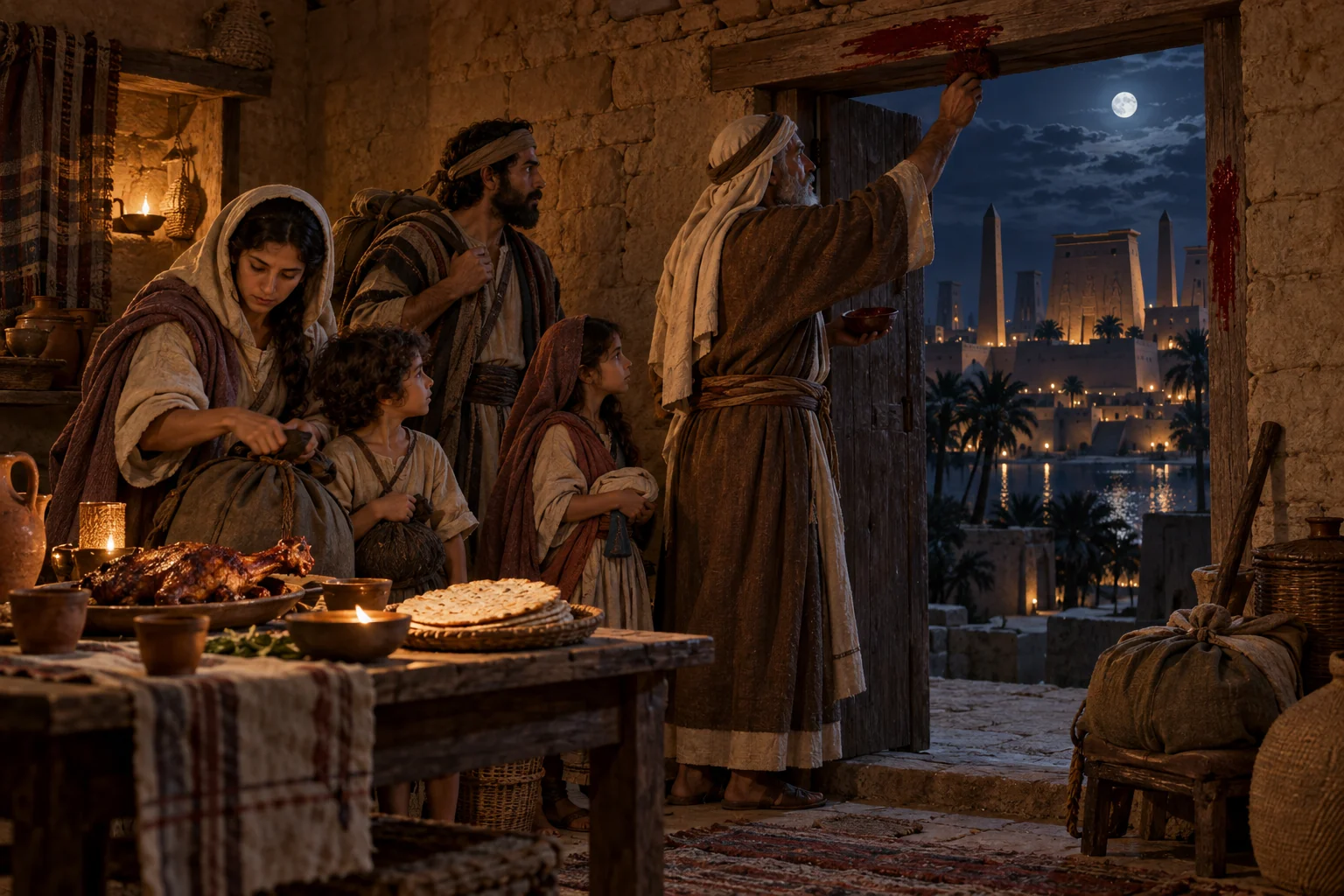
Exodus 12 turns the Abrahamic promise from patriarchal expectation into national deliverance. Yahweh judges Egypt, brings Abraham’s descendants out with possessions, establishes sacred time around Passover, and identifies Israel through the blood of an unblemished substitute. Redemption becomes the event by which Israel remembers who God is and who the people are.
The chapter also establishes a canonical pattern without erasing its historical meaning. The Passover lamb, unbroken bones, deliverance of the firstborn, exodus from bondage, and one law for the covenant assembly become theological resources for the Gospels, Paul, Hebrews, and Revelation. Later fulfillment depends on this concrete act of Israel’s rescue rather than replacing it.
Key Claims
- Redemption reorganizes Israel’s time. The calendar begins with Yahweh’s deliverance rather than Egypt’s economic order.
- Passover joins substitution and participation. Applied blood marks covenant households that also eat the meal in readiness to depart.
- The tenth plague is cosmic judgment. Yahweh defeats Pharaoh and executes judgment against Egypt’s gods.
- The mixed multitude anticipates wider inclusion. Outsiders join Israel’s departure under covenantal provisions rather than replacing Israel.
- The New Testament receives an exodus pattern. Jesus’ death, deliverance from slavery, and the identity of the redeemed assembly draw on Exodus 12.
Interpretive Context
Exodus 12 operates simultaneously as historical narrative, ritual legislation, theological polemic, and canonical pattern. Typological readings remain accountable to the chapter’s original claims: Israel is delivered from an actual oppressor, Egypt’s firstborn die under judgment, and Passover becomes a recurring embodied memorial.
Questions concerning the destroyer, Egypt’s gods, and cosmic conflict should be handled without dividing Yahweh’s sovereignty from secondary agency. Likewise, New Testament appropriation should proceed organically. Messiah fulfills and intensifies Passover themes, but the church’s use of those themes cannot erase Israel’s historical redemption or continuing place in the promise-plan.
Selected Scholarship
- Propp, W. H. C. (1999–2006). Exodus 1–18 and Exodus 19–40.
- Sarna, N. M. (1991). Exodus.
- Durham, J. I. (1987). Exodus.
- Dozeman, T. B. (2009). Commentary on Exodus.
- Kaiser, W. C., Jr. (2008). The Promise-Plan of God.
Scripture Connections
Genesis 12:10–20; 15:13–14; Exodus 4:22–23; 12:1–51; Numbers 9:1–14; Hosea 11:1; Matthew 2:15; 26:17–30; John 19:36; 1 Corinthians 5:7–8; Hebrews 11:28; Revelation 5:6–10
Continue on Substack
The complete article remains on Rabbit Room Apologetics at Substack.
Originally published September 22, 2026. This WordPress page is a discovery guide; the complete article is hosted on Substack.
Leave a Reply