ARTICLE GUIDE
At a Glance
The figure of Melchizedek presents an unusual hermeneutical phenomenon: an obscure patriarchal character confined in the Hebrew Bible to Genesis 14 18 20 and Psalm 110 4 who nevertheless becomes a cornerstone of Second Temple eschatology and New Testament Christology.
Read moreShow less
What This Study Explores
Second Temple Judaism • Christology • Eschatology
Who Is Melchizedek, and How Does Hebrews Use Him?
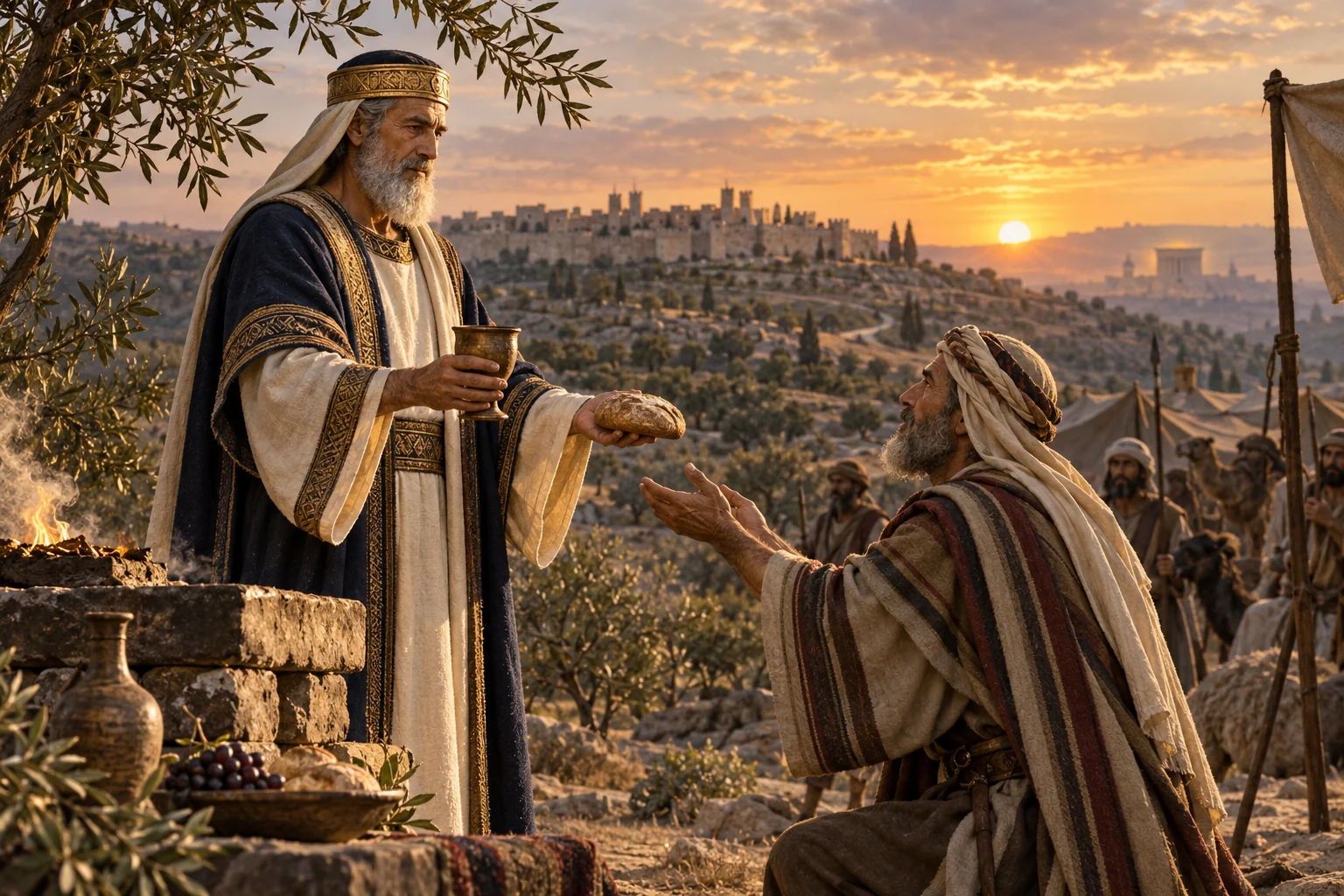
Melchizedek is best read first as a real priest-king of Salem who blesses Abraham in Genesis 14. The narrative’s silence about his ancestry, birth, and death does not require that he be a pre-incarnate appearance of Christ. Instead, that deliberately sparse literary profile makes him an ideal canonical type of a priesthood prior to and independent of Levi.
Psalm 110 joins Davidic kingship to an enduring priesthood “according to the order of Melchizedek,” and Hebrews applies that pattern to Jesus. Hebrews does not claim that the Genesis figure is ontologically eternal; it exploits the text’s lack of genealogy and death notice to contrast the mortal Levitical succession with Messiah’s indestructible life. Jesus fulfills the royal-priestly trajectory and secures lasting access to God.
Key Claims
- Genesis presents a historical priest-king. Melchizedek serves El Elyon, blesses Abram, and receives a tithe within the Abrahamic narrative.
- Narrative silence enables typology. Hebrews reasons from the literary portrait rather than inventing a biological claim about the ancient king.
- Psalm 110 unites throne and priesthood. The Davidic oracle projects a royal priest whose ministry exceeds the Levitical order.
- Second Temple texts illuminate reception. 11QMelchizedek, Philo, Josephus, and later identification with Shem show interpretive development but do not control doctrine.
- Messiah restores humanity’s royal-priestly calling. His priesthood serves the promise-plan’s recovery of sacred space and blessing for the nations.
Interpretive Context
Hebrews’ description of Melchizedek as “without father or mother” follows the literary silence of Genesis and supports a typological argument; it need not make the historical king an eternal divine being. Second Temple texts such as 11QMelchizedek show how highly the figure could be developed, but Hebrews’ decisive claim is that the scriptural pattern finds its superior and permanent realization in the risen Son.
Melchizedek appears immediately after the Babel dispersion and within the first narrative development of Abraham’s vocation to bless the nations. His non-Israelite priesthood demonstrates that God’s purpose was never confined to ethnic isolation, while Abraham’s priority in the promise remains intact. Sinai’s Levitical order is a genuine pedagogical stage, not an error; Hebrews argues that its provisional structures reach their telos in the risen Son.
Selected Scholarship
- Horton, F. L. (1976). The Melchizedek Tradition.
- Kaiser, W. C., Jr. (2008). The Promise-Plan of God.
- Mason, E. F. (2008). You Are a Priest Forever.
- Imes, C. J. (2023). Being God’s Image.
- Heiser, M. S. (2015). The Unseen Realm.
Scripture Connections
Genesis 14; Psalm 110; Genesis 3; Jeremiah 31; Ezekiel 36; Hebrews 7; Genesis 12; Genesis 14:18–20
Continue on Substack
The complete article remains on Rabbit Room Apologetics at Substack.
Originally published August 20, 2026. This WordPress page is a discovery guide; the complete article is hosted on Substack.