ARTICLE GUIDE
At a Glance
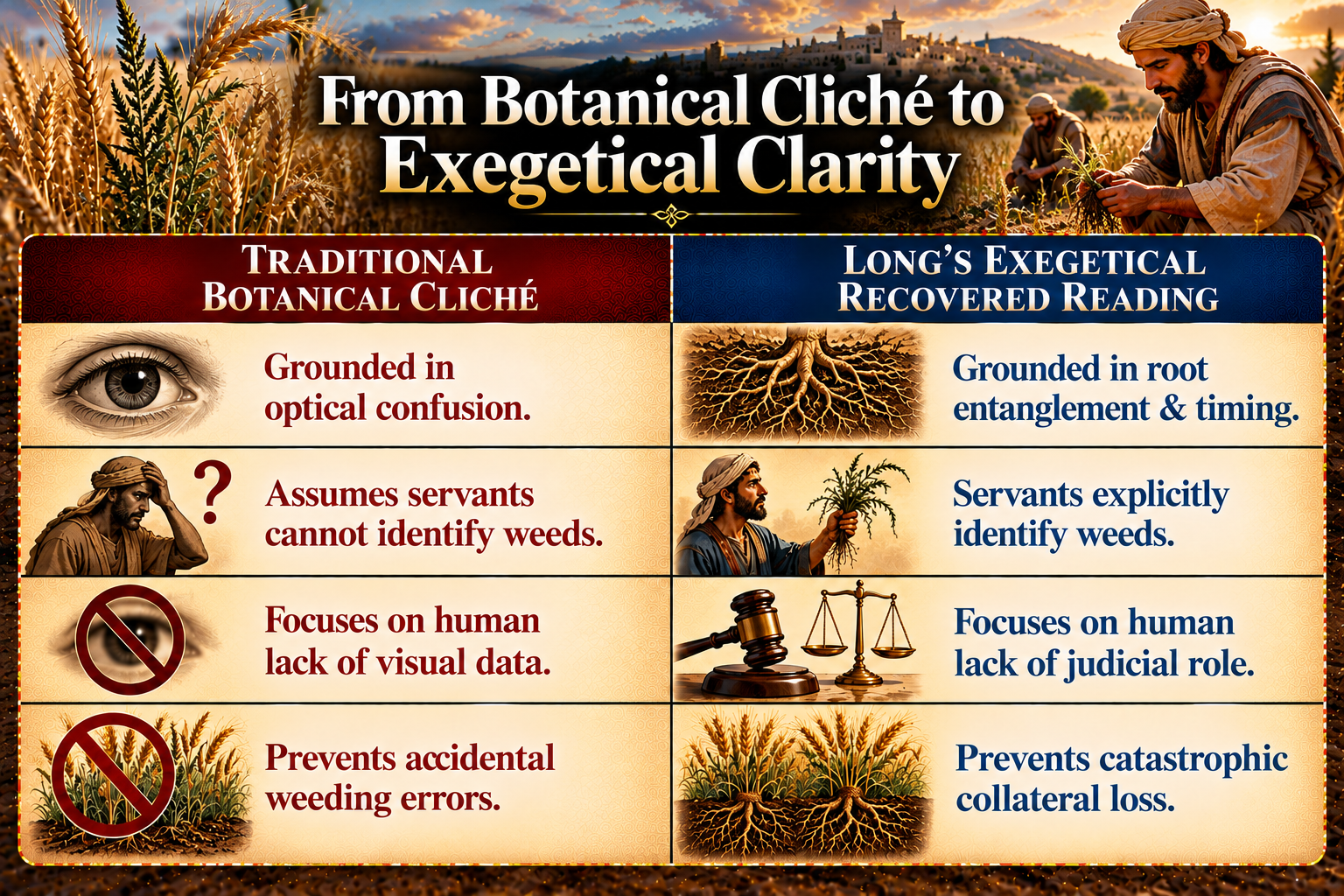
The parable of wheat and weeds frames patient kingdom witness in a mixed world, reserving the final separation for God’s judgment.
Why does the householder forbid premature uprooting?
Key Claims
- The essay locates the field’s mixture within inaugurated eschatology.
- Premature purification threatens collateral harm to genuine wheat.
- The enemy’s sabotage addresses the origin of evil without assigning it to the householder.
- Human servants are called to patient, non-coercive witness; final sorting belongs to the angelic harvest.
Primary Textual Anchors
- Matthew 13:24–30, 36–43 — the parable and its interpretation.
- Matthew 13:31–33 — mustard seed and yeast in the surrounding discourse.
- Romans 11:28–29 — the essay’s non-supersessionist horizon.
Scripture Connections
Matthew 13:24–30, 36–43 — the parable and its interpretation. Matthew 13:31–33 — mustard seed and yeast in the surrounding discourse. Romans 11:28–29 — the essay’s non-supersessionist horizon.
Selected Scholarship
- Thomas G. Long — Proclaiming the Parables, chapter 6.
- Walter C. Kaiser Jr. — The Promise-Plan of God (2008).
Related Guides
- From the Sower to the Soils: Pedagogical Discernment, Promise-Plan Theology, and the Mechanics of Hearing in Matthew 13:1–23
- The Apocalyptic Mansion and the School of Wisdom
Continue on Substack
Read the complete article on Substack, with Watch and Listen resources where available.
Leave a Reply