ARTICLE GUIDE
At a Glance
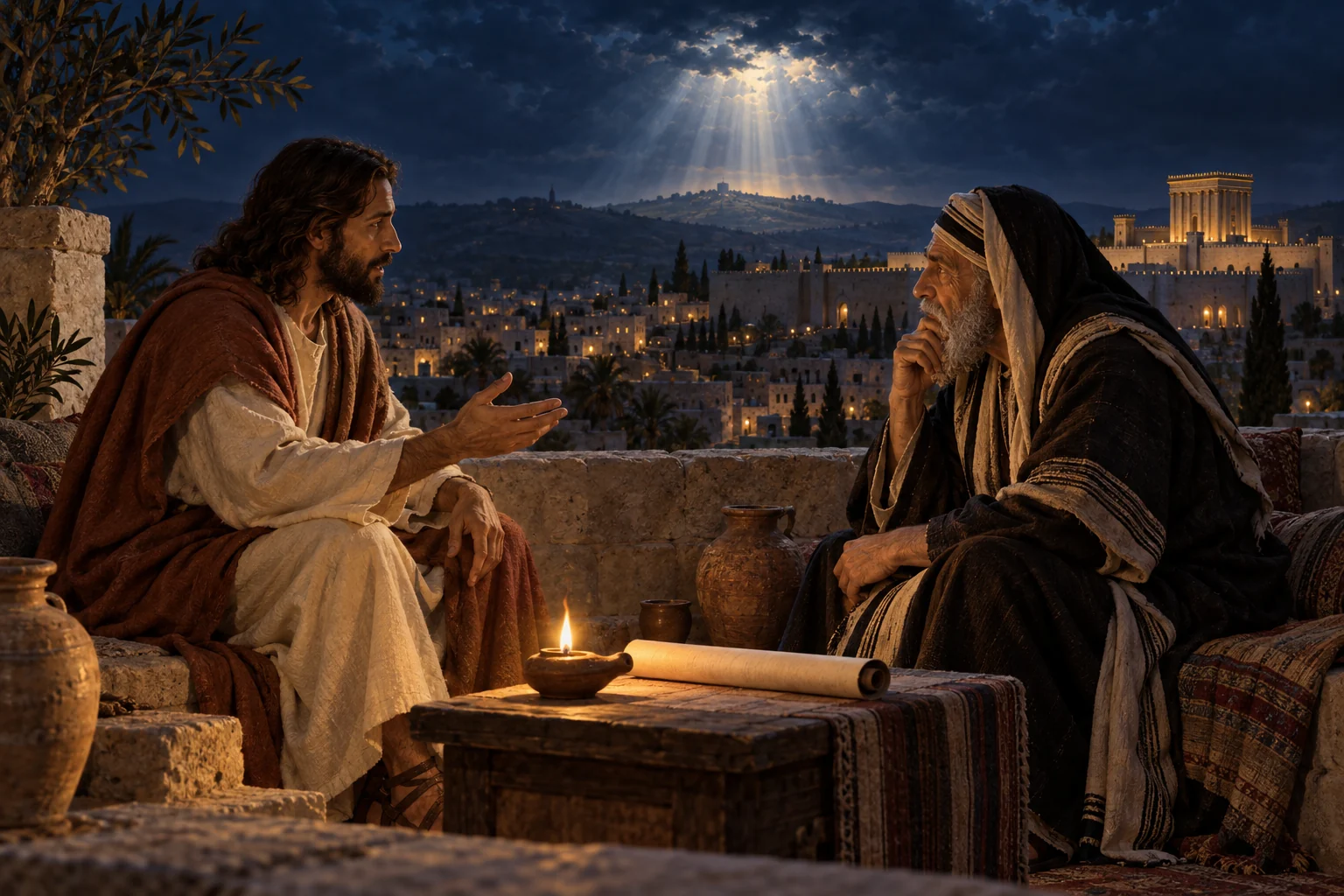
Within the Apostolic Scriptures, John 3—featuring the nocturnal dialogue between Jesus and Nicodemus—stands as one of the most theologically dense narratives of early Christology. Yet in much of the modern Western church and evangelicalism, this text has been severed from its Hebraic cognitive environment.
Read moreShow less
What This Study Explores
Promise-Plan Theology • Christology
Direct Answer: What does being born anothen mean in John 3?
John’s anothen deliberately carries the senses “again” and “from above.” Nicodemus hears repetition of physical birth, while Jesus speaks of the eschatological renewal produced by God’s Spirit—the cleansing and new heart promised to Israel and necessary for perceiving God’s kingdom.
The new birth is grounded in the heavenly Son of Man’s descent and exaltation. As the bronze serpent was lifted up for Israel’s healing, the Son is lifted up in crucifixion and vindication so that those who trust him receive the life of the coming age.
Key Claims
- Nicodemus represents a serious Jewish teacher whose misunderstanding advances the dialogue rather than a caricature of Judaism.
- Water and Spirit evoke prophetic promises of cleansing, renewed hearts, and restored covenant life.
- Anothen links personal transformation to divine origin rather than merely a second earthly beginning.
- The Son of Man’s heavenly authority frames new birth christologically.
- The serpent typology joins judgment, healing, crucifixion, exaltation, and life in a single Johannine paradox.
Interpretive Context
Scholars debate whether “water” points primarily to natural birth, baptism, John’s ministry, or Ezekiel 36; the prophetic cleansing-and-Spirit background best explains the combined phrase while allowing baptismal resonance for later readers. Likewise, John’s language of Israel and world must not be turned into supersessionism: Jesus summons Israel’s teacher into Israel’s promised renewal, which then opens life to the nations.
The Son of Man language joins Ezekiel’s promised renewal to Danielic heavenly authority and the cross’s paradoxical enthronement. New birth is thus neither detached private spirituality nor escape from Israel’s story; it is participation in the age-to-come life inaugurated when the descended Son is lifted up and the Spirit creates a cleansed people.
Selected Scholarship
- Raymond E. Brown, The Gospel According to John I–XII — classic critical exegesis of John 3.
- Craig S. Keener, The Gospel of John — extensive Jewish, Greco-Roman, and literary background.
- Richard Bauckham, Gospel of Glory — Johannine divine identity, witness, and exaltation themes.
- Daniel Boyarin, The Jewish Gospels — Jewish contexts for elevated Son of Man and divine-mediator traditions.
- Amy-Jill Levine, The Misunderstood Jew (2006).
Scripture Connections
John 3; John 3:1; John 3:2; John 3:3; John 3:4; John 3:5; Ezekiel 36:25; Ezekiel 36:25–27
Continue on Substack
The complete article and its available video material remain on Rabbit Room Apologetics at Substack.
Originally published June 5, 2026. This WordPress page is a discovery guide; the complete article is hosted on Substack.