ARTICLE GUIDE
At a Glance
Satan’s quotation of Psalm 91 is examined through Qumran, Second Temple demonology, Davidic expectation, and Jesus’ wilderness victory.
Read moreShow less
What This Study Explores
This study integrates Psalm 91, Matthew 4, Deuteronomy, Qumran manuscripts, Davidic–Solomonic exorcistic traditions, Divine Council cosmology, and the canonical promise-plan.
Why Did the Tempter Choose Psalm 91 at the Temple?
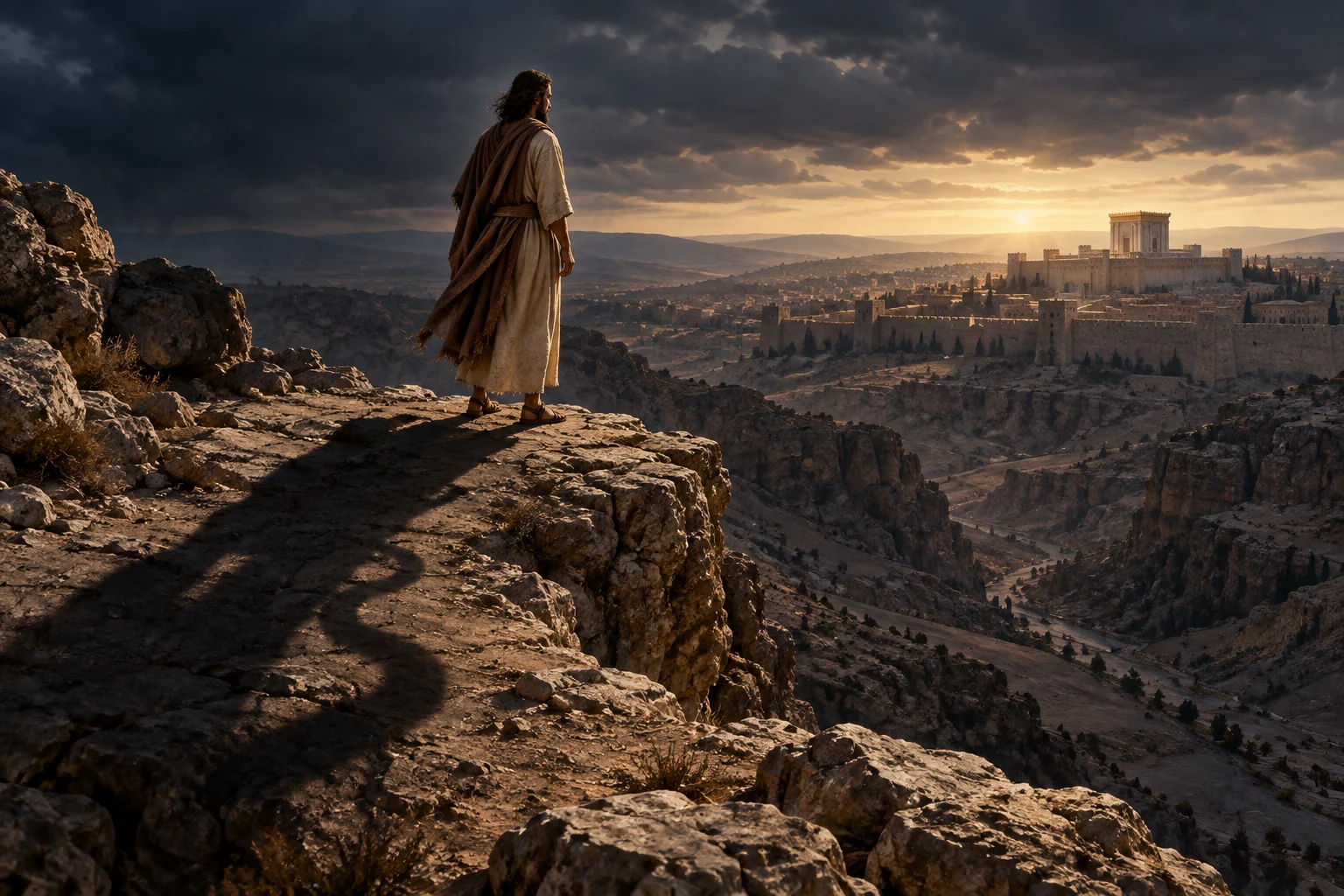
Psalm 91 was more than a generic promise of personal safety in parts of Second Temple Judaism. Its language of night terror, pestilence, destruction, angels, lion, and serpent was received apotropaically, and Qumran preserved it among compositions associated with protection from hostile spirits. Quoting it at the temple challenged Jesus to prove messianic Sonship through a spectacle drawn from a text linked with divine protection and spiritual conflict.
The temptation works by isolating a true promise from covenantal obedience. Jesus answers with Deuteronomy 6:16, refusing to test God or force angelic intervention. His victory identifies him as the faithful Son and Davidic Messiah who defeats the adversary through allegiance to the Father rather than manipulation of Scripture.
Key Claims
- Psalm 91 had an apotropaic reception history. Qumran and the Septuagint show that some Jewish readers heard its dangers in spiritual as well as ordinary terms.
- 11Q5 and 11Q11 must not be conflated. One catalogs Davidic compositions for the afflicted; the other preserves apotropaic psalms culminating in Psalm 91.
- The temple setting sharpens the challenge. The tempter demands a public sign of protected messianic identity at Israel’s sacred center.
- Jesus defeats interpretive manipulation with covenant fidelity. Deuteronomy 6:16 restores the quotation to obedient trust rather than presumptuous testing.
- Demonological reconstruction has limits. Second Temple traditions illuminate the scene without becoming a fourth canon or proving every proposed detail of Satan’s strategy.
Interpretive Context
Modern readings often demythologize Psalm 91’s threats into disease and danger alone. Comparative Semitic evidence and later Jewish reception justify asking whether ancient readers could also hear hostile powers. Yet the Hebrew text does not require every term to be a proper demon name, and responsible interpretation must distinguish lexical possibility from later reception.
The temptation belongs between Jesus’ baptismal declaration as Son and his kingdom proclamation. It recapitulates Israel’s wilderness testing while advancing the conflict announced in Genesis 3:15. The cosmic-warfare dimension therefore serves the promise-plan rather than replacing the historical, ethical, and covenantal dimensions of the passage.
Selected Scholarship
- Blair, J. M. (2009). De-Demonising the Old Testament.
- Flint, P. W. (1997). The Dead Sea Psalms Scrolls and the Book of Psalms.
- Heiser, M. S. (2015). The Unseen Realm.
- France, R. T. (2007). The Gospel of Matthew.
- García Martínez, F., & Tigchelaar, E. J. C. (1997). The Dead Sea Scrolls Study Edition.
Scripture Connections
Genesis 3:15; Deuteronomy 6:16; 32:8–9; Psalm 91; Habakkuk 3:3–5; Matthew 3:16–4:17; Luke 4:1–13; Romans 11:17–29; Colossians 2:13–15
Continue on Substack
The complete article remains on Rabbit Room Apologetics at Substack.
Originally published September 22, 2026. This WordPress page is a discovery guide; the complete article is hosted on Substack.