ARTICLE GUIDE
At a Glance
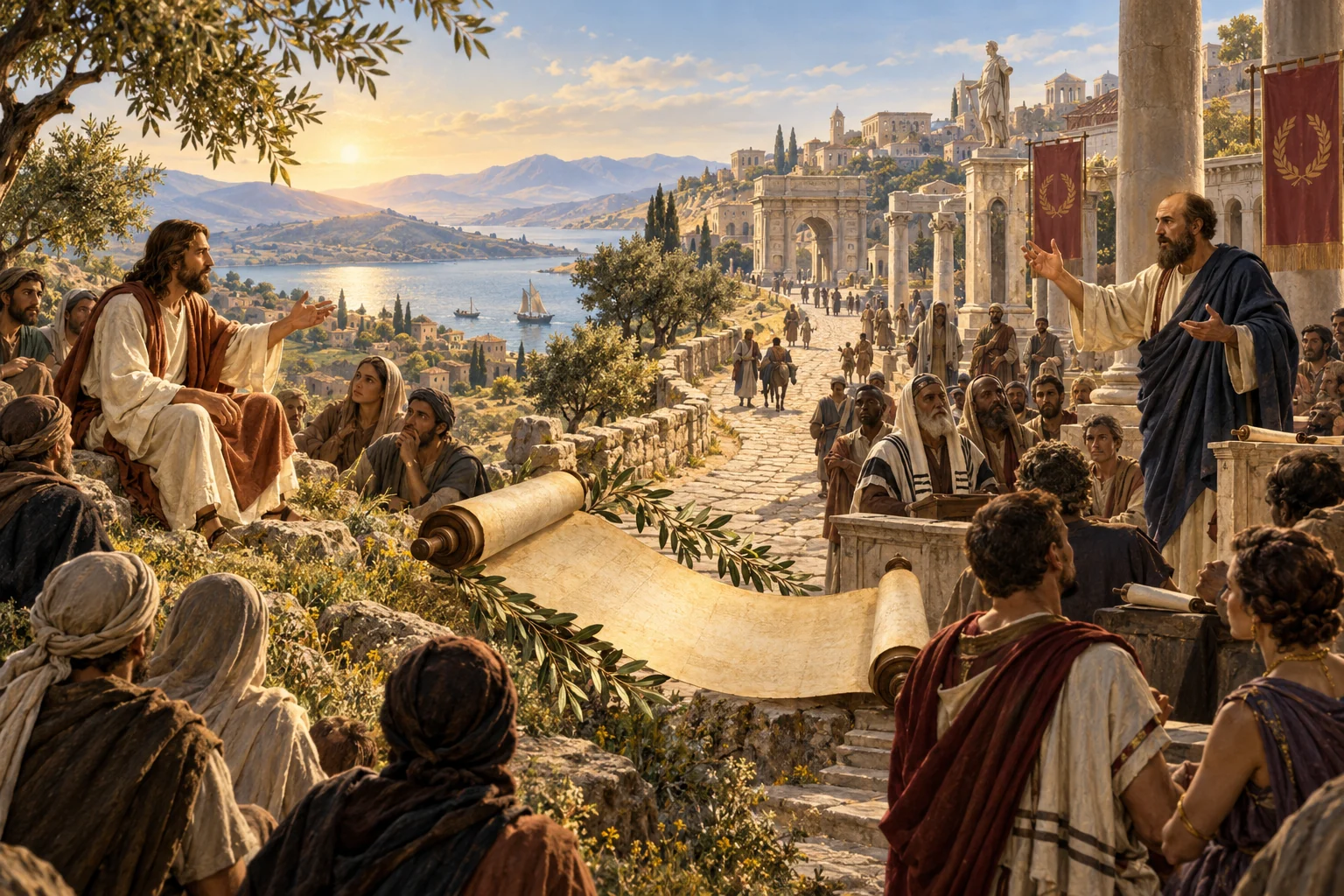
For more than a century, New Testament scholarship and popular Christian discourse have frequently posited a fundamental theological rupture between Jesus of Nazareth and the Apostle Paul.
Read moreShow less
What This Study Explores
Pauline Studies • Gospel Studies
Did Paul Replace Jesus’ Kingdom Gospel with a Different Religion?
No. Jesus and Paul announce the same public gospel: Israel’s God has acted through the faithful life, crucifixion, resurrection, and exaltation of Jesus the Messiah to inaugurate his reign, defeat hostile powers, forgive sins, and form a renewed covenant people. Jesus’ kingdom proclamation and Paul’s cross-centered preaching are not rival programs; the cross and resurrection are the decisive means by which the kingdom advances.
The appearance of rupture arises when Jesus is detached from Israel’s story or Paul is read through later Western abstractions. Restored to their first-century Jewish setting, both proclaim fulfillment of the Abrahamic and Davidic promises, summon people to loyal trust, and anticipate the renewal of creation. Paul’s Gentile mission extends Israel’s promised blessing while Romans 11 explicitly rejects Gentile boasting and preserves Israel’s irrevocable calling.
Key Claims
- Euangelion is a royal announcement. It declares what God has accomplished in Messiah before describing the benefits received by individuals.
- Kingdom and cross interpret one another. Jesus’ self-giving enthronement defeats sin and the powers through apparent weakness.
- Paul’s gospel remains Israel-shaped. Abraham, Torah, David, exile, and restoration supply its narrative grammar.
- Justification and participation are complementary. Covenant membership, union with Messiah, transformed life, and final resurrection belong to one saving event.
- Gentile inclusion is non-supersessionist. The nations are grafted into Israel’s cultivated olive tree rather than constituted as its replacement.
Interpretive Context
Canonical unity does not erase differences of audience, vocabulary, or vocation: Jesus announces Israel’s kingdom restoration within his earthly mission, while Paul explains the crucified and risen Messiah’s significance for mixed Jew–Gentile assemblies. The reconciliation is strongest when those differences remain visible and are located within the same narrative of promise, kingdom, cross, resurrection, Spirit, and the still-irrevocable calling of Israel.
The study engages the long critical tradition from Baur, Wrede, and Bultmann through Sanders, while drawing on N. T. Wright’s kingdom narrative, David Brondos’s narrative soteriology, Paul-within-Judaism scholarship, and Kaiser’s canonical promise-plan. Second Temple and divine-council materials illuminate the historical and cosmic setting, but the canonical writings control the theological synthesis.
Selected Scholarship
- Brondos, D. A. Work on Paul’s narrative soteriology.
- Kaiser, W. C., Jr. (2008). The Promise-Plan of God.
- Sanders, E. P. (1977). Paul and Palestinian Judaism.
- Wright, N. T. (1996). Jesus and the Victory of God.
- Wright, N. T. (2013). Paul and the Faithfulness of God.
Scripture Connections
Genesis 3; Isaiah 52; Isaiah 61; Mark 1; Luke 13; Mark 15; Luke 23; John 19
Continue on Substack
The complete article remains on Rabbit Room Apologetics at Substack.
Originally published August 21, 2026. This WordPress page is a discovery guide; the complete article is hosted on Substack.