ARTICLE GUIDE
At a Glance
The prophetic ministry of Jeremiah stands at the catastrophic watershed of Judah’s history. Ministering during the twilight of the Davidic monarchy and the onset of the Babylonian exile (ca. 627 570 BCE , Jeremiah confronted a society caught in spiritual and political crisis.
Read moreShow less
What This Study Explores
Divine Council Worldview
Who is the “Queen of Heaven,” and why does Jeremiah condemn her worship?
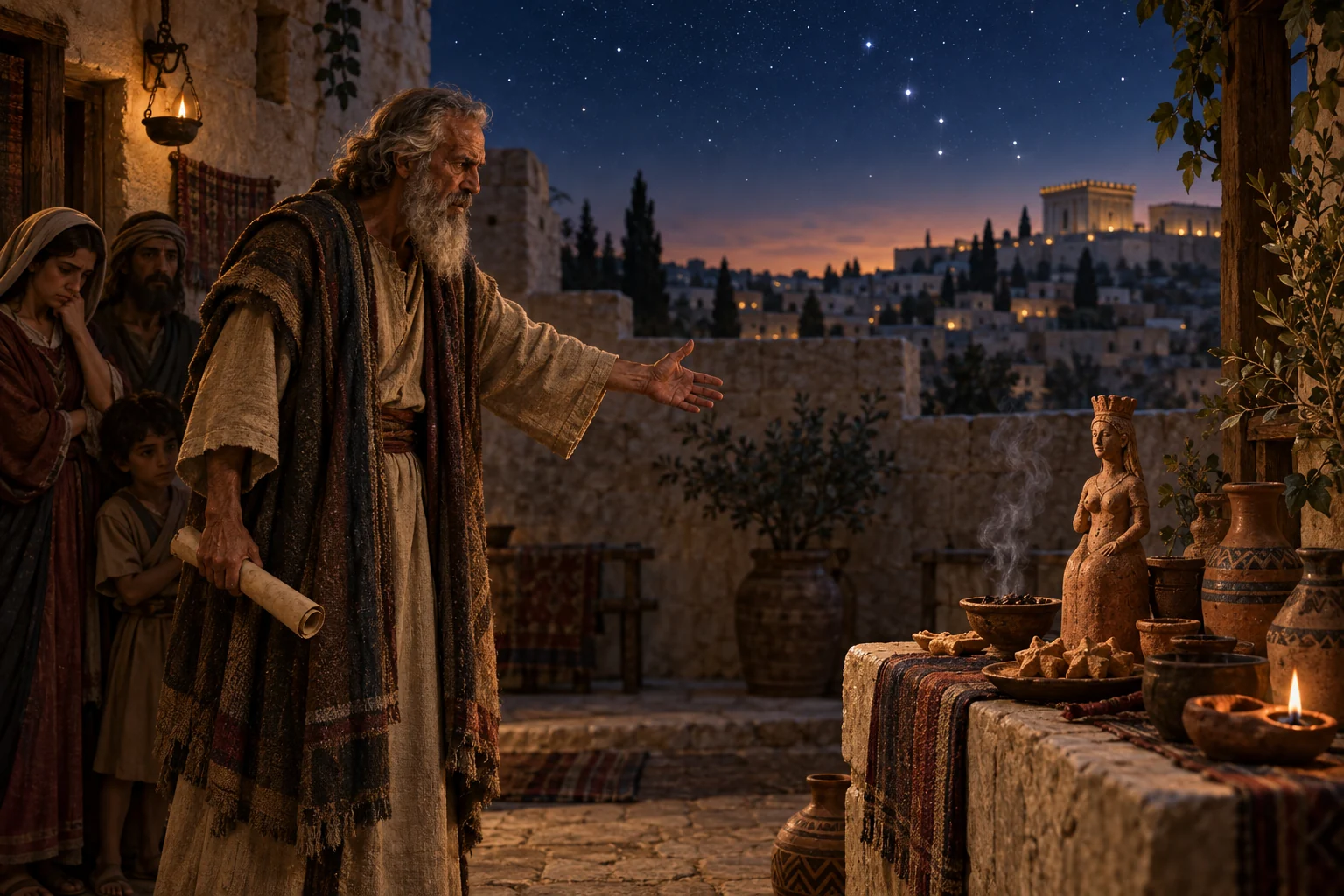
The title in Jeremiah 7 and 44 most likely refers to a prominent astral fertility goddess known through the wider ancient Near East, often associated with Ishtar, Astarte, or related local manifestations. Jeremiah’s concern is not simply the goddess’s precise identity but Judah’s organized transfer of worship, offerings, and trust from Yahweh to a rival power.
The passages expose idolatry as covenant treason with cosmic pretensions. Israel’s God is not one regional deity among others: he is the sovereign Creator and Lord of the heavenly host, so devotion to the “Queen of Heaven” counterfeits the order of divine kingship.
Key Claims
- Jeremiah depicts the cult as a household practice involving children, fathers, and women.
- Cakes, drink offerings, and incense show a coordinated liturgy rather than casual superstition.
- The title probably draws on a family of related ancient Near Eastern goddess traditions, not one securely identifiable figure in every setting.
- Judah’s claim that the cult brought prosperity reverses the prophetic interpretation of judgment.
- Yahweh’s universal sovereignty renders every rival claim to heavenly queenship derivative and rebellious.
Interpretive Context
Textual and archaeological evidence should be handled without forcing every goddess name or figurine into a single identity. The Masoretic Text and Septuagint preserve the same central indictment even where wording and historical framing differ: Judah persists in worship that contradicts exclusive covenant allegiance.
Divine-council language makes the polemic more, not less, monotheistic. Scripture can acknowledge heavenly beings and the nations’ spiritual rebellion while reserving uncreated sovereignty, worship, and kingship for Yahweh alone.
Selected Scholarship
- John Day, Yahweh and the Gods and Goddesses of Canaan
- Mark S. Smith, The Early History of God
- Othmar Keel and Christoph Uehlinger, Gods, Goddesses, and Images of God
- Michael S. Heiser, The Unseen Realm
- Jack R. Lundbom, Jeremiah 21–36 and Jeremiah 37–52
Scripture Connections
Jeremiah 7; Revelation 12; Jeremiah 44; Genesis 3; Jeremiah 31; Ezekiel 36; Genesis 6; Genesis 11
Continue on Substack
The complete article remains on Rabbit Room Apologetics at Substack.
Originally published August 24, 2026. This WordPress page is a discovery guide; the complete article is hosted on Substack.