ARTICLE GUIDE
At a Glance
The Kingdom of God is the organic execution of Scripture’s promise-plan rather than a late intertestamental invention or a New Testament replacement of Israel’s pledges. Although the exact phrase “kingdom of God” is uncommon in the Hebrew Bible, Yahweh’s sovereign reign is present from creation onward and develops through covenant, Messiah, and future restoration.
What This Study Explores
The organic growth of God’s kingdom, its roots in the biblical covenants, and its unfolding fulfillment in the promise-plan.
How Does the Kingdom of God Develop across Scripture?
The Kingdom of God is the historical execution of God’s promise-plan: Yahweh’s purposeful reign restoring creation, reclaiming the nations, establishing the Davidic Messiah, and dwelling with a renewed people. Although the exact phrase “kingdom of God” is uncommon in the Hebrew Bible, the concept is present wherever Yahweh reigns, judges hostile powers, covenants with Israel, promises David an enduring throne, and announces future restoration.
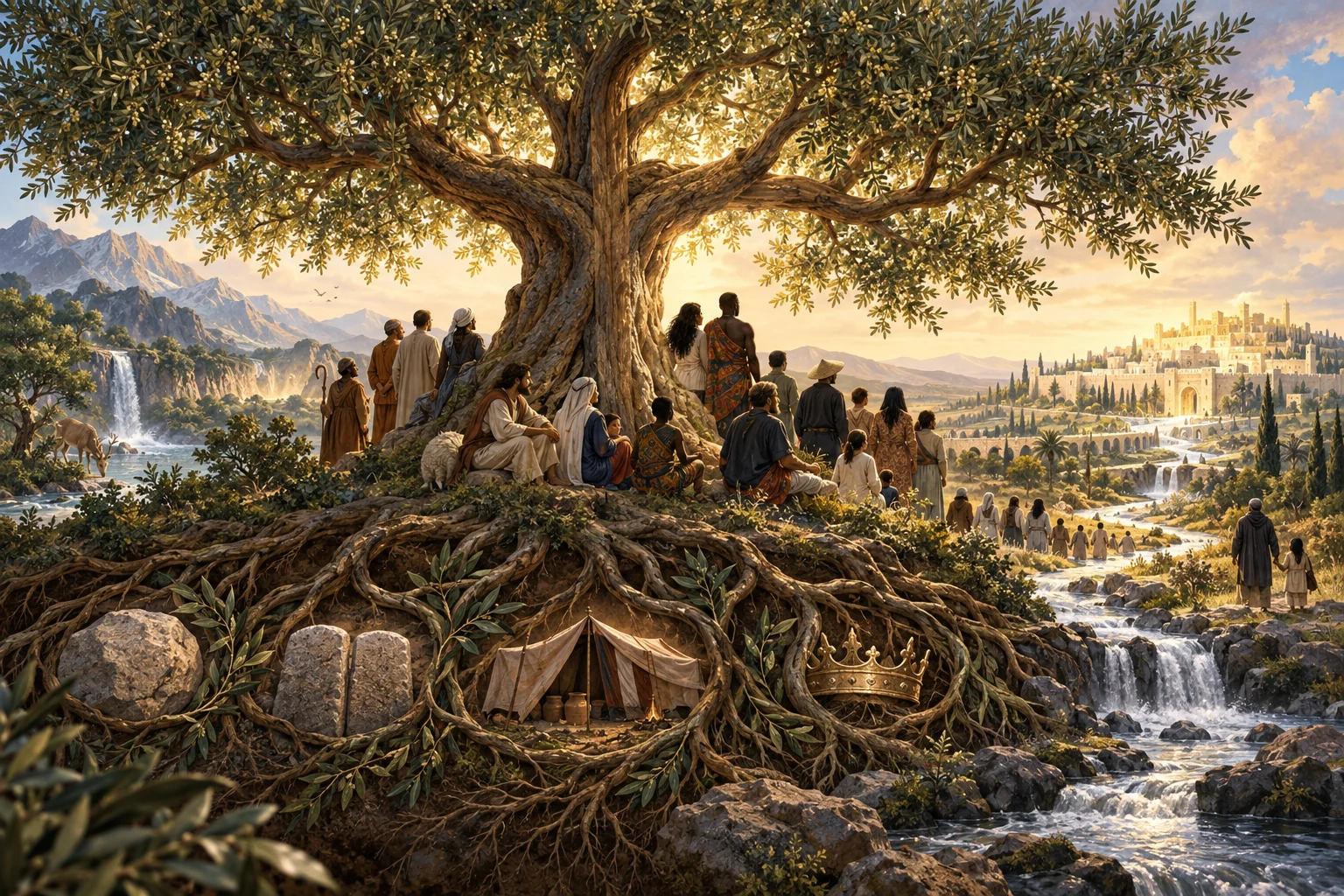
Jesus inaugurates rather than invents this kingdom. His proclamation, deeds, death, resurrection, and heavenly session advance the same pledged purpose that begins in Genesis. Gentiles enter Israel’s cultivated olive tree through Messiah; they do not replace Israel or form an unrelated heavenly people. The kingdom is already active under the enthroned Son but awaits public consummation, resurrection, Israel’s promised restoration, and renewed creation.
Key Claims
- The kingdom is present throughout the Hebrew Bible. Conceptual presence does not depend on repetition of one exact phrase.
- Promise and kingdom are complementary. The promise-plan states God’s pledged purpose; the kingdom executes it in history.
- Jesus inaugurates the promised reign. Synoptic kingdom language announces that Israel’s awaited future has entered the present.
- The Davidic Messiah presently reigns. Acts reads Jesus’ resurrection and exaltation through the royal psalms.
- Organic unity avoids two opposite errors. It rejects both supersessionist erasure of Israel and a permanent division into unrelated peoples of God.
Interpretive Context
Walter C. Kaiser Jr. and Willis J. Beecher supply the controlling promise-plan framework. Inaugurated eschatology clarifies the kingdom’s already/not-yet movement, while cosmic-temple and divine-council studies illuminate the ancient cognitive environment. Those contextual tools remain subordinate to the canon’s own progressive architecture and to Romans 11’s prohibition of Gentile boasting over Israel’s root.
The kingdom’s organic development should not be confused with uninterrupted institutional growth or a simple equation of church and kingdom. The New Testament holds inauguration and consummation together: Messiah already reigns and the Spirit forms a foretaste, while death, rebellion, and injustice still await final defeat. Gentile participation fulfills the Abrahamic mission without authorizing contempt for Israel or turning ethnic particularity into a temporary error.
Selected Scholarship
- Beecher, W. J. (1905). The Prophets and the Promise.
- Kaiser, W. C., Jr. (2008). The Promise-Plan of God.
- Kaiser, W. C., Jr. (2009). Recovering the Unity of the Bible.
- Heiser, M. S. (2015). The Unseen Realm.
- Walton, J. H. (2009). The Lost World of Genesis One.
Scripture Connections
Genesis 3:15; Jeremiah 31; Ezekiel 36; Romans 11; Psalms 110; Rom 11:28–29; 2 Cor 1:20–22; Eph 1:13–14; Gen 3:15; Gen 12:1–3
Continue on Substack
The complete article remains on Rabbit Room Apologetics at Substack.
Originally published September 2026. This WordPress page is a discovery guide; the complete article is hosted on Substack.