ARTICLE GUIDE
At a Glance
This article examines the “Islamic Dilemma” (also termed the “Quranic Dilemma”) as an internal, text-immanent critique employed in contemporary Christian–Muslim polemics.
Read moreShow less
What This Study Explores
Christian–Muslim Polemics • Qur’anic Studies
What Is the Islamic Dilemma, and How Strong Is It?
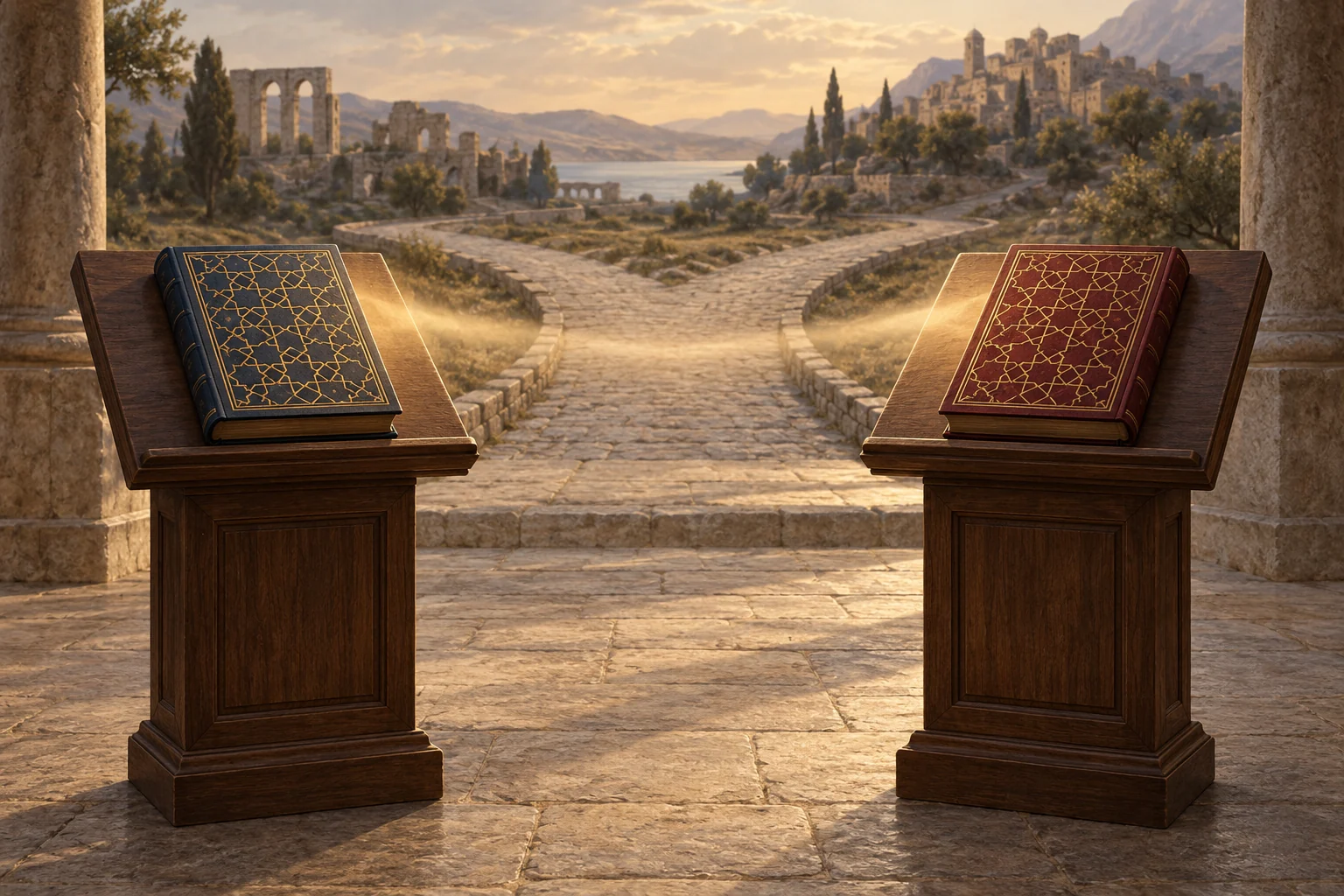
The Islamic Dilemma is an internal critique built from Qurʾānic affirmations of the Torah and Gospel as divine guidance available to seventh-century Jews and Christians. The Qurʾān instructs the People of the Book to judge by these revelations and, in one passage, directs Muhammad toward prior readers. Yet the historically attested biblical texts already affirm claims about Jesus that later Islamic theology denies.
The resulting tension is substantial: if the prior Scriptures were reliable, Qurʾānic denials of Christ’s divine identity, crucifixion, and resurrection conflict with revelation the Qurʾān affirms; if they were textually corrupted before Muhammad, commands to follow them become difficult to explain. The argument clears away an indiscriminate corruption charge, but it should lead into positive biblical exegesis rather than serve as a stand-alone rhetorical trap.
Key Claims
- The argument is text-immanent. It tests Islamic claims using Qurʾānic premises rather than assuming Christian authority at the outset.
- The relevant Scriptures were historically accessible. Manuscripts predating Islam substantially attest the same Christological and crucifixion claims.
- Early taḥrīf was not always textual corruption. Some early interpretation emphasized concealment, distortion, or misreading.
- The dilemma requires careful definitions. Tawrāt, Injīl, preservation, and corruption must be examined historically rather than treated as slogans.
- Its constructive goal is biblical retrieval. Once blanket corruption is challenged, the promise-plan and identity of Messiah can be heard on their own terms.
Interpretive Context
The argument is strongest when it distinguishes what the Qurʾān says from later maximal claims about a globally corrupted biblical text. Tawrāt, Injīl, confirmation, guardianship, concealment, and distortion do not carry identical meanings in every passage, and appeals to lost pristine originals require historical evidence; the dilemma therefore presses a cumulative coherence problem rather than functioning as a one-verse rhetorical trap.
Syriac and Melkite Christian apologetics supplied early forms of the argument, while Ibn Ḥazm represents an important development toward systematic accusations of textual falsification. Muslim responses appeal to lost originals, selective preservation, or Qurʾānic confirmation as criterion; each must be evaluated separately. Christian use should remain charitable and precise, recognizing diversity within Islamic interpretation while pressing the coherence of explicit textual claims.
Selected Scholarship
- Griffith, S. H. (2008). The Church in the Shadow of the Mosque.
- Lazarus-Yafeh, H. (1992). Intertwined Worlds.
- Nickel, G. (2011). Narratives of Tampering in the Earliest Commentaries on the Qurʾān.
- Reynolds, G. S. (2010). The Qurʾān and Its Biblical Subtext.
- Wood, D. Contemporary presentations of the Qurʾānic dilemma.
Scripture Connections
Genesis 3; Acts 17; Romans 9; Jeremiah 31; Ezekiel 36; Genesis 12; John 1
Continue on Substack
The complete article remains on Rabbit Room Apologetics at Substack.
Originally published August 14, 2026. This WordPress page is a discovery guide; the complete article is hosted on Substack.