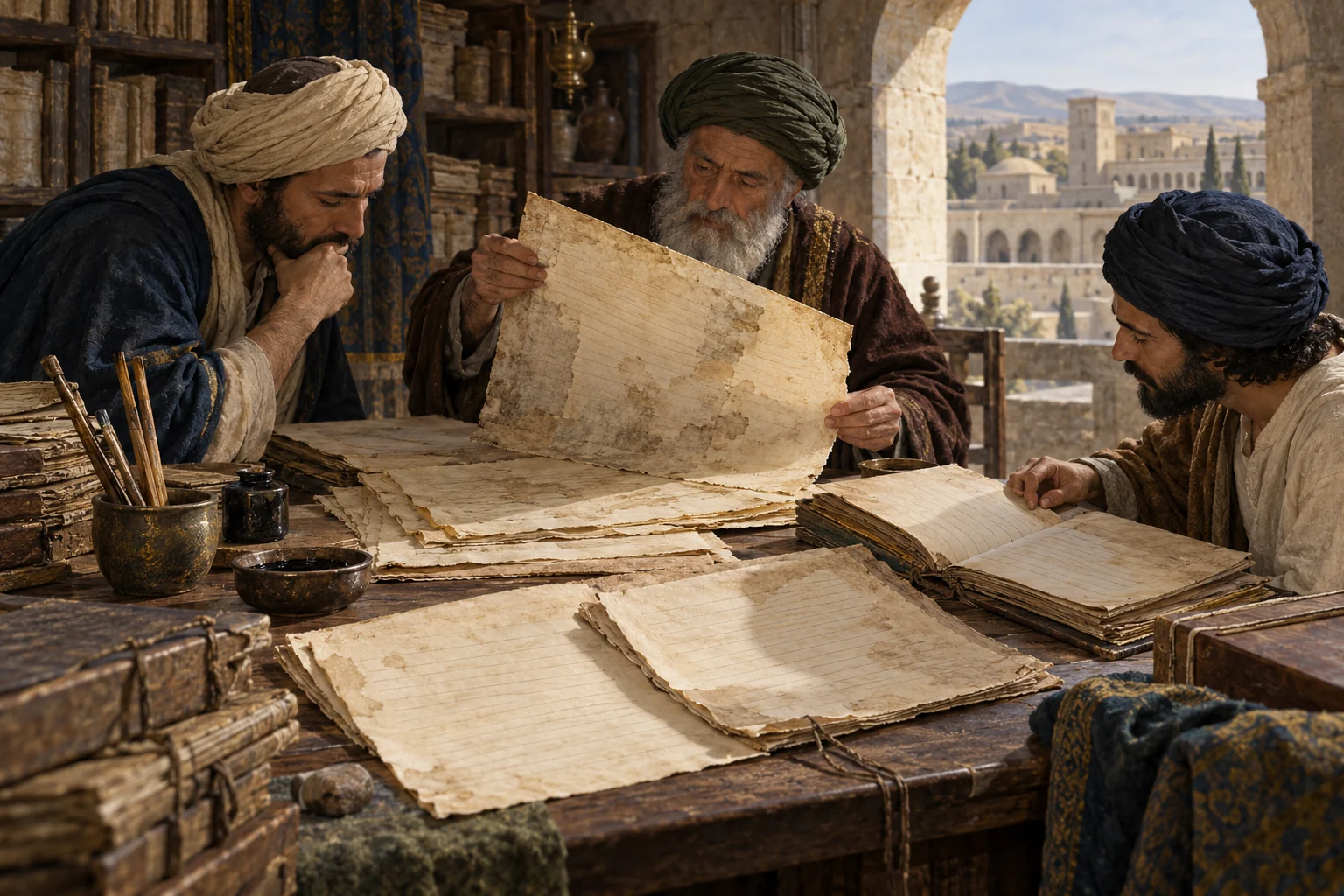
ARTICLE GUIDE
At a Glance
The Imperial Compilation and the Syro-Aramaic Subtext The Standard Islamic Narrative asserts that the Qurʾān was revealed verbatim in the seventh-century Meccan dialect of the Quraysh, standardized under Caliph ʿUthmān ibn ʿAffān around 650 652 CE, and preserved with letter-perfect uniformity from a heavenly tablet (al-Lawḥ al-Maḥfūẓ).
Read moreShow less
What This Study Explores
Christian–Muslim Polemics • Qur’anic Studies
What Do the Qurʾān’s Compilation and Syro-Aramaic Features Reveal?
The earliest Qurʾānic witnesses preserve a defective consonantal skeleton whose later pointing and vocalization permit more than one reading at numerous locations. Reports of companion codices, the Ṣanʿāʾ palimpsest, and physical corrections in early manuscripts complicate claims that a single fully vocalized text was transmitted with letter-perfect uniformity from the beginning. They do not, by themselves, prove late invention or wholesale corruption.
Syro-Aramaic vocabulary, liturgical echoes, and Late Antique Jewish and Christian narrative parallels further locate the text within a multilingual religious environment rather than an isolated Meccan vacuum. These data place pressure on strong inlibration claims because the theological model makes an uncreated, verbally exact book the primary locus of revelation. Biblical revelation instead centers on God’s historical promise culminating in the incarnate Word, with manuscripts serving as transmitted witnesses to those events.
Key Claims
- The early rasm underdetermined some readings. Diacritics and short vowels were added to a consonantal skeleton that could support multiple vocalizations.
- Standardization was an imperial process. ʿUthmānic and later Umayyad activity narrowed textual plurality rather than merely reproducing a modern printed form.
- Early codices show production history. Corrections and the Ṣanʿāʾ lower text demonstrate revision and variant wording without supporting every maximal revisionist theory.
- Syro-Aramaic evidence is strongest cumulatively. Loanwords, liturgical forms, and intertexts reveal a Late Antique matrix even where particular reconstructions remain disputed.
- Inlibration and incarnation carry different textual stakes. Variation presses directly on a letter-perfect heavenly-book model but does not erase biblical events witnessed through textual transmission.
Interpretive Context
The study engages François Déroche, Behnam Sadeghi and Mohsen Goudarzi, Daniel Brubaker, Arthur Jeffery, Gabriel Said Reynolds, and Syriac-oriented proposals associated with Christoph Luxenberg. It distinguishes widely accepted manuscript facts from contested philological reconstructions.
Historical criticism is integrated with Walter Kaiser’s promise-plan rather than used as a substitute theology. The resulting comparison contrasts imperial textual stabilization with the organic canonical movement from promise to incarnation and maintains Romans 11’s rejection of supersessionism.
Selected Scholarship
- Brubaker, D. A. (2019). Corrections in Early Qurʾān Manuscripts. Think and Tell Press.
- Déroche, F. (2014). Qurʾans of the Umayyads. Brill.
- Jeffery, A. (1938). The Foreign Vocabulary of the Qurʾān. Oriental Institute.
- Reynolds, G. S. (2010). The Qurʾān and Its Biblical Subtext. Routledge.
- Sadeghi, B., & Goudarzi, M. (2012). Ṣanʿāʾ 1 and the origins of the Qurʾān. Der Islam, 87, 1–129.
Scripture Connections
John 1; Genesis 3; Genesis 4; Genesis 12; 2 Samuel 7; Jeremiah 31; Ezekiel 36; Galatians 3
Continue on Substack
The complete article and its available video material remain on Rabbit Room Apologetics at Substack.
Originally published September 10, 2026. This WordPress page is a discovery guide; the complete article is hosted on Substack.