ARTICLE GUIDE
At a Glance
Psalm 9 stands within Book I of the Psalter as a foundational hymn of royal thanksgiving, cosmic judgment, and covenantal petition. Positioned within the initial Davidic collection, the psalm is introduced with a historical and liturgical superscription: “To the choirmaster: according to
Read moreShow less
What This Study Explores
Biblical Theology • Canonical Interpretation • The Promise-Plan of God
What does Psalm 9 reveal about Yahweh’s kingship and justice?
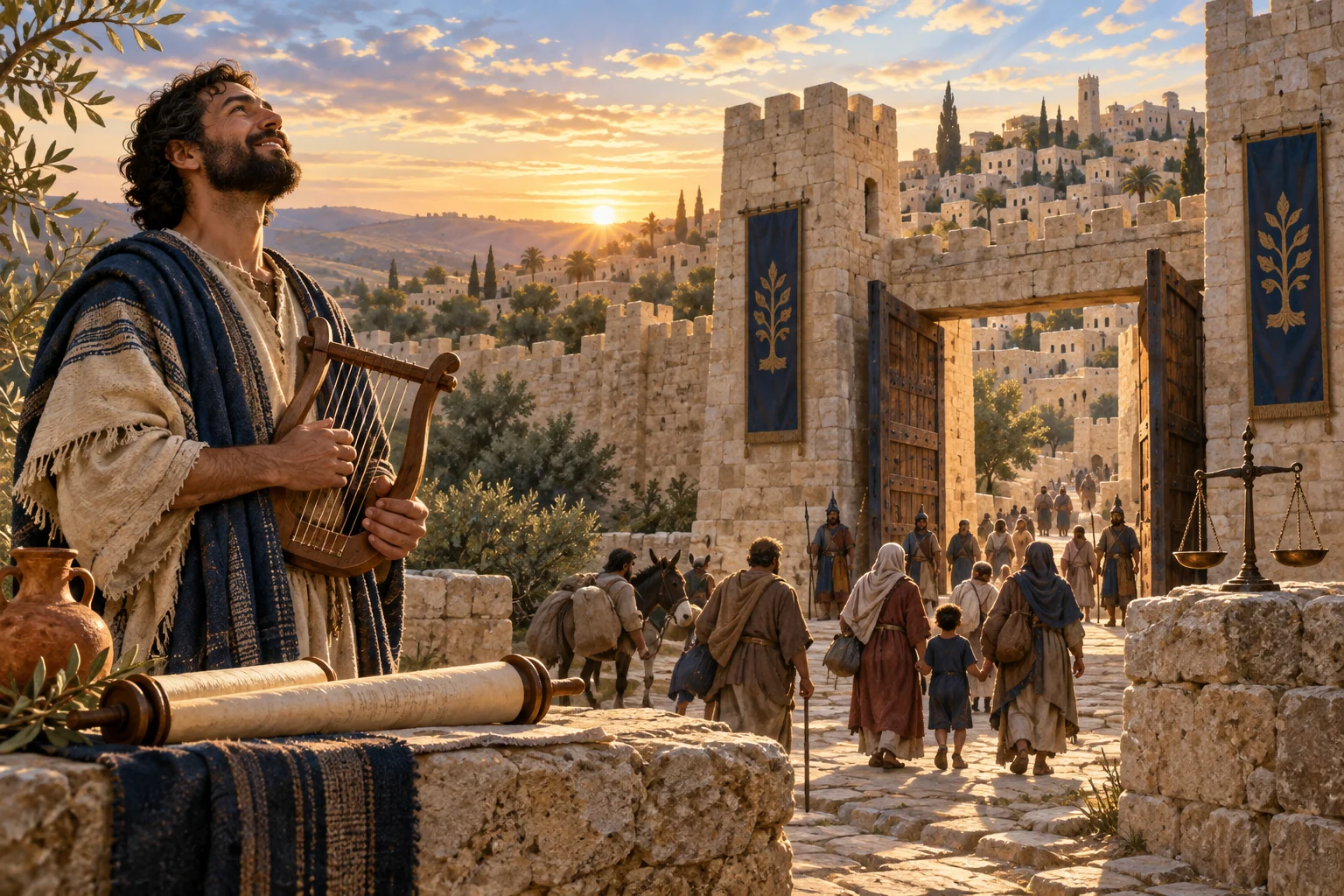
Psalm 9 presents Yahweh as the eternally enthroned Judge whose universal rule defeats oppressive powers and provides a stronghold for the crushed, afflicted, poor, and needy. Divine judgment and protection of the vulnerable are two expressions of the same righteous kingship.
The psalm moves between praise for decisive past deliverance and petition for justice still awaited. That movement models covenantal lament within the already-and-not-yet tension: faith celebrates God’s established throne while urgently asking him to make its justice visible.
Key Claims
- Psalms 9 and 10 form a single alphabetic composition in the Septuagint, Vulgate, and important manuscript traditions.
- The psalm expands from David’s personal vindication to Yahweh’s judgment of rebellious nations.
- God’s throne is established specifically for righteous judgment and equitable governance.
- Remembering the oppressed contrasts with the erasure of the wicked nations’ name and legacy.
- The movement between the gates of death and the gates of Zion anticipates messianic death, resurrection, and public praise.
Interpretive Context
The psalm’s royal, judicial, and refuge imagery belongs to an ancient Near Eastern world in which kingship is proven through protection of the vulnerable. Its social ethics are therefore integral to divine holiness rather than an optional application.
Within the promise-plan, the Davidic Messiah embodies Yahweh’s stronghold, enters the gates of death, and rises to reign. His final judgment answers the psalm’s plea while restoring sacred space and securing the hope of the poor.
Selected Scholarship
- John Goldingay, Psalms, Volume 1: Psalms 1–41 (2006).
- Peter C. Craigie, Psalms 1–50 (2nd ed., 2004).
- Nancy L. deClaissé-Walford, Rolf A. Jacobson, and Beth LaNeel Tanner, The Book of Psalms (2014).
- Walter Brueggemann and William H. Bellinger Jr., Psalms (2014).
- Walter C. Kaiser Jr., The Promise-Plan of God (2008).
Scripture Connections
Psalm 9; Psalms 9; Psalm 10; Acts 17:31; Psalm 9:8; Romans 3:10–18; Psalm 9:17; Revelation 6:9–11
Continue on Substack
The complete article remains on Rabbit Room Apologetics at Substack.
Originally published September 3, 2026. This WordPress page is a discovery guide; the complete article is hosted on Substack.