ARTICLE GUIDE
At a Glance
Matthew 8 and 9 form a distinct narrative unit coming immediately after the Sermon on the Mount in Matthew 5–7. Having revealed His messianic authority in word through the kingdom Torah on the mount, Jesus demonstrates His equal authority in deed through a sequence of mighty acts.
Read moreShow less
What This Study Explores
Torah and the Believer
How Does Matthew 9 Reveal Jesus’ Messianic Authority?
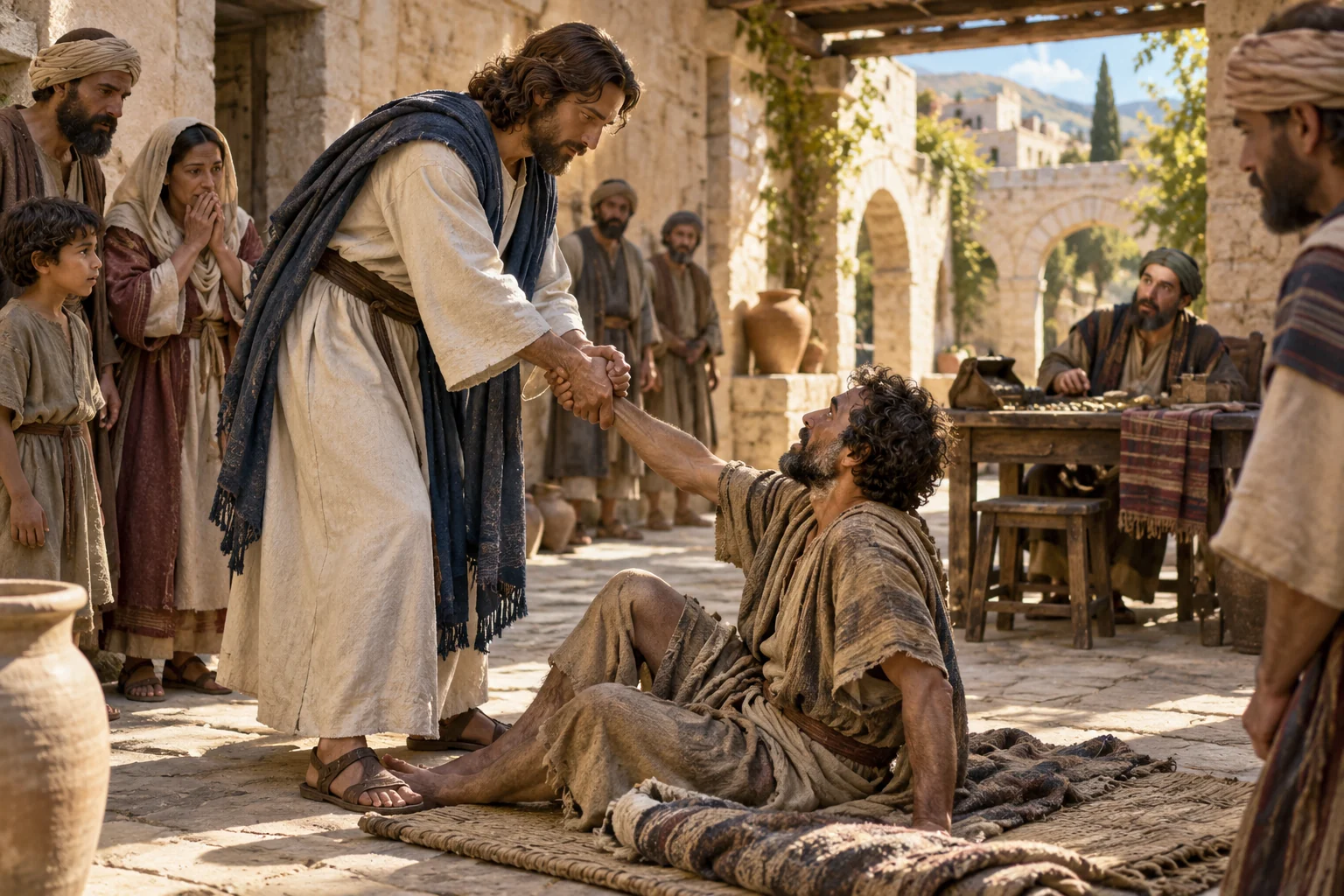
Matthew 9 presents Jesus exercising authority that belongs to Israel’s God: he forgives sins, discerns hearts, restores bodies, raises the dead, overcomes impurity, and calls social outsiders into discipleship. The healing of the paralytic makes invisible pardon publicly verifiable, while the Son of Man title evokes Daniel 7 and frames Jesus’ earthly ministry within his heavenly authority.
Jesus also reorders covenant boundaries around mercy and faithful response. Table fellowship with tax collectors is medicinal rather than permissive; the physician comes to restore the sick. As Bridegroom, Jesus explains why his presence creates a new eschatological moment. The chapter culminates in compassion for shepherdless crowds and prayer for laborers, preparing the commissioning of the Twelve in Matthew 10.
Key Claims
- Forgiveness and healing belong together. Physical restoration verifies Jesus’ authority to grant covenantal pardon.
- Mercy governs faithful Torah practice. Hosea 6:6 exposes purity applications that abandon God’s restorative purpose.
- The Bridegroom signals messianic presence. Fasting must be interpreted in relation to the arrival, removal, and return of Jesus.
- Faith receives restoration without becoming technique. The chapter highlights trusting approach to Jesus, not a mechanical power within the sufferer.
- Compassion generates mission. Jesus’ response to vulnerable crowds is prayer, teaching, healing, and the multiplication of laborers.
Interpretive Context
The paired healing and controversy stories should not be flattened into a contrast between compassionate Jesus and an uniformly hostile Judaism. Forgiveness, table fellowship, fasting, ritual impurity, and the tassel of Jesus’ garment all operate inside Israel’s scriptural world; Matthew’s claim is that messianic authority is now present within that world, restoring excluded people and provoking decisions about the identity of the Son of Man.
Matthew 8–9 forms a structured demonstration of the authority announced in the Sermon on the Mount. The sequence evokes Moses while consistently surpassing ordinary prophetic categories. First-century table fellowship, purity boundaries, fasting practices, and Danielic Son of Man expectations clarify the controversies. The chapter’s healing stories point toward new creation while preserving Israel’s covenantal priority and anticipating wider Gentile participation.
Selected Scholarship
- Davies, W. D., & Allison, D. C., Jr. (1991). Matthew 8–18.
- France, R. T. (2007). The Gospel of Matthew.
- Hagner, D. A. (1993). Matthew 1–13.
- Keener, C. S. (2009). The Gospel of Matthew.
- Kaiser, W. C., Jr. (2008). The Promise-Plan of God.
Scripture Connections
Matthew 9; Matthew 8; Matthew 5; Daniel 7:13–14; Hosea 6:6; Numbers 15:38–40; Isaiah 35:5–6; Ezekiel 34
Continue on Substack
The complete article remains on Rabbit Room Apologetics at Substack.
Originally published August 18, 2026. This WordPress page is a discovery guide; the complete article is hosted on Substack.