ARTICLE GUIDE
At a Glance
Matthew 4 marks a pivotal structural shift in the progressive unfolding of God’s redemptive promise-plan. Following the public baptism of Messiah and the Father’s heavenly declaration of His Sonship, the narrative immediately transitions to the wilderness, establishing an intentional typological parallel to the Old Testament’s narrative arc.
Read moreShow less
What This Study Explores
Promise-Plan Theology
How Does Jesus Succeed Where Adam and Israel Failed?
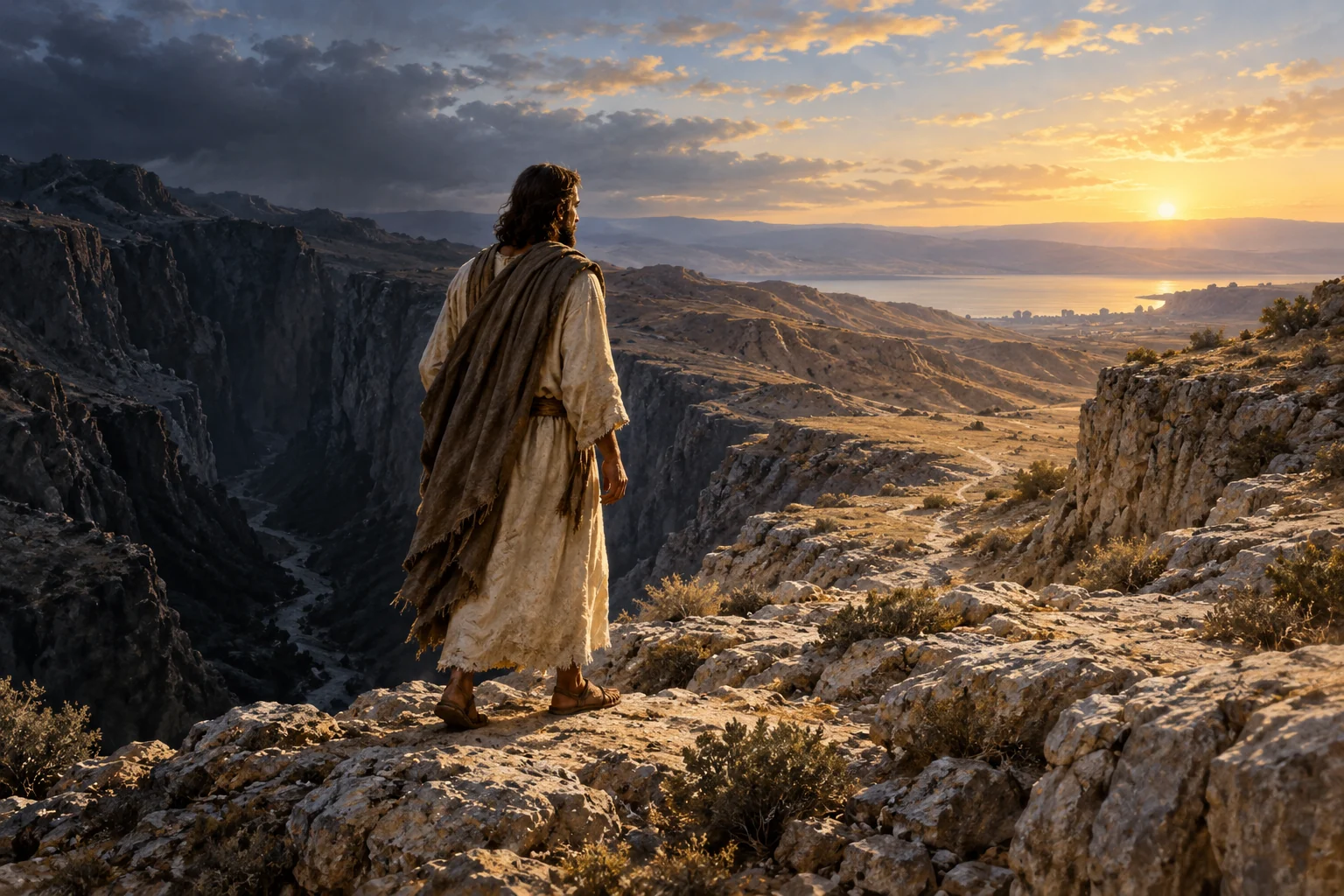
After passing through the waters of baptism, Jesus enters the wilderness for forty days as Israel once entered for forty years. He faces temptation as a genuinely hungry human being, yet refuses autonomous provision, spectacular presumption, and political dominion gained through worship of the adversary. Each answer from Deuteronomy shows the faithful Son embodying the covenant obedience Israel was called to give.
The victory also reverses Adam’s failure. Adam grasped amid abundance; Jesus trusts amid deprivation. Having defeated the tempter, Jesus announces the kingdom in Galilee, calls disciples into a new-exodus vocation, and heals disease and oppression. Light dawns in territory associated with darkness, signaling the beginning of Messiah’s campaign to reclaim people and sacred space.
Key Claims
- The testing recapitulates Israel’s wilderness story. Baptism, forty days, hunger, and Deuteronomy frame Jesus as faithful representative Israel.
- Temptation targets sonship and vocation. The adversary offers distorted ways to exercise genuine messianic authority.
- Jesus refuses autonomous power. Provision, protection, and kingship must be received through obedience to the Father.
- Scripture is embodied rather than weaponized. Jesus reads Deuteronomy within its covenantal purpose, while Satan isolates a psalm from faithful vocation.
- Kingdom proclamation follows victory. Calling, teaching, healing, and exorcism enact the arrival of God’s reign.
Interpretive Context
Jesus’ three Deuteronomy citations identify him with Israel’s wilderness testing while showing the obedient sonship Israel failed to sustain; the point is faithful trust, not the magical use of isolated verses. Details such as the visionary or spatial mode of the high-mountain scene remain secondary, and cosmic-geography associations should not eclipse Matthew’s explicit movement from testing to Isaiah’s Galilean light and the summons to discipleship.
The wilderness carried associations with testing, exodus, demonic habitation, and hoped-for restoration in Jewish thought. Matthew interweaves Adam, Moses, Elijah, Israel, and Davidic Messiah typologies without reducing Jesus to any one predecessor. The move to Galilee fulfills Isaiah’s light-to-the-nations trajectory while retaining Israel’s priority; the later Gentile mission expands the Abrahamic promise through Israel’s victorious King.
Selected Scholarship
- Davies, W. D., & Allison, D. C., Jr. (1988). Matthew 1–7.
- France, R. T. (2007). The Gospel of Matthew.
- Hagner, D. A. (1993). Matthew 1–13.
- Keener, C. S. (2009). The Gospel of Matthew.
- Kaiser, W. C., Jr. (2008). The Promise-Plan of God.
Scripture Connections
Matthew 4; Exodus 34:28; 1 Kings 19:8; Psalm 11:5; Deuteronomy 8:3; Deuteronomy 8; Psalm 91:11–12; Psalm 91
Continue on Substack
The complete article remains on Rabbit Room Apologetics at Substack.
Originally published August 12, 2026. This WordPress page is a discovery guide; the complete article is hosted on Substack.