ARTICLE GUIDE
At a Glance
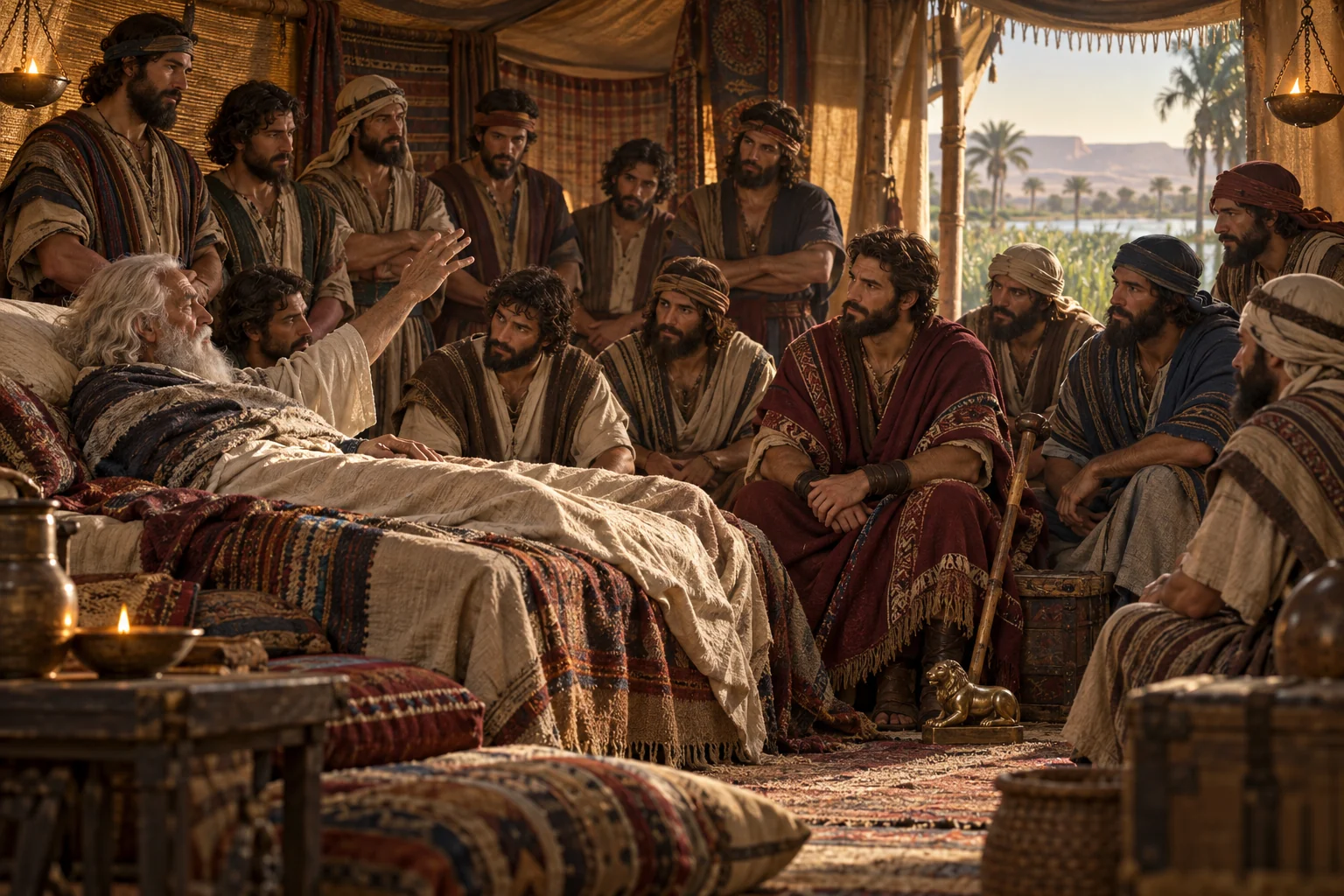
Genesis 49 stands as a structural and theological watershed in the Pentateuch, capturing Jacob’s final prophetic words as he gathers his twelve sons on his deathbed.
Read moreShow less
What This Study Explores
Biblical Theology • Canonical Interpretation • The Promise-Plan of God
Why Is Judah Central in Jacob’s Blessings in Genesis 49?
Genesis 49 transforms the patriarchal household into the prophetic map of Israel’s tribal future. Reuben forfeits preeminence through instability, and Simeon and Levi face scattering because of violence. Judah, however, receives leadership, victory, the lion image, and the promise that the scepter will not depart. Royal authority is thereby concentrated in the tribe from which David and ultimately Messiah arise.
The difficult Shiloh saying in Genesis 49:10 has generated several translations, but the surrounding poetry clearly anticipates enduring Judahite rule and the obedience or gathering of peoples. Abundant wine and milk depict royal prosperity and restored creation. The oracle carries the Abrahamic promise forward: Israel’s king will mediate blessing beyond Israel while the distinct tribal inheritance remains meaningful.
Key Claims
- The blessings are prophetic verdicts. Jacob interprets character, past conduct, tribal destiny, and the latter-days horizon together.
- Birth order does not guarantee vocation. Reuben’s rights divide between Joseph’s inheritance and Judah’s royal leadership.
- Violence receives judgment. Simeon and Levi are scattered, although Levi’s later priestly faithfulness transforms scattering into service.
- Judah receives the royal trajectory. Lion, scepter, ruler’s staff, and peoples’ obedience converge on Davidic and messianic hope.
- Promise expands through twelve tribes. The patriarchal family becomes the covenant nation without losing the particular seed line.
Interpretive Context
Jacob’s verdicts are not fatalistic descriptions of ancestry. Reuben, Simeon, and Levi show that inherited privilege can be forfeited through conduct, while Levi’s later priestly service shows that a sentence of scattering can be redirected within covenant grace. Judah’s royal prominence and Joseph’s fruitfulness distribute different aspects of the firstborn inheritance rather than collapsing every promise into one tribe.
Ancient Near Eastern deathbed blessings could function as binding legal and prophetic acts. The phrase bĕʾaḥărît hayyāmîm widens the horizon beyond immediate settlement toward Israel’s developing eschatological expectation. Interpretations of “Shiloh” include a proper name, “until he comes to whom it belongs,” or a tribute-related reading; the guide should preserve that lexical debate while recognizing the poem’s unmistakable royal thrust.
Selected Scholarship
- Hamilton, V. P. (1995). The Book of Genesis, Chapters 18–50.
- Kaiser, W. C., Jr. (2008). The Promise-Plan of God.
- Sarna, N. M. (1989). Genesis.
- Waltke, B. K. (2001). Genesis.
- Wenham, G. J. (1994). Genesis 16–50.
Scripture Connections
Genesis 49; Hebrews 11:21; 1 Chronicles 5:1–2; Genesis 38; Matthew 1:2–3; Luke 1:32–33; Genesis 49:10; Revelation 5:5
Continue on Substack
The complete article remains on Rabbit Room Apologetics at Substack.
Originally published August 8, 2026. This WordPress page is a discovery guide; the complete article is hosted on Substack.