ARTICLE GUIDE
At a Glance
Genesis 48 marks a critical structural transition within the progressive unfolding of God’s promise-plan. Set against the backdrop of Jacob’s imminent death in Egypt, the narrative shifts the covenantal trajectory from a single patriarch to an expanding constellation of tribal heads.
Read moreShow less
What This Study Explores
Promise-Plan Theology
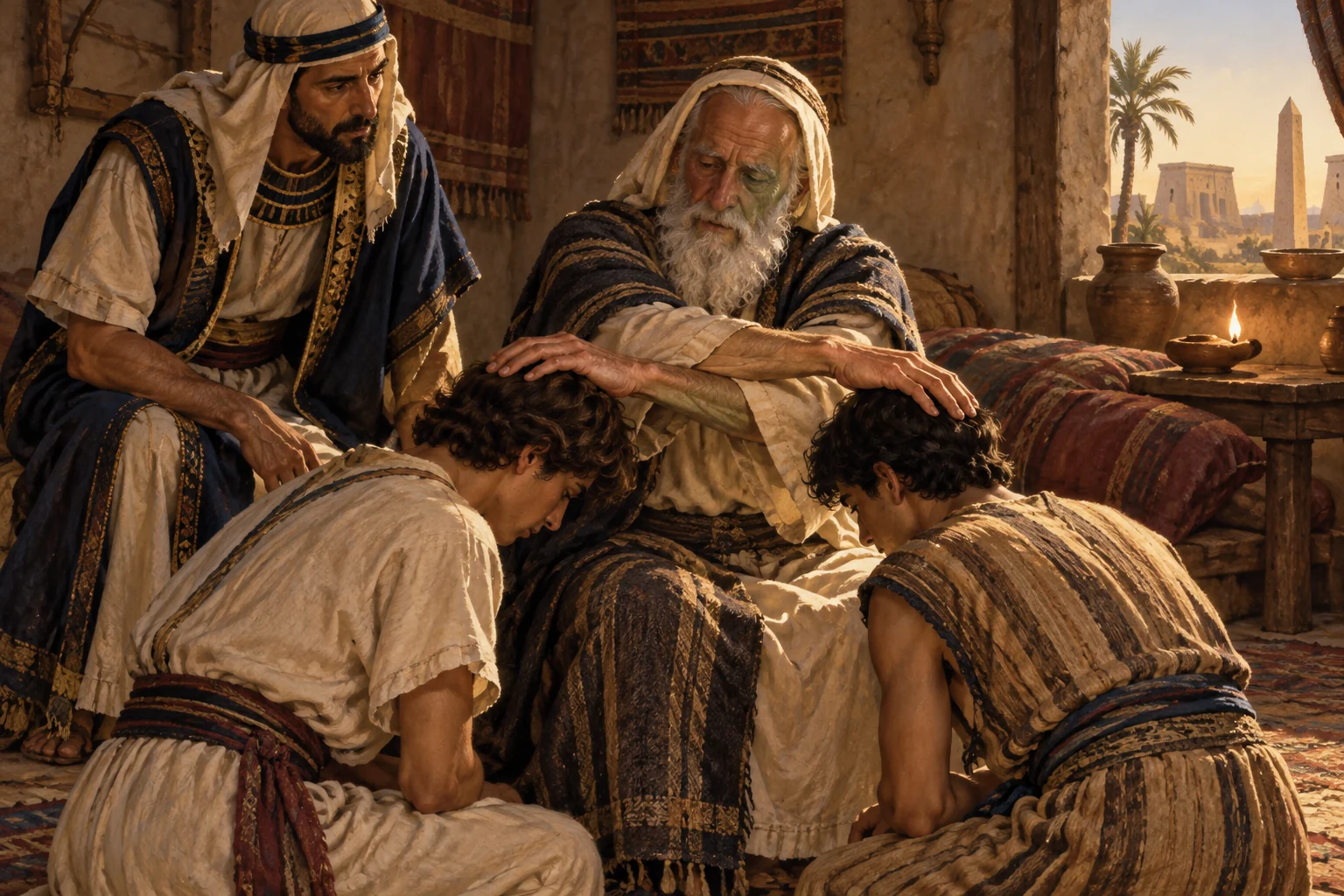
Why Does Jacob Cross His Hands when Blessing Ephraim and Manasseh?
Jacob intentionally places his right hand upon the younger Ephraim and his left upon Manasseh, overriding expected firstborn priority while blessing both. The crossed hands continue Genesis’s repeated pattern: God’s election does not mechanically follow human custom or birth order. Joseph receives the double portion through the adoption of both sons as full tribal ancestors.
The blessing invokes the God before whom Abraham and Isaac walked, the God who shepherded Jacob, and the Angel who redeemed him from evil. The singular blessing joins divine and angelic language in a way that contributes to the Hebrew Bible’s complex presentation of Yahweh’s visible agent. Ephraim’s greater future does not mean Manasseh is rejected; differentiated vocation operates within shared covenant blessing.
Key Claims
- Adoption creates the double inheritance. Ephraim and Manasseh become Jacob’s sons on the legal level of Reuben and Simeon.
- Election disrupts conventional priority. The younger’s elevation continues the Isaac, Jacob, and Joseph patterns.
- Physical blindness contrasts prophetic sight. Jacob perceives covenant destiny more clearly than Joseph’s ordinary expectation.
- The blessing contains a divine-agent pattern. God and the redeeming Angel are invoked within one act of covenant benediction.
- Future tribal prominence remains promise-governed. Ephraim’s multiplication serves Israel’s history without making the tribe a replacement for Israel.
Interpretive Context
The verb describing Jacob’s hands can mean that he crossed them or that he acted with deliberate insight, and the narrative itself emphasizes intentional reversal rather than accidental confusion. The phrase “fullness of nations” should be read first within Ephraim’s tribal multiplication and later prominence; canonical reuse may broaden its resonance, but it does not authorize speculative identifications of Ephraim with modern Gentile peoples.
Patriarchal adoption and firstborn customs explain the legal effect of Jacob’s declaration. The Hebrew phrase concerning Ephraim becoming a “multitude of nations” or “fullness of nations” has prompted expansive interpretations; its primary sense concerns numerous descendants and tribal prominence, not an automatic identification with all later Gentile believers. Genesis 48 contributes to binitarian trajectories but should be read with the broader Angel-of-Yahweh corpus.
Selected Scholarship
- Hamilton, V. P. (1995). The Book of Genesis, Chapters 18–50.
- Kaiser, W. C., Jr. (2008). The Promise-Plan of God.
- Sarna, N. M. (1989). Genesis.
- Sommer, B. D. (2009). The Bodies of God and the World of Ancient Israel.
- Wenham, G. J. (1994). Genesis 16–50.
Scripture Connections
Genesis 48; Genesis 28:13–15; Genesis 27; Genesis 1:20–22; Hebrews 11:21; Romans 9:10–13; Romans 11:25–26; Genesis 48:19
Continue on Substack
The complete article remains on Rabbit Room Apologetics at Substack.
Originally published August 7, 2026. This WordPress page is a discovery guide; the complete article is hosted on Substack.