ARTICLE GUIDE
At a Glance
Genesis 46 constitutes a pivotal redemptive-historical transition within the progressive unfolding of God’s promise-plan.
Read moreShow less
What This Study Explores
Promise-Plan Theology
Why Does God Lead Jacob’s Family into Egypt?
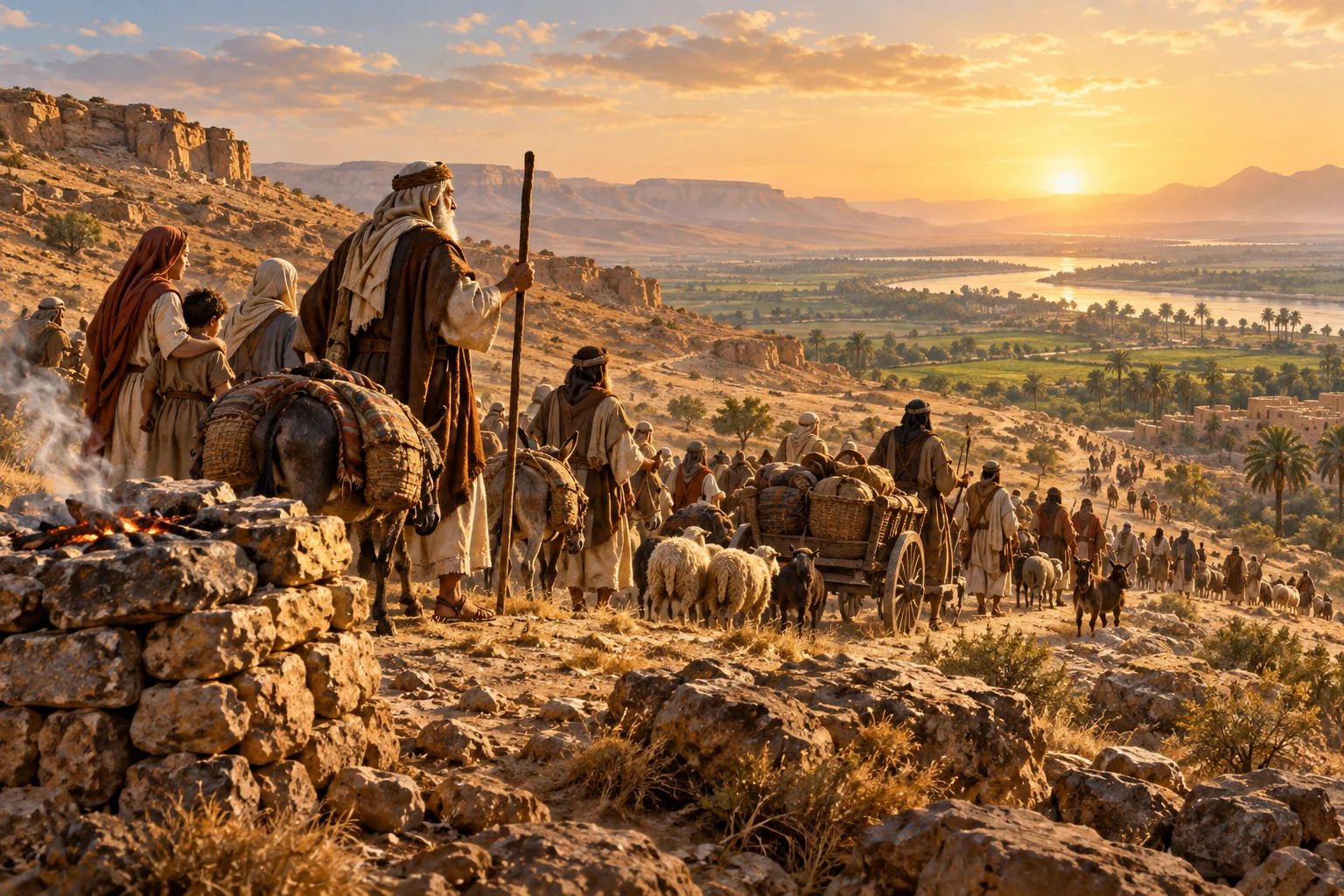
Egypt is not a retreat from the promise but a divinely authorized stage within it. At Beersheba, the boundary of ancestral sacred memory, Jacob sacrifices and receives God’s assurance: do not fear, I will go down with you, make you a great nation there, and bring you up again. The migration fulfills the trajectory announced to Abraham in Genesis 15.
The list of Jacob’s household depicts the covenant family becoming a people. The symbolic seventy parallels the Table of Nations and suggests that Israel’s formation serves a worldwide purpose. God accompanies the family outside Canaan, demonstrating that divine presence is not geographically imprisoned, while the promise of return prevents Egypt from becoming its final inheritance.
Key Claims
- Beersheba marks a covenantal threshold. Jacob seeks divine authorization before leaving the land promised to the patriarchs.
- God’s presence extends into exile. Yahweh descends with his people while preserving the concrete promise of return.
- Egypt becomes Israel’s national incubator. Geographic concentration permits multiplication into a distinct people.
- The seventy carry universal resonance. Israel’s household is formed in relation to the nations and for their eventual blessing.
- Personal comfort and cosmic purpose meet. Joseph will close Jacob’s eyes even as the migration advances redemptive history.
Interpretive Context
Jacob’s sacrifice at Beersheba and God’s night vision frame the migration as covenant obedience rather than abandonment of Canaan. The promise that God will go down with Jacob and bring him up again joins divine presence, death, burial, and eventual corporate exodus in a single assurance. Settlement in Goshen then gives the family space to multiply while occupational difference limits assimilation into Egyptian religious and social life.
Genealogical totals vary according to counting conventions and textual traditions; the Masoretic Text, Septuagint, and Stephen’s speech in Acts use differing totals. The theological symbolism need not depend on forcing every list into one arithmetic scheme. Deuteronomy 32’s nations framework provides a broader cosmic backdrop, while Genesis 15 supplies the explicit covenantal explanation for sojourn and return.
Selected Scholarship
- Hamilton, V. P. (1995). The Book of Genesis, Chapters 18–50.
- Kaiser, W. C., Jr. (2008). The Promise-Plan of God.
- Sarna, N. M. (1989). Genesis.
- Waltke, B. K. (2001). Genesis.
- Wenham, G. J. (1994). Genesis 16–50.
Scripture Connections
Genesis 46; Genesis 15:13–14; Genesis 10; Acts 7:14–15; Matthew 2:13–15; Hosea 11:1; Hebrews 11:21–22; Romans 4:13–17
Continue on Substack
The complete article remains on Rabbit Room Apologetics at Substack.
Originally published August 6, 2026. This WordPress page is a discovery guide; the complete article is hosted on Substack.