ARTICLE GUIDE
At a Glance
Genesis 40 forms the crucial middle movement—Scene 2 of a three-scene narrative structure—tracing Joseph’s trajectory from Potiphar’s household, through the subterranean prison, to Pharaoh’s court. Within the overarching framework of God’s promise-plan, this chapter demonstrates how Yahweh providentially directs historical events through human suffering and divine revelation[cite: 1, 2].
Read moreShow less
What This Study Explores
Promise-Plan Theology
What Does Genesis 40 Teach about Revelation during Delay?
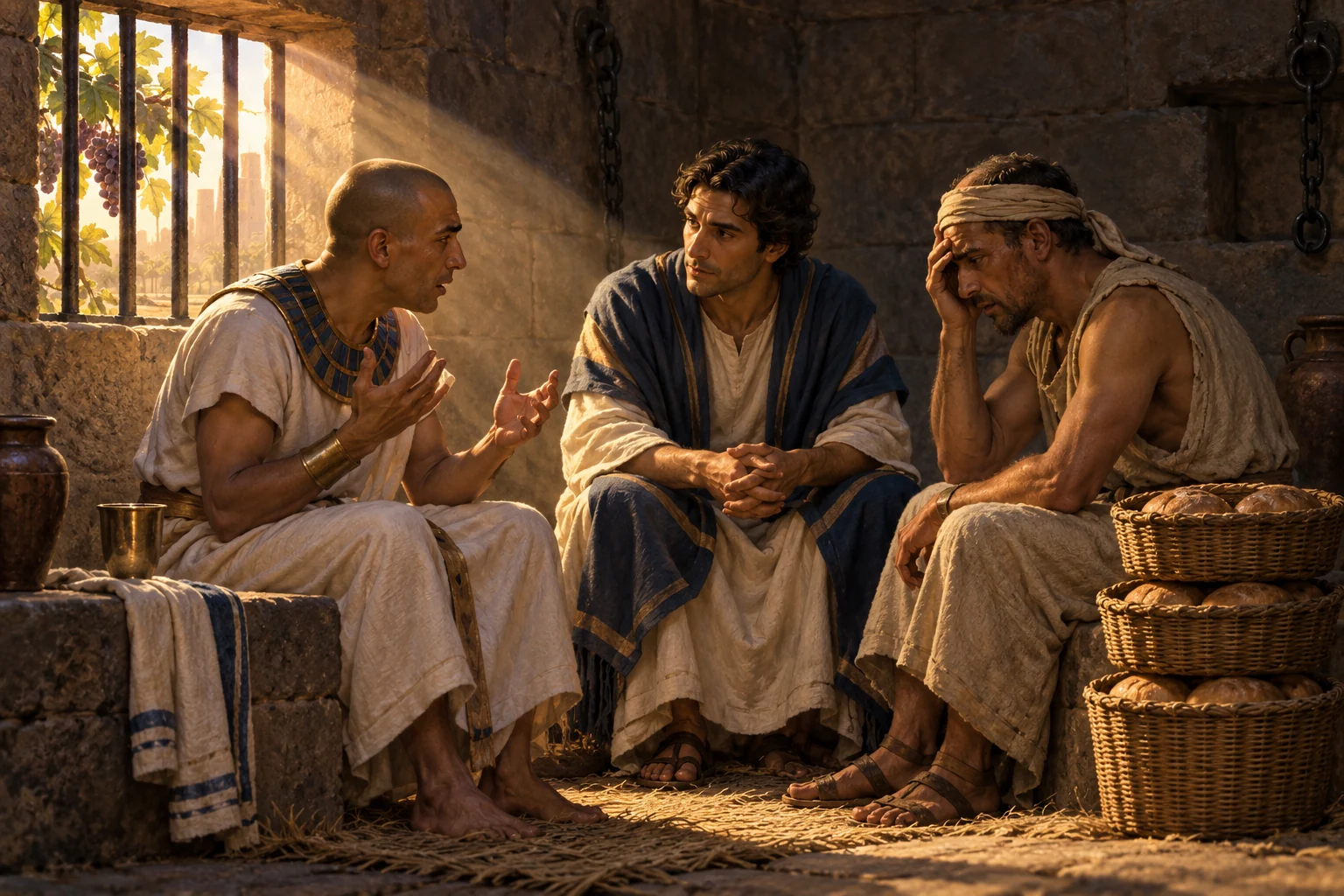
Joseph remains unjustly imprisoned, yet his faithful stewardship places him beside Pharaoh’s cupbearer and baker. Their paired dreams expose the limits of Egyptian omen systems and display Joseph’s central confession: interpretations belong to God. He does not claim an innate magical technique; he serves as a dependent mediator of divine disclosure.
The interpretations are exact—restoration for the cupbearer and execution for the baker—but Joseph’s request for remembrance initially fails. The restored official forgets him for two full years. Divine silence and human ingratitude do not mean providence has stalled; the delay positions Joseph’s eventual emergence at the precise moment Pharaoh needs the wisdom only God can provide.
Key Claims
- Service continues in confinement. Joseph’s attention to the prisoners’ troubled faces displays resilient character.
- Interpretation belongs to God. Biblical revelation confronts imperial divination without celebrating human technique.
- One symbolic pattern can carry opposite outcomes. The two dreams demonstrate divine specificity rather than generic optimism.
- Joseph uses legitimate human means. Asking the cupbearer for advocacy is compatible with trust in providence.
- Forgottenness becomes providential timing. The delayed remembrance connects Joseph directly to Pharaoh’s crisis.
Interpretive Context
Ancient Egyptian cupbearers and bakers were trusted court officials whose positions involved royal security. Dream manuals and professional interpreters formed part of Egyptian scribal culture, sharpening the contrast with Joseph’s God-dependent interpretation. The chapter should not be reduced to a simple lesson that every personal dream contains divine prediction; its function belongs to a specific revelatory and covenantal narrative.
The cupbearer’s forgetting creates the chapter’s central tension between accurate revelation and delayed deliverance. Joseph can truthfully interpret both dreams, yet his own release remains dependent on God’s timing rather than the gratitude of court officials. Within the Joseph cycle, the extra years in prison position him for Pharaoh’s later crisis, turning human neglect into the means by which the Abrahamic family and surrounding nations will eventually be preserved.
Selected Scholarship
- Hamilton, V. P. (1995). The Book of Genesis, Chapters 18–50.
- Kaiser, W. C., Jr. (2008). The Promise-Plan of God.
- Sarna, N. M. (1989). Genesis.
- Waltke, B. K. (2001). Genesis.
- Wenham, G. J. (1994). Genesis 16–50.
Scripture Connections
Genesis 40; Genesis 37; Psalm 105; Psalm 105:17–19; Daniel 2:27–28; Luke 22:37; Acts 2:23; Luke 23:39–43
Continue on Substack
The complete article remains on Rabbit Room Apologetics at Substack.
Originally published July 31, 2026. This WordPress page is a discovery guide; the complete article is hosted on Substack.