ARTICLE GUIDE
At a Glance
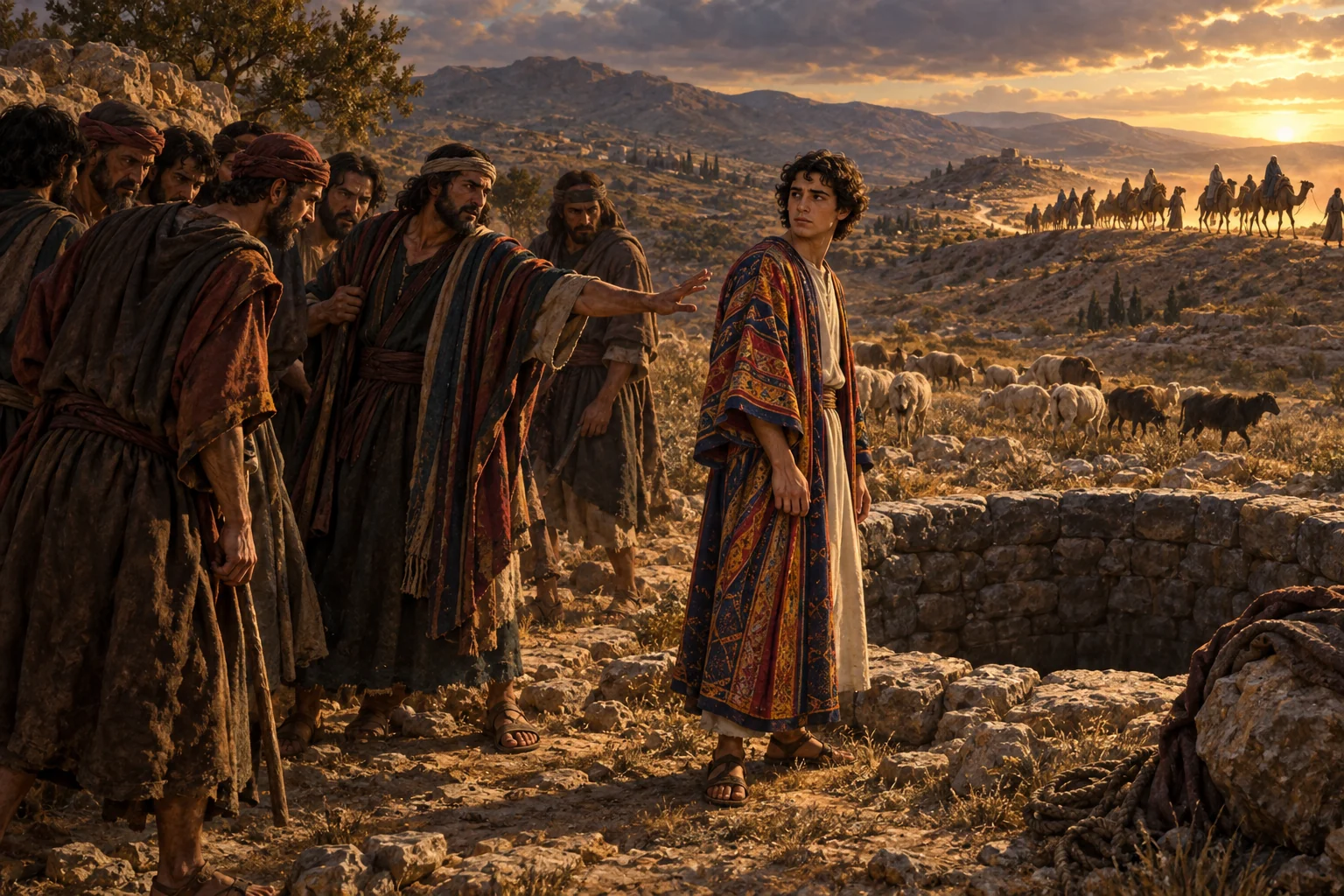
The narrative of Genesis 37 stands as a critical turning point within the progressive unfolding of the divine promise-plan.
Read moreShow less
What This Study Explores
Promise-Plan Theology
Direct Answer: How does the betrayal of Joseph advance rather than defeat God’s promise?
The brothers intend to destroy Joseph’s dreams and secure their own status, but their violence becomes the path by which Joseph reaches Egypt ahead of the coming famine. Divine providence neither excuses their guilt nor depends on their virtue; it overrules evil without becoming its moral author.
Genesis 37 thus opens a long reversal: the rejected son is humiliated, preserved, and eventually exalted for the survival of the very family that rejected him. That pattern advances the Abrahamic promise and becomes a canonical type that later illuminates Israel’s rejection and vindication of Jesus.
Key Claims
- The Jacob toledot section focuses on the preservation of the covenant family through Joseph and Judah.
- Joseph’s special garment signals favored status and intensifies inherited patterns of family rivalry.
- The two dreams announce divine election and future authority in terrestrial and celestial imagery.
- Reuben’s hesitation and Judah’s sale of Joseph expose different forms of compromised responsibility.
- The robe, goat’s blood, and deception of Jacob echo earlier family deception and show sin’s generational recurrence.
Interpretive Context
Joseph is not presented as a flawless allegory of Christ, and every narrative detail should not be forced into typology. The legitimate connection is a broad canonical pattern—chosen servant, rejection, humiliation, divine presence, exaltation, and deliverance—explicitly reinforced by later biblical writers.
The Joseph narrative refuses both moral simplification and uncontrolled allegory. Joseph’s youthful reporting and favored status contribute to family tension, yet the brothers remain responsible for hatred, trafficking, and deception. The robe and slaughtered goat echo Jacob’s earlier manipulation of Isaac, exposing generational patterns of sin, while God’s largely hidden providence begins moving the covenant family toward the foreign sojourn foretold to Abraham.
Selected Scholarship
- Gordon J. Wenham, Genesis 16–50 (1994).
- Victor P. Hamilton, The Book of Genesis, Chapters 18–50 (1995).
- Nahum M. Sarna, Genesis (1989).
- Bruce K. Waltke with Cathi J. Fredricks, Genesis: A Commentary (2001).
- Walter C. Kaiser Jr., The Promise-Plan of God (2008).
Scripture Connections
Genesis 37; Genesis 1; Deuteronomy 32:8–9; Acts 7:9–10; Revelation 12:1; Genesis 37:9; Matthew 3:13–17; Ezekiel 37:15–28
Continue on Substack
The complete article remains on Rabbit Room Apologetics at Substack.
Originally published July 10, 2026. This WordPress page is a discovery guide; the complete article is hosted on Substack.