ARTICLE GUIDE
At a Glance
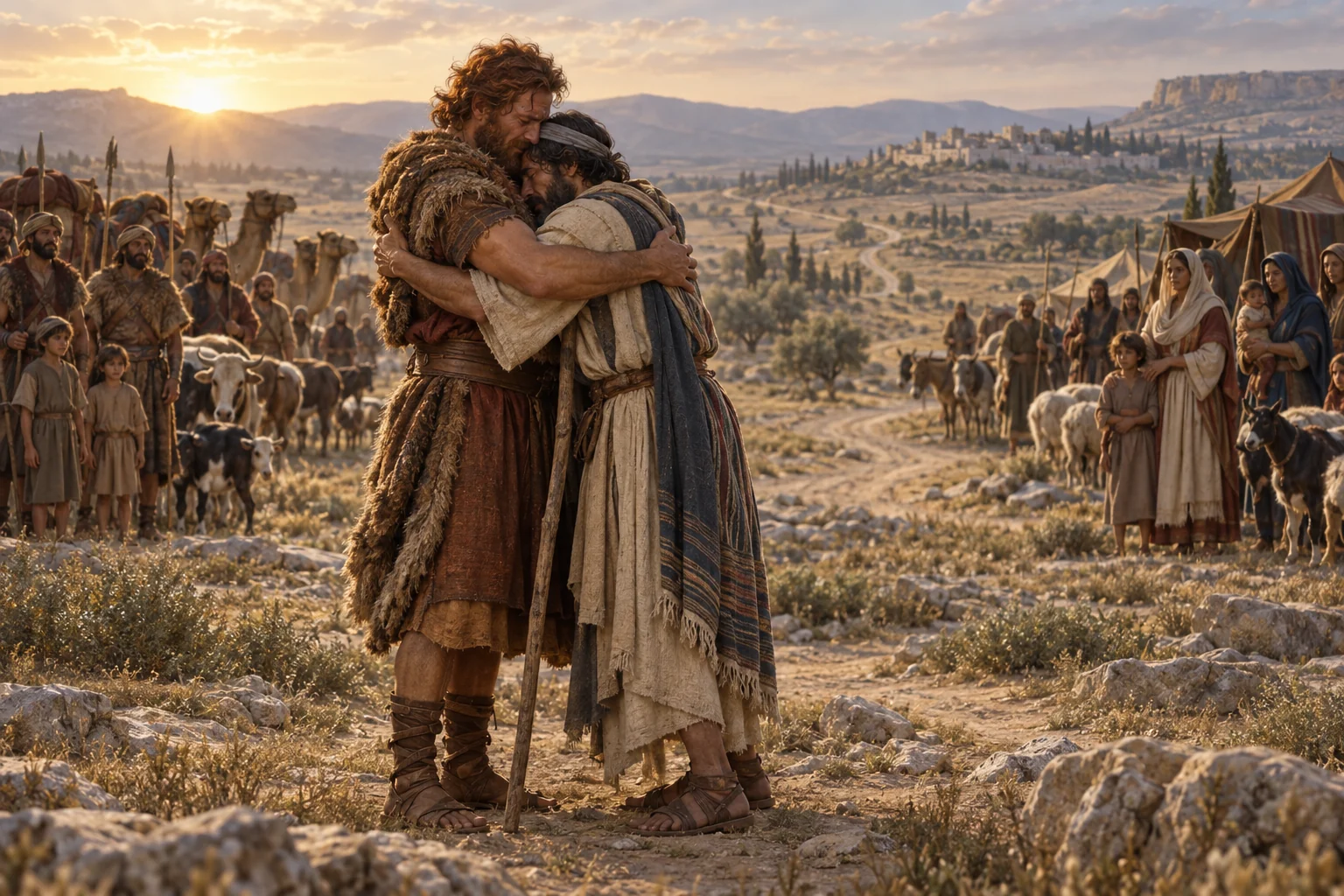
Genesis 33 stands as a pivotal hinge point within the patriarchal narrative cycle, following immediately after Jacob’s life-altering encounter with the pre-incarnate Messiah at Penuel. Twenty years prior, Jacob had fractured his family through deception, stealing the firstborn birthright and blessing from his brother Esau, which forced him to flee approximately 500 miles to Haran.
Read moreShow less
What This Study Explores
Biblical Theology • Canonical Interpretation • The Promise-Plan of God
Direct Answer: Has Jacob become completely transformed when he reconciles with Esau?
Jacob has genuinely changed, but not instantly or completely. He moves ahead of his family, bows before Esau, acknowledges grace, and offers material restitution; yet he still arranges loved ones by preference and evades Esau’s proposed journey to Seir.
The reconciliation therefore displays progressive sanctification rather than a flawless conversion scene. God removes the feared violence, Esau offers unexpected mercy, and Jacob begins to act differently while recognizable habits of calculation remain.
Key Claims
- Jacob’s sevenfold bow reverses his earlier grasping for superiority and places peace above entitlement.
- Esau’s running embrace and tears present genuine reconciliation in the narrative’s plain sense.
- Jacob’s gift functions as restitution for the blessing he obtained through deception.
- The link between Esau’s face and the face of God connects human forgiveness with Jacob’s Peniel encounter.
- Jacob’s detour to Succoth and settlement near Shechem reveal transformation still in progress and set up the next crisis.
Interpretive Context
Later Jewish traditions sometimes interpret the unusual scribal marks over “kissed him” as suspicion of Esau, but the narrative context emphasizes embrace, weeping, and refused compensation. Respecting that scene does not idealize all later Edomite history; it distinguishes this brotherly meeting from subsequent national conflict.
Jacob’s encounter with Esau also prepares the reader to distinguish reconciliation from naïveté. Peace is real even though trust, vocation, and geography remain differentiated; the scene commends confession, restitution, and relinquished control without requiring the brothers’ households to merge or pretending that every consequence of the earlier deception has vanished.
Selected Scholarship
- Gordon J. Wenham, Genesis 16–50 (1994).
- Victor P. Hamilton, The Book of Genesis, Chapters 18–50 (1995).
- Robert Alter, Genesis: Translation and Commentary (1996).
- Nahum M. Sarna, Genesis (1989).
- Kenneth A. Mathews, Genesis 11:27–50:26 (2005).
Scripture Connections
Genesis 33; Genesis 27; Romans 9:10–13; Malachi 1:2–3; Matthew 5:23–24; Hebrews 12:15–17; Genesis 3; Genesis 1:1–2
Continue on Substack
The complete article remains on Rabbit Room Apologetics at Substack.
Originally published June 29, 2026. This WordPress page is a discovery guide; the complete article is hosted on Substack.