ARTICLE GUIDE
At a Glance
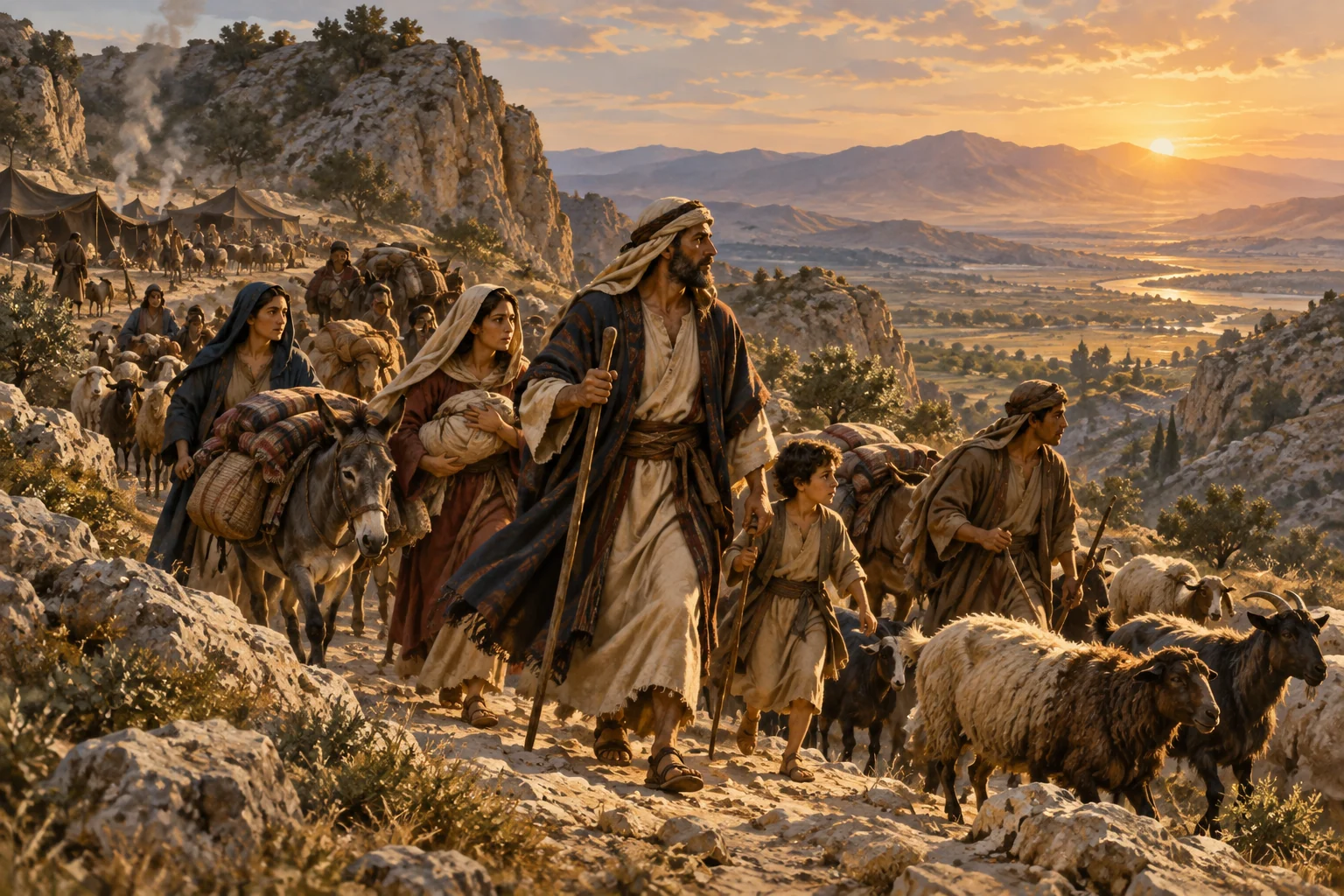
Genesis 31 serves as a critical geographic and covenantal turning point within the progressive unfolding of the divine promise-plan. Having spent twenty years in Padan-Aram under the deceptive administration of his uncle Laban, Jacob is commanded by the sovereign Creator to return to the Land of Canaan—the specific territory allotted as an inheritance to the Abrahamic line.
Read moreShow less
What This Study Explores
Promise-Plan Theology
Direct Answer: Why does Jacob’s departure from Laban involve both household gods and a boundary treaty?
The conflict concerns more than a family relocation. Jacob is leaving an exploitative household with wives, children, livestock, and disputed inheritance, while Rachel’s theft of the teraphim intensifies the legal and religious contest over who controls the family’s future.
God protects Jacob across territorial and political boundaries, and the cairn at Gilead establishes a negotiated limit that Laban may not cross for harm. The episode moves the promised family toward Canaan while exposing the mixture of faith, deception, idolatry, and emerging independence within Jacob’s household.
Key Claims
- Yahweh’s command to return and promise of presence govern Jacob’s departure from Paddan-Aram.
- Rachel and Leah interpret Laban’s conduct as economic disenfranchisement and consent to leave.
- The teraphim may carry religious, household, or inheritance significance, though their exact legal function remains debated.
- The narrative mocks gods that can be stolen and concealed while presenting Yahweh as sovereign beyond local territory.
- The Mizpah covenant is primarily a wary nonaggression boundary, not a sentimental pledge between close friends.
Interpretive Context
Parallels from Nuzi and other ancient Near Eastern archives illuminate household property and inheritance customs but should not be used to prove a single function for every teraphim. The chapter itself emphasizes Laban’s exploitative control, Rachel’s concealed action, divine restraint, and the formal separation of the households.
The chapter’s sacred geography and family politics converge in a contrast between portable idols and the God who speaks, protects, and governs across territories. Rachel can hide Laban’s gods beneath her, but neither Laban’s claims nor Jacob’s tactics determine the promise’s future; Yahweh escorts the household and fixes the boundary that secures its return.
Selected Scholarship
- Gordon J. Wenham, Genesis 16–50 (1994).
- Victor P. Hamilton, The Book of Genesis, Chapters 18–50 (1995).
- Nahum M. Sarna, Genesis (1989).
- K. Lawson Younger Jr., Ancient Conquest Accounts (1990).
- Kenneth A. Mathews, Genesis 11:27–50:26 (2005).
Scripture Connections
Genesis 31; John 1:14; Galatians 3:16–18; Ephesians 1:5; Colossians 2:15; Genesis 1; Genesis 3; Genesis 1:1–2
Continue on Substack
The complete article remains on Rabbit Room Apologetics at Substack.
Originally published June 24, 2026. This WordPress page is a discovery guide; the complete article is hosted on Substack.