ARTICLE GUIDE
At a Glance
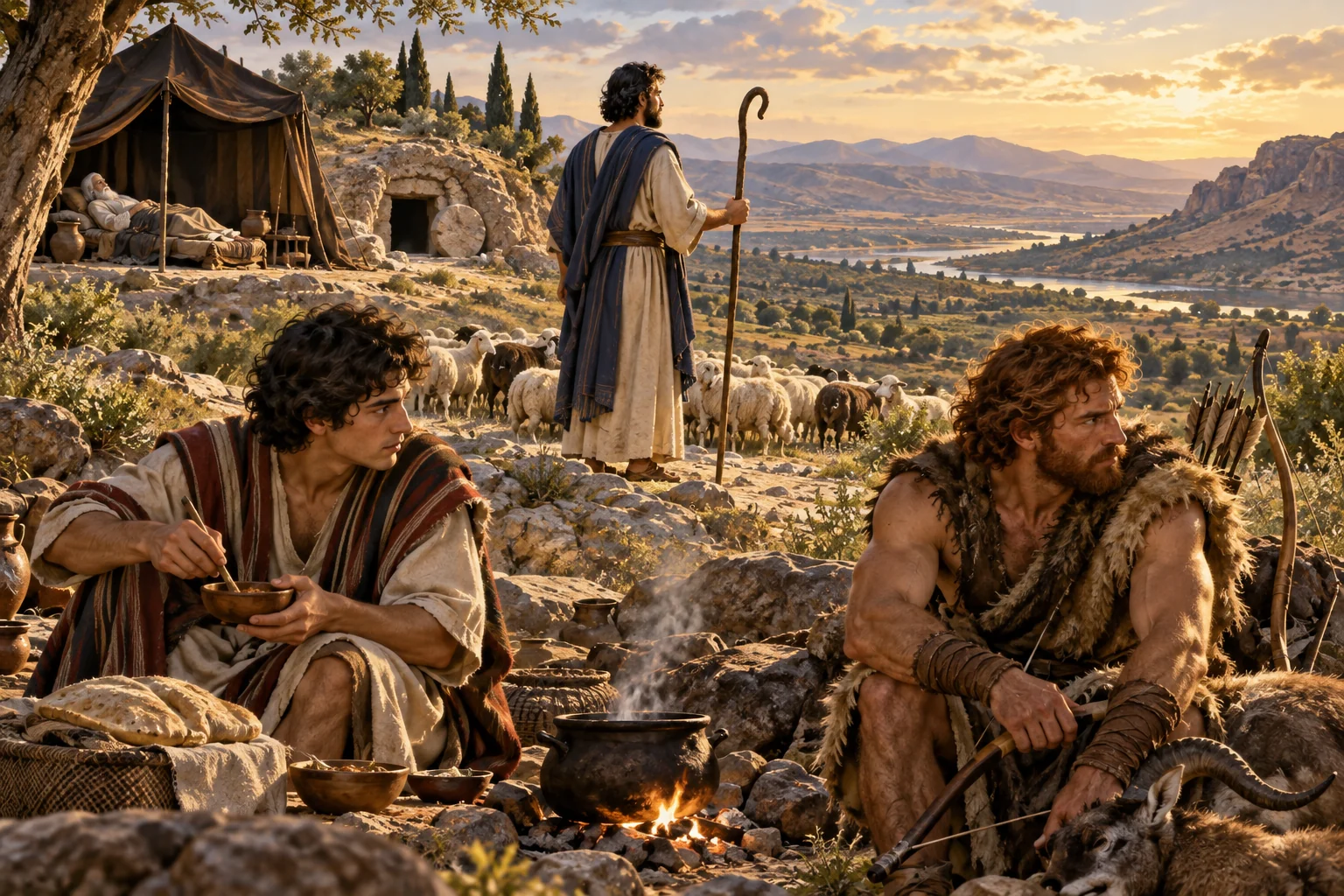
Genesis 25 represents a critical transition within the progressive unfolding of the divine promise-plan, chronicling the transfer of the covenantal mantle from Abraham to Isaac, and immediately introducing the subsequent generational crisis through Jacob and Esau.
Read moreShow less
What This Study Explores
Promise-Plan Theology
Direct Answer: Why does God choose Jacob before either twin has established a moral record?
The oracle overturns primogeniture to show that the promise advances by divine freedom rather than social rank, natural strength, or earned superiority. It does not declare Jacob morally better than Esau; the ensuing narratives expose Jacob’s serious faults.
Esau’s later sale of the birthright reveals his own disregard for the covenant inheritance, while Jacob’s grasping pursuit shows desire corrupted by manipulation. God’s election establishes vocation and purpose, not permission for either brother’s sin.
Key Claims
- Abraham’s death and burial close one generation while Isaac receives the covenant blessing.
- Ishmael’s twelve-prince genealogy fulfills God’s word while distinguishing his line from Isaac’s covenant role.
- Isaac responds to Rebekah’s barrenness with prayer rather than a surrogate scheme.
- The prenatal oracle interprets the twins as peoples and reverses conventional firstborn precedence.
- Esau exchanges a long-term birthright for immediate appetite, demonstrating contempt for its covenant significance.
Interpretive Context
Paul’s use of Jacob and Esau in Romans 9 concerns God’s freedom in advancing the historical promise and must be read alongside Genesis’s corporate language about two nations. The text addresses election before it supplies a complete later doctrine of individual salvation.
The chapter holds differentiated election together with genuine blessing beyond the chosen line: Ishmael’s twelve princes fulfill God’s word even as Isaac bears the covenant vocation. This pattern guards against reading Jacob’s selection as proof of personal superiority or treating non-election for a particular role as abandonment by divine providence.
Selected Scholarship
- Gordon J. Wenham, Genesis 16–50 (1994).
- Victor P. Hamilton, The Book of Genesis, Chapters 18–50 (1995).
- Nahum M. Sarna, Genesis (1989).
- Douglas J. Moo, The Epistle to the Romans, 2nd ed. (2018).
- Kenneth A. Mathews, Genesis 11:27–50:26 (2005).
Scripture Connections
Genesis 25; Romans 9:10–13; Hebrews 12:16; Genesis 3; Genesis 1:1–2
Continue on Substack
The complete article remains on Rabbit Room Apologetics at Substack.
Originally published June 17, 2026. This WordPress page is a discovery guide; the complete article is hosted on Substack.