ARTICLE GUIDE
At a Glance
Within the progressive unfolding of God’s divine promise-plan, Genesis 14 serves as a critical demonstration of Yahweh’s sovereign ability to protect the bearer of the covenantal promises amid international geopolitical upheaval.
Read moreShow less
What This Study Explores
Promise-Plan Theology
Direct Answer: What does Genesis 14 reveal about Abram, Melchizedek, and God Most High?
Genesis 14 portrays Abram as the protected bearer of God’s promise amid international conflict. His rescue of Lot displays courage and kinship loyalty, but the narrative attributes victory to God Most High rather than to Abram’s household strength or political alliances.
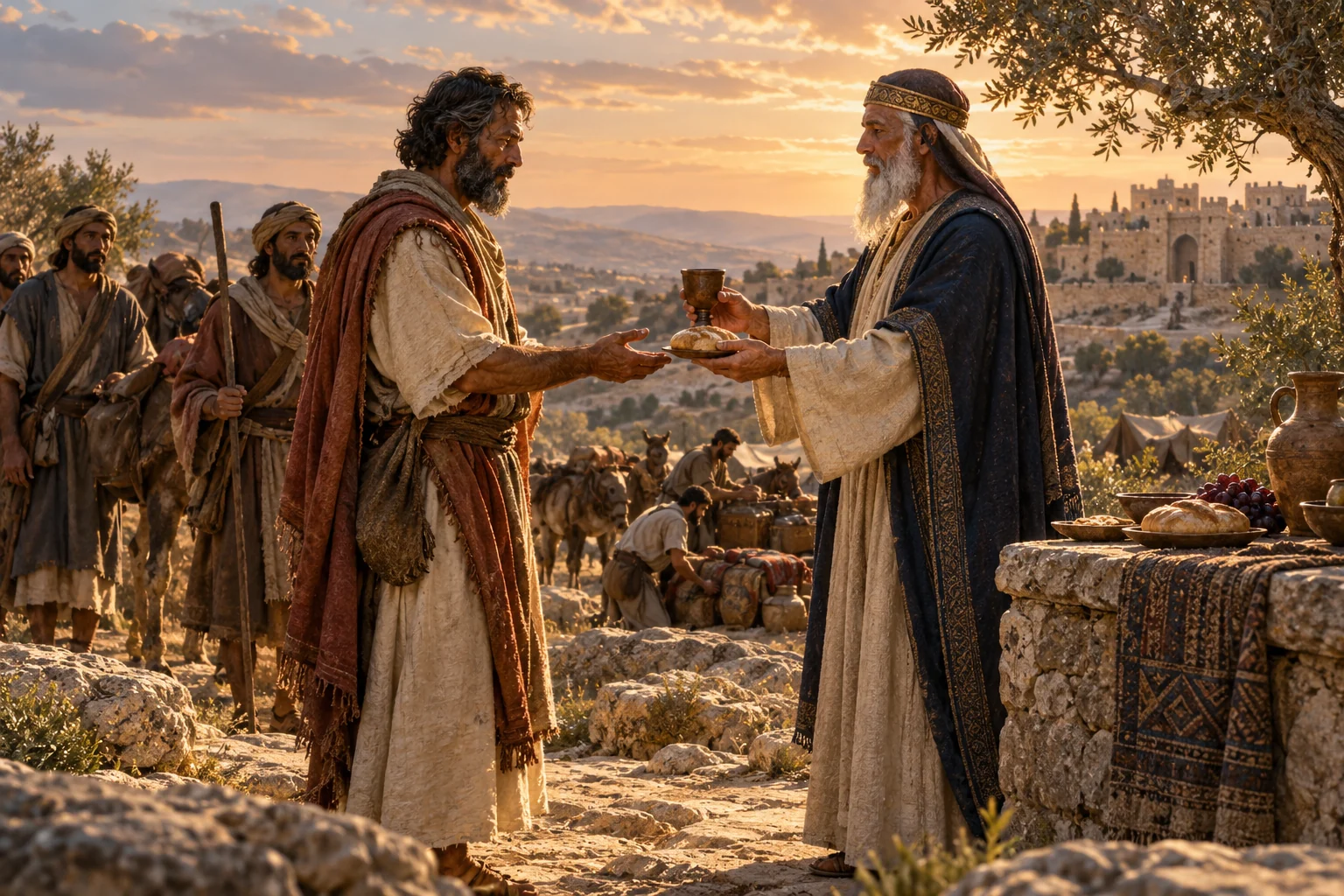
Melchizedek interprets the victory theologically: the Creator and Possessor of heaven and earth has delivered Abram’s enemies into his hand. Abram’s tithe and refusal of Sodom’s wealth contrast worshipful dependence on God with enrichment through a compromised king.
Key Claims
- The war of the eastern and Jordan Valley coalitions places the Abrahamic promise within real geopolitical danger.
- Abram acts as a capable household chieftain yet receives victory as divine gift rather than autonomous achievement.
- Melchizedek joins royal and priestly roles and identifies El Elyon with the Creator whom Abram serves.
- Abram’s tithe recognizes Melchizedek’s priestly blessing without making the chapter a complete later priesthood system.
- Refusing Sodom’s goods protects the testimony that Abram’s blessing comes from Yahweh rather than corrupt patronage.
Interpretive Context
Historical identifications of the kings and the precise location of Salem remain debated, and later canonical uses of Melchizedek should not erase his role in Genesis. Psalm 110 and Hebrews 7 develop a typological trajectory from this brief encounter, but Genesis 14 first contrasts two kings and locates Abram’s deliverance under the sovereignty of God Most High. Associations between the defeated peoples and later giant-clan traditions are possible canonical echoes, not the chapter’s controlling claim.
Psalm 110 and Hebrews 7 do not require Melchizedek to be removed from his historical setting or identified as a preincarnate appearance. His narrated combination of kingship, priesthood, righteousness, and peace provides the canonical pattern by which the Messiah’s superior and enduring priesthood can later be articulated.
Selected Scholarship
- Gordon J. Wenham, Genesis 1–15 — literary and exegetical treatment of the coalition war and Melchizedek.
- Victor P. Hamilton, The Book of Genesis: Chapters 1–17 — historical, lexical, and theological analysis.
- K. A. Mathews, Genesis 11:27–50:26 — covenantal setting and narrative structure.
- John H. Walton, Genesis — ancient Near Eastern background and the significance of Abram’s royal encounters.
- Walter C. Kaiser Jr., The Promise-Plan of God (2008).
Scripture Connections
Genesis 14; Hebrews 7:1–3; Hebrews 7:4–10; Genesis 3:1–24; Genesis 1:27
Continue on Substack
The complete article remains on Rabbit Room Apologetics at Substack.
Originally published June 8, 2026. This WordPress page is a discovery guide; the complete article is hosted on Substack.