ARTICLE GUIDE
At a Glance
The Standard Islamic Narrative asserts that the Qurʾān was revealed verbatim in the seventh-century Meccan dialect of the Quraysh, standardized under Caliph ʿUthmān ibn ʿAffān, and preserved with letterperfect vocalic uniformity.
Read moreShow less
What This Study Explores
Christian–Muslim Polemics • Qur’anic Studies
Do the Qurʾān’s Syro-Aramaic features reveal a sectarian Christian background?
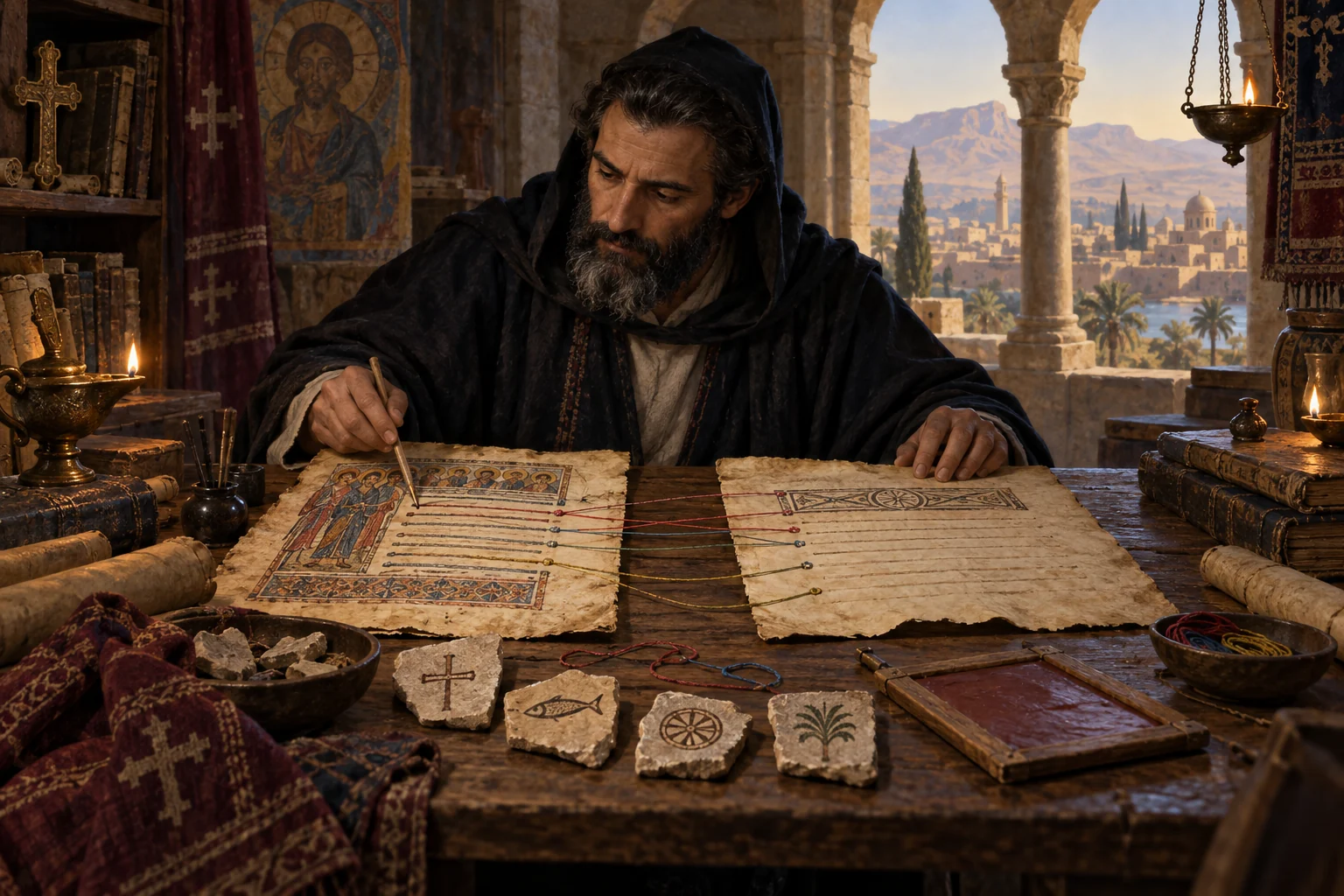
They strongly locate the Qurʾān within the multilingual, biblically saturated world of late antiquity. Syriac loanwords, lectionary echoes, and affinities with non-Chalcedonian and other Christian traditions help explain both its vocabulary and its retellings of biblical material.
That evidence illuminates a cultural and theological matrix; it does not by itself prove that every disputed passage has a Syriac solution or that the text is merely copied. The deeper contrast is theological: Christianity centers revelation in the incarnate Word, while Islam increasingly locates divine speech in an Arabic book.
Key Claims
- The Qurʾān emerged amid active Jewish and Christian communities rather than in religious isolation.
- Syriac and Aramaic vocabulary often preserves liturgical, scriptural, and polemical contexts behind Qurʾānic expressions.
- Qurʾānic accounts of Jesus and Mary frequently resemble late-antique Christian traditions outside the New Testament canon.
- Philology can clarify difficult readings, but conjectural retranslations must be tested against Arabic grammar and manuscript evidence.
- The historical evidence complicates a simple dictation narrative without eliminating the Qurʾān’s distinctive Arabic composition.
Interpretive Context
Late antiquity was a networked religious environment in which homilies, hymns, lectionaries, and oral disputation crossed linguistic boundaries. A source-critical reading therefore asks how the Qurʾān receives and reshapes inherited traditions, not merely whether it contains isolated foreign words.
Christian evaluation should distinguish historical explanation from theological judgment. Linguistic dependence is not itself a refutation; the decisive issue is how the Qurʾān reconfigures creation, covenant, incarnation, crucifixion, and revelation in relation to the canonical biblical witness.
Selected Scholarship
- Sidney H. Griffith, The Bible in Arabic
- Gabriel Said Reynolds, The Qurʾān and Its Biblical Subtext
- Angelika Neuwirth, The Qur’an and Late Antiquity
- Christoph Luxenberg, The Syro-Aramaic Reading of the Koran
- François de Blois, studies on Qurʾānic vocabulary and late-antique religion
Scripture Connections
John 1; Romans 11; Genesis 3; Jeremiah 31; Ezekiel 36; Acts 17
Continue on Substack
The complete article remains on Rabbit Room Apologetics at Substack.
Originally published August 24, 2026. This WordPress page is a discovery guide; the complete article is hosted on Substack.