ARTICLE GUIDE
At a Glance
Genesis 4 records the immediate historical and theological consequences of the cosmic temple’s fracture.
Read moreShow less
What This Study Explores
Promise-Plan Theology • Cosmic Temple
Direct Answer: How does Genesis 4 show sin spreading beyond Eden?
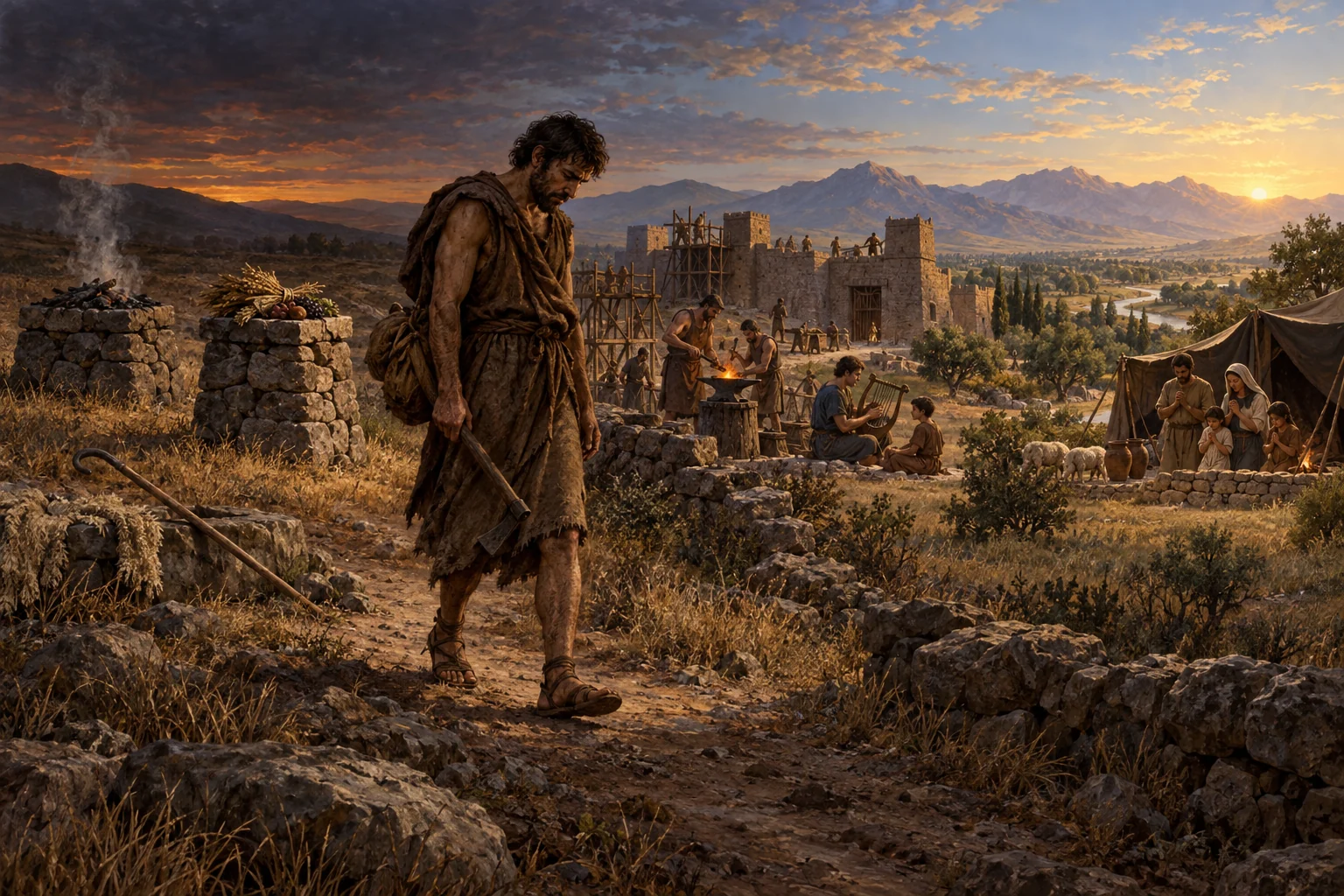
Genesis 4 moves the fracture of Eden into worship, family, land, city, and culture. Cain refuses God’s warning, murders his brother, and is driven farther from divine presence, while Lamech later turns vengeance into a boastful social principle.
Even so, God restrains violence by protecting Cain, preserves human cultural development, and continues the promise-bearing line through Seth. The chapter ends with people calling on Yahweh’s name, placing worshipful dependence alongside escalating human disorder.
Key Claims
- Both Cain and Abel bring offerings; the narrative emphasizes God’s regard for the offerer as well as the gift.
- Sin is pictured as a predatory power that desires Cain but must be ruled.
- Abel’s blood cries from the ground, joining homicide to the pollution and frustration of the land.
- Cain’s mark protects him from retaliatory killing and limits the spiral of vengeance.
- Seth’s birth and the invocation of Yahweh’s name preserve hope after Abel’s death and Cain’s exile.
Interpretive Context
Genesis does not say that Cain’s offering was rejected simply because it lacked blood; grain offerings are acceptable elsewhere in Scripture. Hebrews and 1 John focus attention on faith, works, and moral posture, though the exact defect is not fully specified. The mark of Cain is protective, not a racial stigma, and has no legitimate connection to later racist interpretations. Cainite cultural achievements are genuine goods even as Lamech’s violence exposes their moral ambiguity.
Cain’s movement eastward and his city-building extend exile while also showing that cultural development can coexist with moral disorder. Lamech intensifies vengeance, but Seth’s birth and the calling on Yahweh’s name preserve the promise-bearing line; Hebrews 11 and 1 John 3 later interpret Abel and Cain through faith, righteousness, and murderous hatred.
Selected Scholarship
- Gordon J. Wenham, Genesis 1–15 — narrative structure and theological interpretation of Cain and Abel.
- Victor P. Hamilton, The Book of Genesis: Chapters 1–17 — lexical analysis of offering, sin, blood, and exile.
- Nahum M. Sarna, Genesis — Jewish literary interpretation of the brothers and Cain’s protection.
- John H. Walton, Genesis — ancient background for offerings, city building, and the threshold imagery of sin.
- Walter C. Kaiser Jr., The Promise-Plan of God — preservation of the promised seed-line through the Cain-and-Seth narratives.
Scripture Connections
Genesis 4:1–26; Genesis 4; Genesis 4:1–7; Genesis 4:8–16; Genesis 4:17–24; Genesis 4:25–26; Genesis 3:15; Hebrews 11
Continue on Substack
The complete article remains on Rabbit Room Apologetics at Substack.
Originally published May 27, 2026. This WordPress page is a discovery guide; the complete article is hosted on Substack.