ARTICLE GUIDE
At a Glance
Contemporary Christian systematic theology frequently interprets the primeval narratives of Genesis 1 3 through post-biblical Western categories, reducing the cosmic architecture of creation and the drama of human failure to legal contracts or biological mechanics.
Read moreShow less
What This Study Explores
Promise-Plan Theology • Cosmic Temple
What Do the Two Trees Reveal about Humanity’s Vocation and Fall?
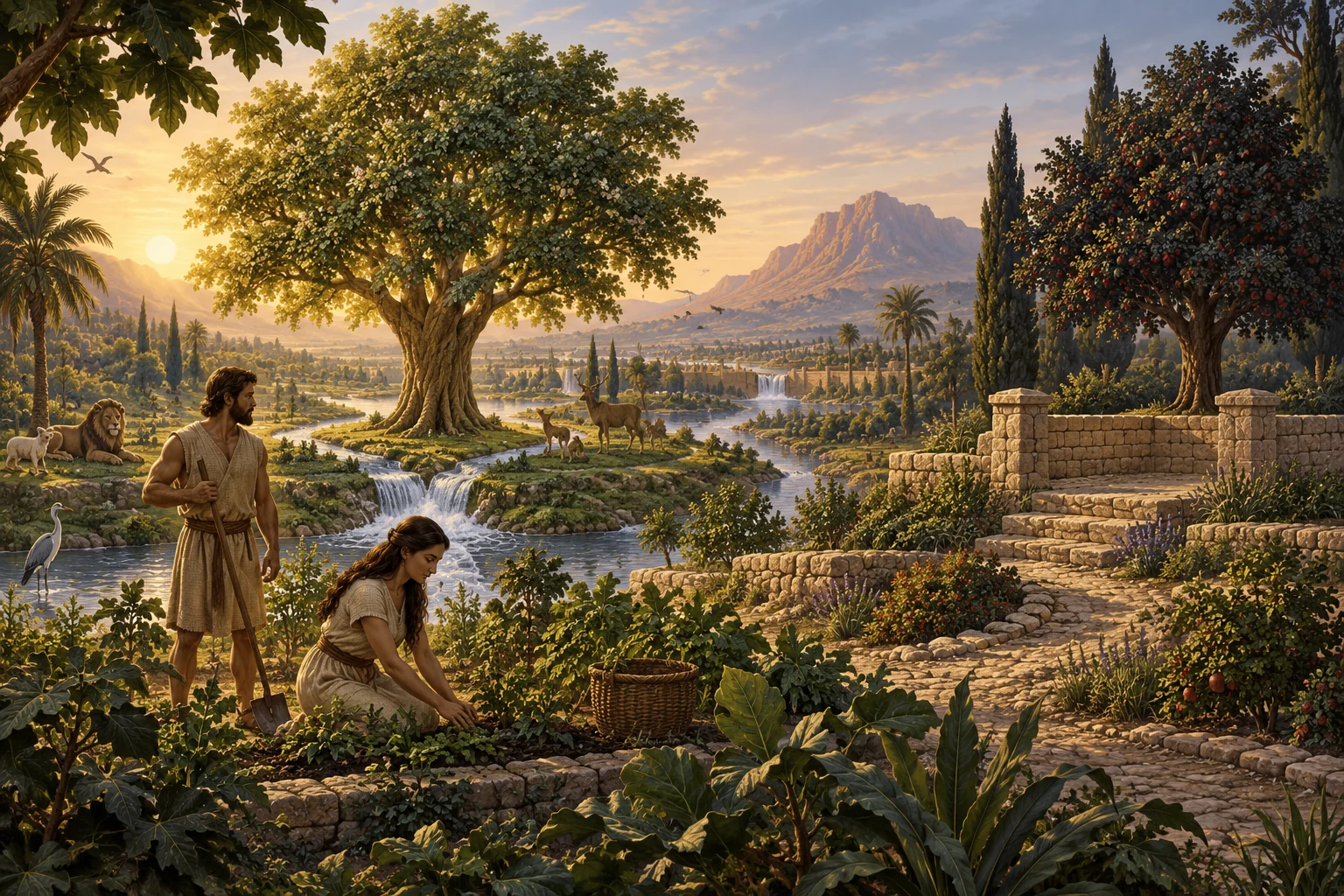
Genesis presents Eden as the sacred center of God’s cosmic temple, with humanity installed as God’s living image and commissioned to serve and guard sacred space. The Tree of Life signifies creaturely dependence and life received through communion with God. The Tree of the Knowledge of Good and Bad signifies the royal prerogative to define and administer moral order—a vocation humanity attempted to seize autonomously rather than mature into under divine wisdom.
The transgression therefore involves more than eating prohibited fruit: it is a revolt against covenantal dependence and a grasping after independent moral sovereignty. The resulting exile, mortality, and fracture of sacred space begin a canonical movement that reaches its answer in Jesus, the faithful Last Adam and true temple. His obedience unto death upon the “tree” opens the way to the restored Tree of Life and the garden-city of Revelation 21–22.
Key Claims
- Eden functions as primordial sanctuary. Genesis 1–2 supplies the architectural and vocational patterns later concentrated in Israel’s tabernacle and temple.
- The image of God is an endowed human status. Royal-priestly vocation flows from that identity; disability, age, or moral failure does not erase it.
- The two trees mark competing modes of rule. One embodies dependent participation in divine life; the other becomes the site of humanity’s seizure of autonomous judgment.
- The fall belongs to a wider cosmic conflict. The serpent’s rebellion initiates a pattern intensified by the Watchers tradition and Babel.
- The promise-plan restores rather than abandons creation. Messiah renews humanity’s priestly calling and brings sacred space to its eschatological completion.
Interpretive Context
The cosmic-temple reading and the interpretation of “the knowledge of good and bad” as a royal claim to autonomous moral judgment are substantial but debated proposals, not bare lexical certainties. Their value lies in how well they integrate the sanctuary imagery, humanity’s image-bearing vocation, the expulsion narrative, and the canonical return of the tree of life without allowing comparative ancient material to overrule Genesis itself.
The reading draws on ancient Near Eastern temple imagery, the paired priestly verbs ʿābad and šāmar, and Second Temple illumination of the supernatural setting. These contextual resources clarify the biblical authors’ cognitive world without displacing the final canonical text. Walter C. Kaiser Jr.’s promise-plan supplies the controlling trajectory from Genesis 3:15 through Abraham, Sinai, David, the new covenant, Messiah, and the renewed creation; Romans 11 prevents Gentile participation from becoming replacement of Israel.
Selected Scholarship
- Beale, G. K. (2004). The Temple and the Church’s Mission.
- Heiser, M. S. (2015). The Unseen Realm.
- Imes, C. J. (2023). Being God’s Image.
- Kaiser, W. C., Jr. (2008). The Promise-Plan of God.
- Walton, J. H. (2009). The Lost World of Genesis One; Walton (2015), The Lost World of Adam and Eve.
Scripture Connections
Genesis 1; Revelation 21; Genesis 6; Genesis 11; Deuteronomy 32; Genesis 3; Jeremiah 31; Ezekiel 36
Continue on Substack
The complete article remains on Rabbit Room Apologetics at Substack.
Originally published August 22, 2026. This WordPress page is a discovery guide; the complete article is hosted on Substack.