ARTICLE GUIDE
At a Glance
Traditional historiography has long framed the emergence of early Christianity as a clean, linear rupture from a monolithic “Judaism”—a narrative commonly termed the “parting of the ways.” Contemporary Second Temple scholarship demonstrates, instead, that first-century identity was constrained by the socio-political matrix of the Roman Empire and a plural Jewish landscape.
Read moreShow less
What This Study Explores
Second Temple Judaism • Historical Method
Did Christianity Simply Separate from Judaism in the First Century?
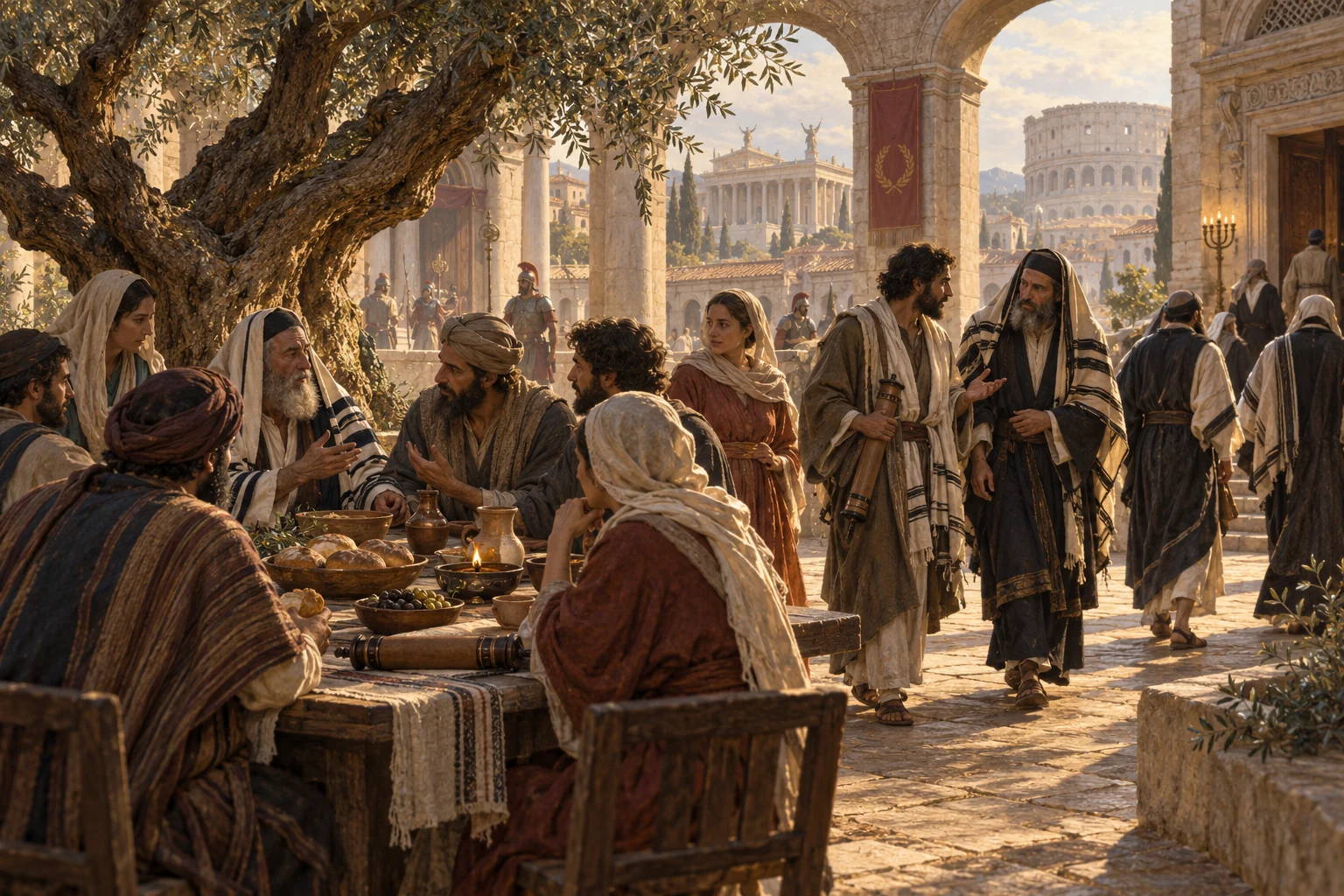
The earliest Jesus movement did not emerge as a gentile religion cleanly separating from a single, monolithic Judaism. It arose within a diverse Second Temple Jewish world of Pharisees, Sadducees, Essenes, diaspora synagogues, apocalyptic groups, and competing restoration movements. Jewish followers of Jesus continued to worship Israel’s God, read Israel’s Scriptures, and understand Messiah within Israel’s promise.
The “sibling paradigm” better describes a long, uneven process in which rabbinic Judaism and the increasingly gentile church developed from the shared matrix of late Second Temple Judaism. Gentiles who abandoned civic cults for exclusive allegiance to Israel’s God entered a costly social world. Paul’s mission incorporated them without requiring ethnic conversion, while Romans 9–11 refused to treat their inclusion as the displacement of ethnic Israel.
Key Claims
- First-century Judaism was internally plural. No single institution or theology exhausted Jewish identity before or immediately after 70 CE.
- Religion and ethnicity were inseparable in the Roman world. Gods, ancestry, civic loyalty, sacrifice, and customary law formed one social package.
- Gentile allegiance to Israel’s God carried public costs. Withdrawal from ancestral cults could appear as impiety, familial betrayal, or civic danger.
- The Jesus movement began as a Jewish sibling. Separation occurred differently across places and generations rather than through one universal break.
- Paul’s gentile mission did not cancel Israel. The nations join Abrahamic blessing while Israel retains the covenants, promises, patriarchs, and irrevocable calling.
Interpretive Context
The essay places Paul within the Greco-Roman world and the plural landscape of Second Temple Judaism, drawing on diaspora synagogue evidence, imperial attitudes toward ancestral customs, and early Christian identity negotiations. The phrase religio licita is treated as modern shorthand rather than a first-century legal category.
Paula Fredriksen, Mark Nanos, Magnus Zetterholm, Shaye Cohen, and Daniel Boyarin help replace a simple “parting” narrative with overlapping sibling developments. Kaiser’s promise-plan provides the theological control: gentiles are grafted into Israel’s story rather than forming a replacement people.
Selected Scholarship
- Boyarin, D. (2004). Border Lines. University of Pennsylvania Press.
- Cohen, S. J. D. (1999). The Beginnings of Jewishness. University of California Press.
- Fredriksen, P. (2017). Paul: The Pagans’ Apostle. Yale University Press.
- Nanos, M. D., & Zetterholm, M. (Eds.). (2015). Paul within Judaism. Fortress Press.
- Stowers, S. K. (1994). A Rereading of Romans. Yale University Press.
Scripture Connections
Genesis 3; Jeremiah 31; Ezekiel 36; Romans 11; Acts 15; Ephesians 2; Romans 9; Acts 18
Continue on Substack
The complete article remains on Rabbit Room Apologetics at Substack.
Originally published September 8, 2026. This WordPress page is a discovery guide; the complete article is hosted on Substack.