ARTICLE GUIDE
At a Glance
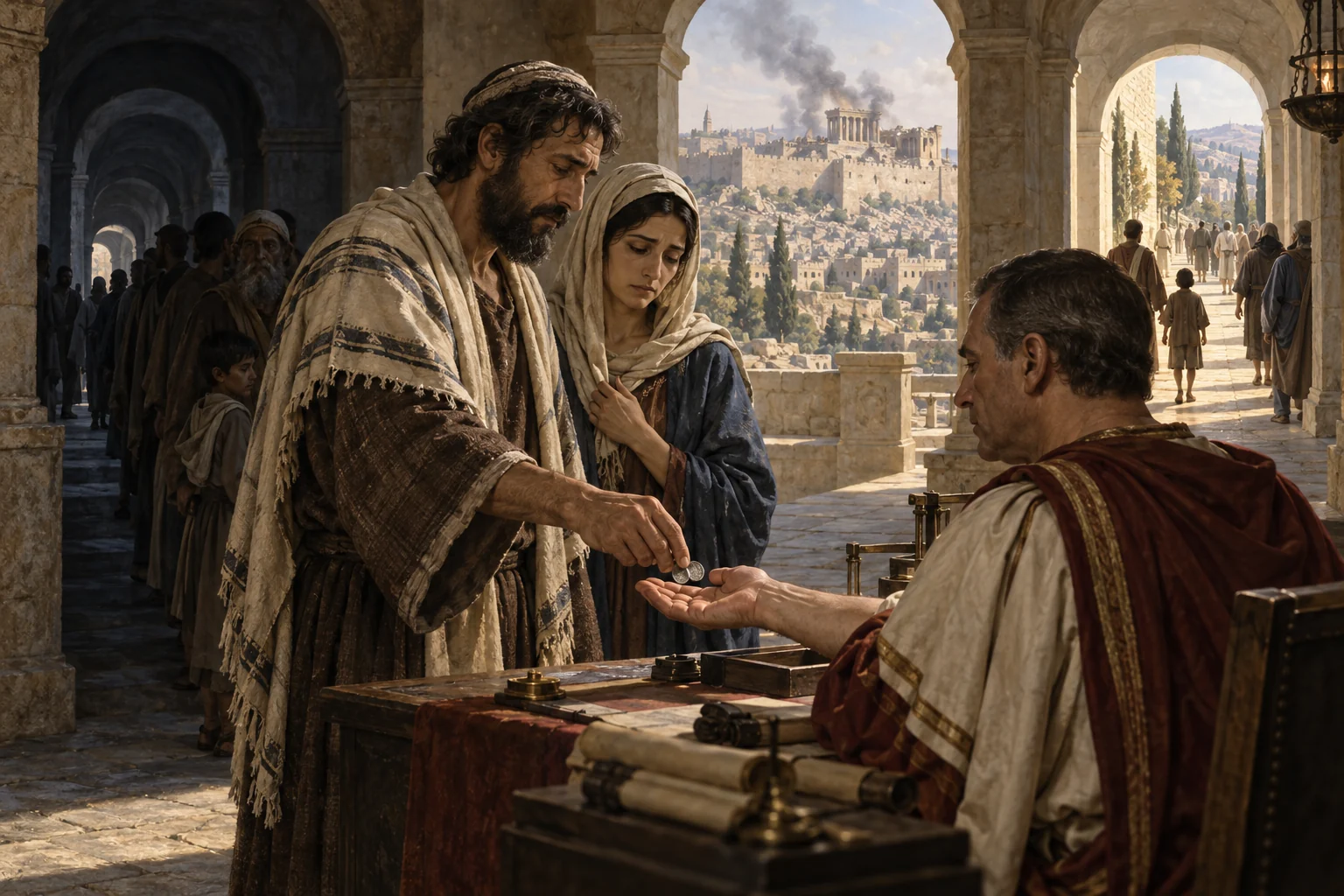
Following the destruction of the Second Temple in 70 CE, Emperor Vespasian instituted the fiscus Judaicus, an annual poll tax of two drachmae (two denarii) levied on Jews throughout the Roman Empire.
Read moreShow less
What This Study Explores
Second Temple Judaism
How Did the Fiscus Judaicus Affect the Parting of the Ways?
After 70 CE, Rome redirected the Jewish Temple tribute to Jupiter Capitolinus and expanded liability beyond the adult male base envisioned in Exodus 30. The fiscus Judaicus therefore operated as more than a revenue measure: it publicly transformed a sanctuary ransom into an imperial sign of Jewish defeat and forced administrators to decide who counted as Jewish across ethnicity, practice, household, and association.
Under Domitian, aggressive enforcement, informers, and examinations intensified the danger for concealed Jews, God-fearers, and some Christ-followers living within overlapping Jewish and gentile networks. Nerva’s reform curtailed abusive accusation but did not abolish the tax. The levy helped harden legal and social boundaries, yet it should be treated as one accelerant in a long, uneven separation—not as a single moment when Judaism and Christianity became two religions.
Key Claims
- The tax inverted the Temple tribute. Rome preserved the two-drachma form while redirecting its sacred destination from Jerusalem to Jupiter.
- Vespasian expanded the taxable base. Documentary evidence shows liability reaching women, children, elders, and dependents in some communities.
- Domitian made identity legally dangerous. Enforcement targeted both concealed Jewish origin and people living a Jewish life without formal profession.
- Nerva reformed abuse rather than abolishing the levy. The famous coin announces relief from malicious prosecution, while later receipts show the tax continued.
- The parting of the ways was gradual. Fiscal classification pressured boundaries but did not instantly erase the Jewish identity of every Jesus-following community.
Interpretive Context
The study distinguishes the biblical half-shekel of Exodus 30 and Matthew 17 from the postwar Roman poll tax. Josephus, Cassius Dio, Suetonius, Egyptian receipts and registers, and Nerva’s FISCI IVDAICI CALVMNIA SVBLATA coin supply the principal evidence.
It places Miriam Pucci Ben Zeev, Marius Heemstra, Martin Goodman, E. Mary Smallwood, Leonard Thompson, and Shaye J. D. Cohen in conversation while resisting a simplistic tax-caused schism. The canonical synthesis preserves Israel’s vocation and reads early assemblies inside the plural Second Temple and post-Temple Jewish world.
Selected Scholarship
- Cohen, S. J. D. (2006). The Beginnings of Jewishness. University of California Press.
- Goodman, M. (1989). Nerva, the Fiscus Judaicus and Jewish identity. Journal of Roman Studies, 79, 40–44.
- Heemstra, M. (2010). The Fiscus Judaicus and the Parting of the Ways. Mohr Siebeck.
- Smallwood, E. M. (1976). The Jews Under Roman Rule. Brill.
- Thompson, L. A. (1982). Domitian and the Jewish tax. Historia, 31(3), 329–342.
Scripture Connections
Exodus 30; Matthew 17; Romans 11; Ephesians 2; John 9; Revelation 2; Hebrews 10; Genesis 3
Continue on Substack
The complete article remains on Rabbit Room Apologetics at Substack.
Originally published September 11, 2026. This WordPress page is a discovery guide; the complete article is hosted on Substack.