ARTICLE GUIDE
At a Glance
Within the progressive unfolding of the divine promise-plan, Genesis 16 introduces a critical narrative tension following the ratification of the Abrahamic covenant in chapter 15. The central conflict revolves around the prolonged delay of the promised seed.
Read moreShow less
What This Study Explores
Promise-Plan Theology
Direct Answer: What does Hagar’s story show about promise, human agency, and divine mercy?
Genesis 16 shows that God’s promise cannot be secured by exploiting culturally available means. Sarai and Abram’s attempt to obtain an heir through Hagar produces rivalry, blame, and affliction because human management has displaced patient trust and failed to protect a vulnerable woman.
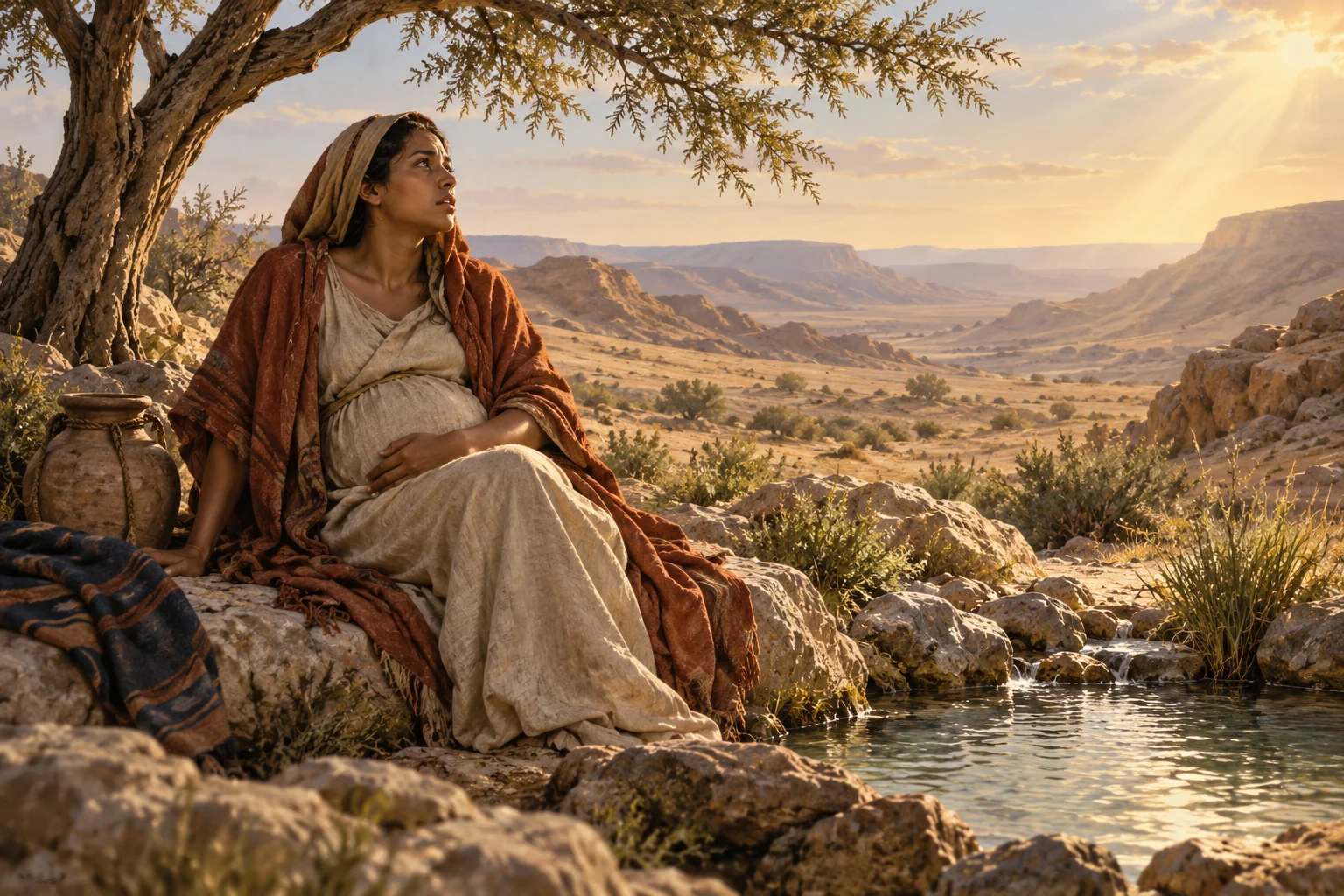
Yet God sees Hagar in the wilderness. The Angel of Yahweh addresses her personally, promises descendants, and names her son Ishmael, demonstrating that divine mercy extends to the afflicted even while the covenantal line will proceed through the son God later promises to Sarai.
Key Claims
- The ten-year delay exposes the pressure that divine timing places on Abram and Sarai’s trust.
- The surrogate arrangement was culturally intelligible but the narrative highlights its destructive human consequences.
- Abram’s passivity and Sarai’s harsh treatment reveal moral failure within the chosen household.
- The Angel of Yahweh speaks with divine authority and gives Hagar a promise of multiplication.
- Hagar’s confession of the God who sees makes an oppressed outsider a recipient and witness of divine attention.
Interpretive Context
Interpreters should neither romanticize the ancient surrogate arrangement nor flatten the characters into simple villains. Hagar is simultaneously an Egyptian servant, a woman subjected to household power, and the mother of a divinely blessed people; Sarai is both mistreated in her own experience and responsible for mistreating another. The command to return is part of this particular ancient narrative and must not be weaponized to require endangered people to remain under abuse.
Paul’s later use of Hagar and Sarah in Galatians develops a covenantal contrast, but it does not erase Hagar’s historical suffering or Yahweh’s care for her and Ishmael. Canonical interpretation must hold the typology together with the narrative’s ethical witness: the God of promise opposes human attempts to secure blessing through domination and hears the afflicted outside the covenant household’s center.
Selected Scholarship
- Gordon J. Wenham, Genesis 16–50 — narrative and theological analysis of Hagar and the promised seed.
- Victor P. Hamilton, The Book of Genesis: Chapters 1–17 — lexical and cultural context for the household conflict.
- Phyllis Trible, Texts of Terror — influential literary attention to Hagar’s suffering and marginalization.
- John H. Walton, Victor H. Matthews, and Mark W. Chavalas, The IVP Bible Background Commentary: Old Testament — ancient surrogate and household customs.
- Kenneth A. Mathews, Genesis 11:27–50:26 (2005).
Scripture Connections
Genesis 16; Galatians 4:22–24; Romans 9:7–8; Genesis 3:1–24; Genesis 1:27
Continue on Substack
The complete article remains on Rabbit Room Apologetics at Substack.
Originally published June 8, 2026. This WordPress page is a discovery guide; the complete article is hosted on Substack.