ARTICLE GUIDE
At a Glance
While Genesis 1 details the functional inauguration of the entire cosmos as God’s temple, Genesis 2 shifts the theological lens from the universal to the terrestrial. Within the Hebraic cognitive environment, Genesis 2 is not a recursive recapitulation of the sixth day, but rather a sequel detailing the aftermath of cosmic ordering.
Read moreShow less
What This Study Explores
Biblical Theology • Canonical Interpretation • The Promise-Plan of God
Direct Answer: How does Genesis 2 portray Eden and humanity’s original vocation?
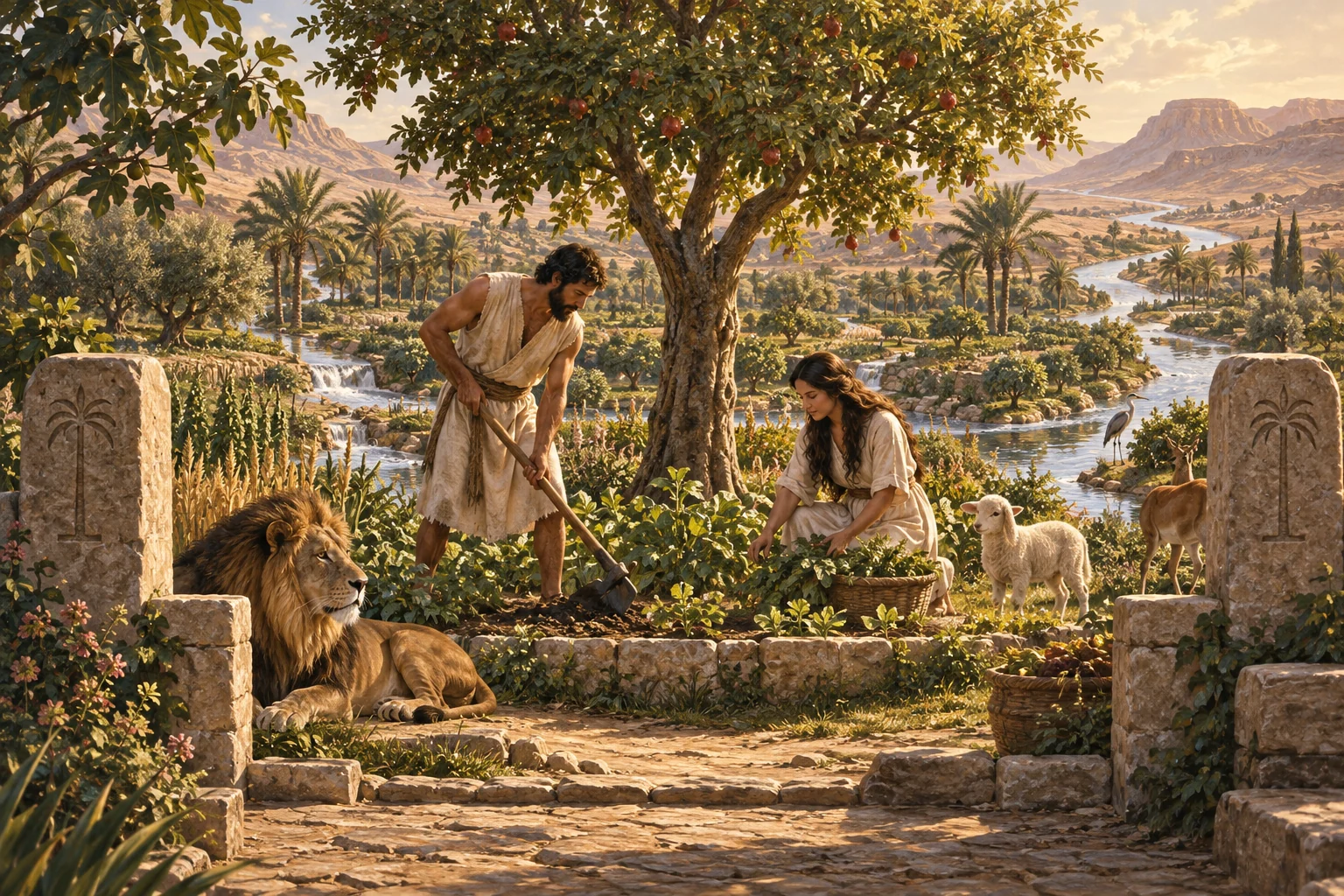
Genesis 2 focuses the cosmic vision of Genesis 1 on a terrestrial sanctuary. God forms the human from the ground, gives life by divine breath, plants Eden, and places the human there to serve and guard the sacred garden.
The chapter presents vocation, moral boundary, companionship, and marriage as gifts ordered toward flourishing. The woman is the man’s corresponding strength, not an inferior assistant, and together they form the human partnership commissioned to cultivate life in God’s presence.
Key Claims
- The human is earth-creature and God-breathed life, joining material dependence with unique divine vocation.
- Eden’s geography, precious materials, trees, and divine presence contribute to its later temple associations.
- The verbs often translated “work” and “keep” also serve priestly contexts of service and guarding.
- The tree command establishes creaturely freedom within a divinely given moral boundary.
- The woman as ezer kenegdo is a strong, corresponding partner, and the one-flesh union establishes covenantal kinship.
Interpretive Context
Scholars debate whether Genesis 2 is a sequel, a focused recapitulation, or a complementary account of humanity’s creation. Archetypal significance and historical reference are not necessarily mutually exclusive, but the text should not be made to answer modern biological questions in technical detail. The priestly reading of the service-and-guarding verbs gains strength from canonical parallels, while Eden’s identification as a formal temple remains a cumulative theological inference.
The chapter’s dust-and-breath anthropology, garden geography, priestly service, moral boundary, and one-flesh union form an integrated account of human life before exile. The essay reads these elements as the terrestrial center of the cosmic temple and as the baseline that the promise-plan will restore after Genesis 3 fractures sacred space and vocation.
Selected Scholarship
- Gordon J. Wenham, Genesis 1–15 — literary, lexical, and theological exegesis of Eden and human partnership.
- John H. Walton, The Lost World of Adam and Eve — archetypal humanity, sacred space, and vocation.
- J. Richard Middleton, The Liberating Image — human rule, relationality, and the extension of sacred order.
- Carmen Joy Imes, Being God’s Image — embodied vocation, male-female partnership, and image-bearing.
- Walter C. Kaiser Jr., The Promise-Plan of God — Eden, human vocation, and the creation foundation of the canon’s redemptive trajectory.
Scripture Connections
Genesis 2:4–25; Genesis 1; Genesis 2; Genesis 2:4–7; Genesis 2:8–14; Genesis 2:15–17; Genesis 2:18–25; Genesis 3
Continue on Substack
The complete article and its available video material remain on Rabbit Room Apologetics at Substack.
Originally published May 26, 2026. This WordPress page is a discovery guide; the complete article is hosted on Substack.