ARTICLE GUIDE
At a Glance
Genesis 5 traces the line from Adam through Seth to Noah, contrasting its promise-bearing trajectory with Cain’s lineage. The repeated deaths disclose the curse’s continuing reign, while Enoch’s translation and Noah’s anticipated rest preserve hope that God’s purpose for humanity will continue.
What This Study Explores
Biblical Theology • Canonical Interpretation • The Promise-Plan of God
Direct Answer: Why does Genesis 5 repeat “and he died” while preserving a line of hope?
The genealogy demonstrates that Adam’s image-bearing family continues to multiply, yet every generation remains under the mortality announced in Eden. The recurring phrase “and he died” makes death’s reign the chapter’s dominant cadence.
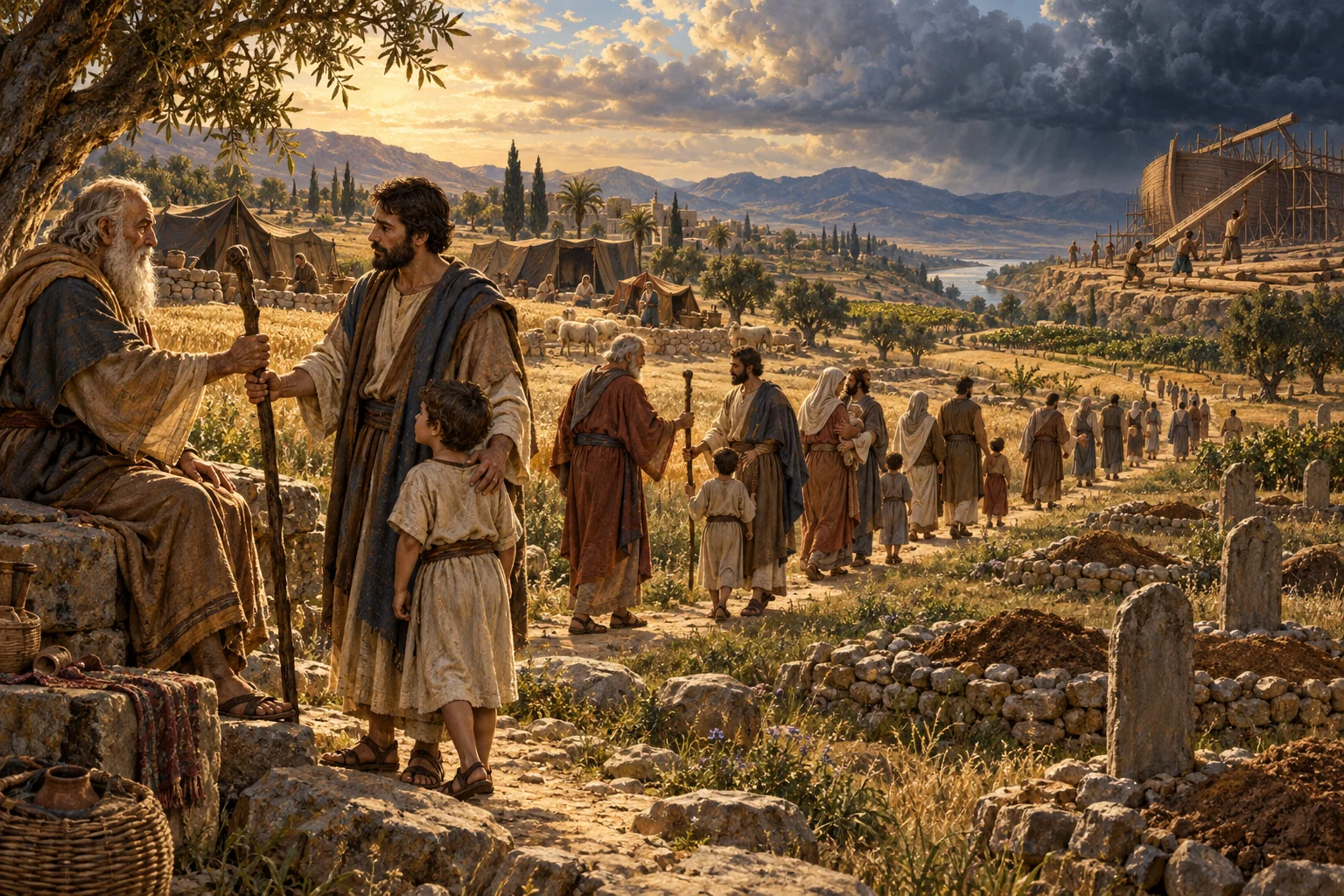
Hope interrupts that cadence through Enoch, who walks with God and is taken, and through Lamech’s naming of Noah in expectation of comfort from the cursed ground. The line from Adam to Noah preserves the family through whom God’s promise will continue beyond judgment.
Key Claims
- The toledot heading presents Adam’s descendants as a significant written family record.
- Seth bears Adam’s likeness and image, showing the continued transmission of human identity and vocation.
- The repeated ages and deaths emphasize both extraordinary longevity and the certainty of mortality.
- Enoch’s removal without the usual death notice signals that death does not have the final word.
- Noah’s name is associated with hoped-for rest and relief from labor on the cursed soil.
Interpretive Context
The long lifespans have been interpreted literally, symbolically, schematically, and comparatively with ancient king lists; the text’s theological force does not depend on resolving every chronological question. Genesis 5 is a selective genealogy rather than a modern demographic register. Calling Seth’s line “godly” captures its promise-bearing function, but the chapter does not claim that every member was morally exemplary or that all Cainites were devoid of common grace.
The genealogy links creation to flood by carrying both image-bearing and mortality through successive generations. Enoch’s exceptional translation interrupts the death refrain, while Lamech’s naming of Noah voices hope for relief from the cursed ground; together these features keep judgment and promise in tension as the narrative approaches the flood.
Selected Scholarship
- Gordon J. Wenham, Genesis 1–15 — structure, chronology, and theology of the genealogy.
- Victor P. Hamilton, The Book of Genesis: Chapters 1–17 — detailed exegesis of image, lifespans, Enoch, and Noah.
- Nahum M. Sarna, Genesis — Jewish commentary on genealogical form and the refrain of death.
- K. A. Mathews, Genesis 1–11:26 — ancient parallels and the promise-bearing function of Adam’s line.
- Robert D. Bergen, “Genesis,” in the CSB Study Bible — concise exegetical notes on the genealogy, Enoch, and Noah’s anticipated rest.
Scripture Connections
Genesis 5:1–32; Genesis 1; Genesis 3:1–24; Genesis 1:27
Continue on Substack
The complete article and its available video material remain on Rabbit Room Apologetics at Substack.
Originally published May 27, 2026. This WordPress page is a discovery guide; the complete article is hosted on Substack.