ARTICLE GUIDE
At a Glance
Genesis 9 serves as a crucial epochal transition in the organic unity of the canonical witness. Occurring immediately after the judgment of the deluge, the chapter functions as a narrative of re-creation, establishing the universal parameters under which God’s progressive redemptive purposes—His promise-plan—will unfold.
Read moreShow less
What This Study Explores
Promise-Plan Theology
Direct Answer: What does the Noahic covenant establish for humanity and creation?
The Noahic covenant establishes a universal order of preservation after the flood. God recommissions humanity to multiply, protects the sanctity of life, permits animal food with a restriction concerning blood, and pledges never again to destroy all flesh by flood.
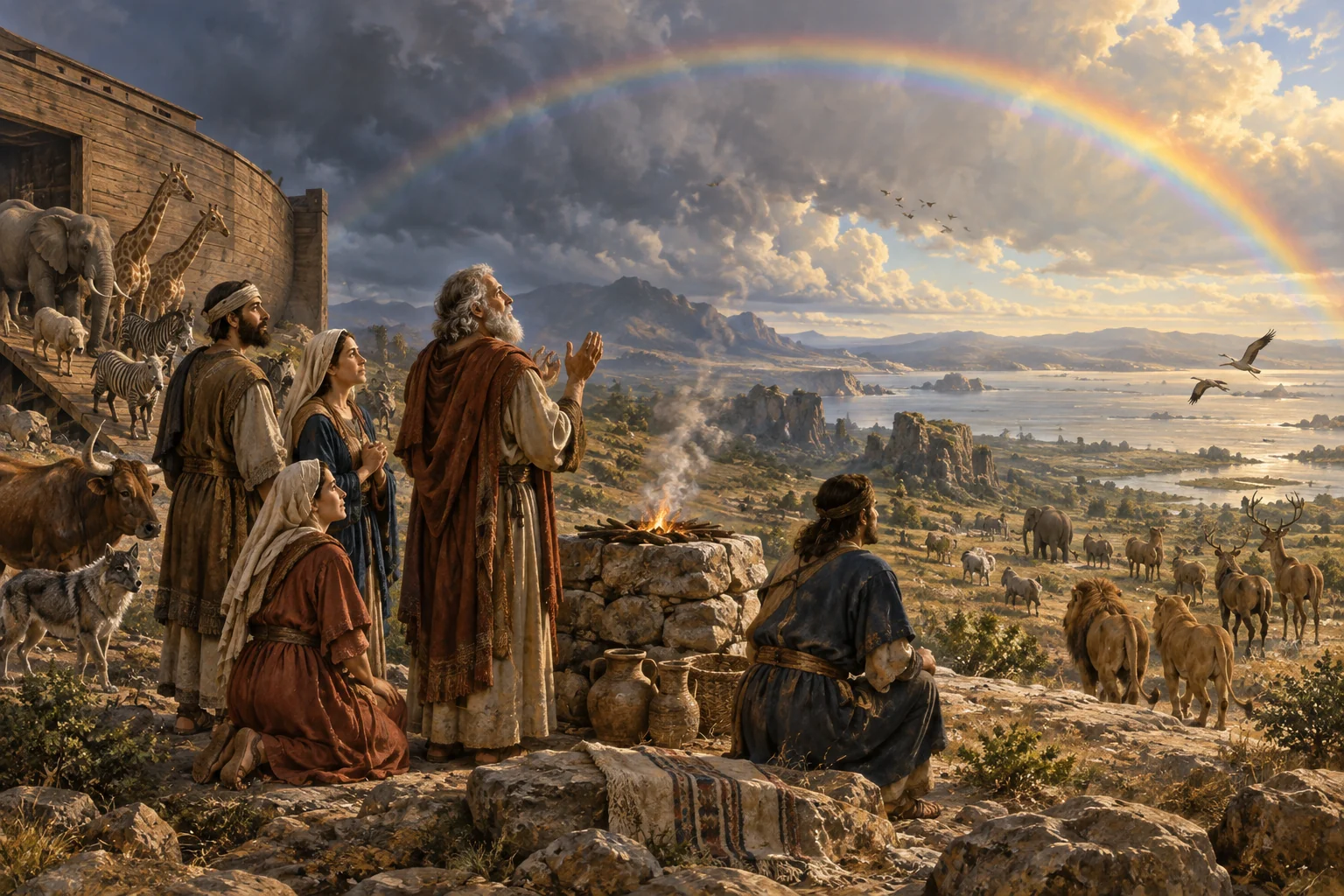
The rainbow seals God’s commitment to the earth and every living creature, providing the stable creational theater in which the Abrahamic promise and messianic redemption can unfold. The chapter also soberly shows that re-creation has not yet removed sin from the human family.
Key Claims
- Noah receives a renewed creation mandate that echoes Adam while acknowledging a now-fractured relationship with animals.
- The blood prohibition teaches that creaturely life belongs to God.
- Human bloodshed receives special gravity because human beings bear God’s image.
- The covenant and its rainbow sign include Noah’s descendants and every living creature.
- Noah’s drunkenness and the family crisis demonstrate that flood judgment did not cure the human heart.
Interpretive Context
The judicial statement in Genesis 9:6 has played a major role in debates over capital punishment, but interpreters differ over whether it directly mandates state execution or establishes a principle of proportionate accountability. The text curses Canaan, not Ham, and supplies no warrant for racist readings or chattel slavery; the so-called “curse of Ham” is a destructive distortion. The blood restriction anticipates later Torah while belonging first to this universal post-flood setting.
The Noahic covenant stabilizes the created order as the arena in which the Abrahamic, Israelite, and messianic promises can unfold. Its universal scope and the later apostolic concern for blood in Acts 15 connect creation ethics with the church’s life, while the chapter’s closing family failure shows why preservation alone cannot accomplish inward renewal.
Selected Scholarship
- Gordon J. Wenham, Genesis 1–15 — covenant structure, image-bearing, and the family narrative.
- Victor P. Hamilton, The Book of Genesis: Chapters 1–17 — exegetical analysis of blood, rainbow, and Canaan.
- Nahum M. Sarna, Genesis — Jewish interpretation of the universal covenant and its sign.
- K. A. Mathews, Genesis 1–11:26 — theological treatment of re-creation, preservation, and human failure.
- Jacob Milgrom, Leviticus 1–16 — the sanctity of blood and the cultic principle that life belongs to God.
Scripture Connections
Genesis 9; Genesis 1:2; Genesis 9:4; Acts 15:20; Hebrews 11:7; 1 Peter 3:20–21; 2 Peter 2:5; Revelation 4:3
Continue on Substack
The complete article remains on Rabbit Room Apologetics at Substack.
Originally published June 2, 2026. This WordPress page is a discovery guide; the complete article is hosted on Substack.