ARTICLE GUIDE
At a Glance
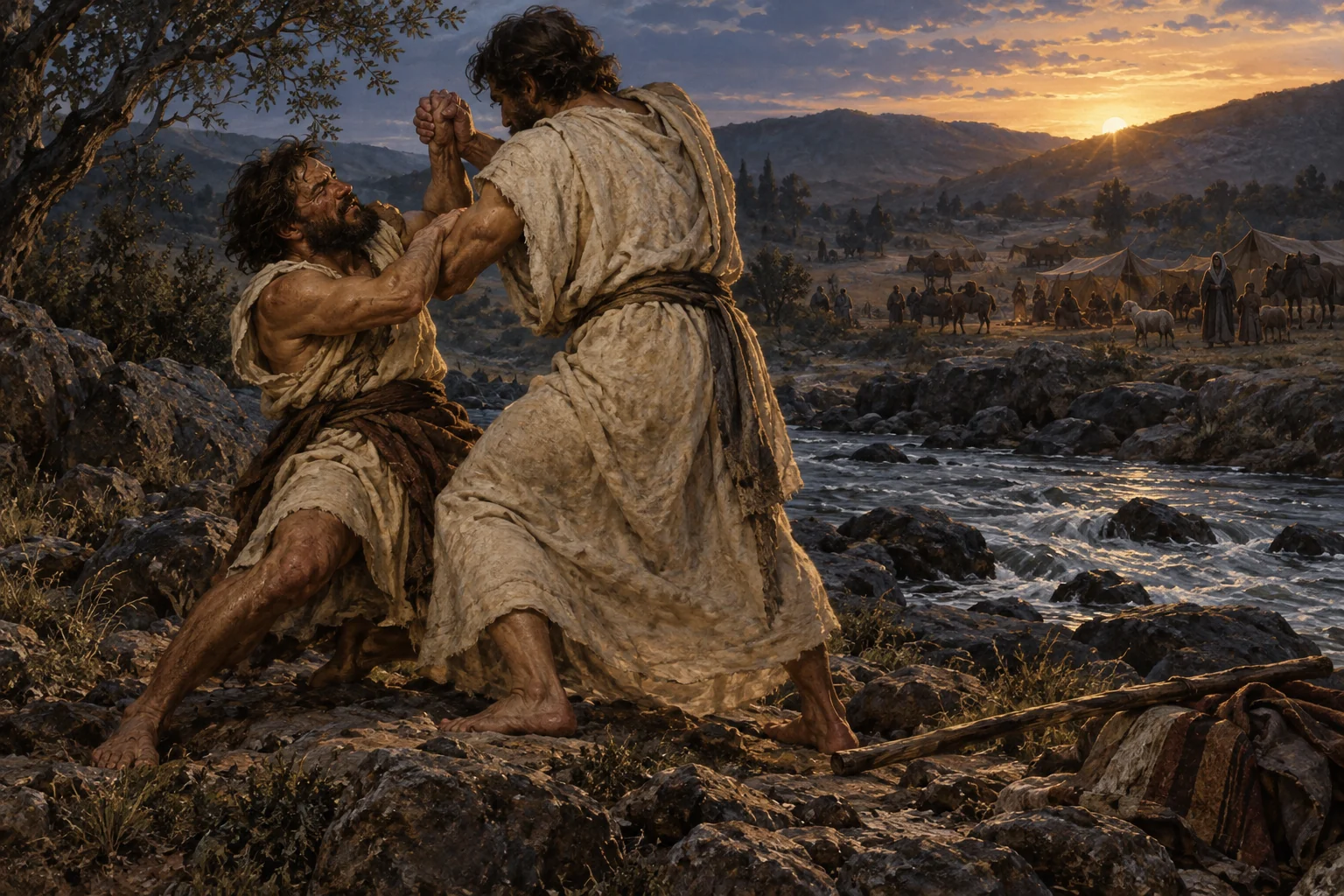
The narrative context of Genesis 32 marks a critical nexus in the progressive unfolding of God’s divine promise-plan. Having departed from the household of Laban, Jacob’s return journey to the land of Canaan forces an inevitable confrontation with his past—specifically, his estranged brother Esau, from whom he fraudulently obtained the birthright and patriarchal blessing.
Read moreShow less
What This Study Explores
Promise-Plan Theology
Direct Answer: Did Jacob defeat God in the wrestling match at Peniel?
No. The mysterious opponent can disable Jacob with a touch, showing that the contest is not a victory of human strength over divine weakness. Jacob “prevails” by refusing to release his only source of blessing after his self-reliance has been broken.
The encounter transforms grasping into dependent persistence. Jacob receives a new name and blessing, but also a permanent limp: Israel’s future rests not on the patriarch’s ability to control outcomes, but on clinging to the God who wounds, preserves, and keeps his promise.
Key Claims
- The angelic camps at Mahanaim frame Jacob’s journey within the intersection of earthly and heavenly realities.
- Jacob combines prudent preparation with a covenantal prayer grounded in God’s prior word.
- His large gift to Esau is both diplomatic appeasement and tangible evidence of blessing acquired in exile.
- Hosea 12 identifies the wrestler using both angelic and divine language, intensifying the figure’s mystery.
- The names Israel and Peniel interpret the encounter as struggle with God, preserved life, and transformed identity.
Interpretive Context
The phrase often rendered “you have striven with God and humans and prevailed” does not mean Jacob overpowers the Creator. The narrative’s irony lies in victory through surrender and blessing through disability. Christological identification of the figure belongs to a broader canonical reading of visible divine manifestation and should be distinguished from the chapter’s immediate ambiguity.
Hosea 12 later interprets Jacob’s striving as pleading and dependence, while Hebrews 11 remembers the aged patriarch worshiping as he leans on his staff. Together these texts confirm the chapter’s paradox: the wound does not cancel blessing but becomes the embodied sign that covenant life advances through weakness sustained by divine mercy.
Selected Scholarship
- Gordon J. Wenham, Genesis 16–50 (1994).
- Victor P. Hamilton, The Book of Genesis, Chapters 18–50 (1995).
- Nahum M. Sarna, Genesis (1989).
- Walter Brueggemann, Genesis (1982).
- Bruce K. Waltke, Genesis: A Commentary (2001).
Scripture Connections
Genesis 32:1–31; Genesis 32; Hosea 12:3–4; Romans 9:10–13; John 1:51; John 3:16; Hebrews 11:21; Ephesians 2:11–22
Continue on Substack
The complete article remains on Rabbit Room Apologetics at Substack.
Originally published June 25, 2026. This WordPress page is a discovery guide; the complete article is hosted on Substack.