ARTICLE GUIDE
At a Glance
Matthew opens his Gospel narrative not with dramatic action or discourse, but with a genealogical record that functions as an overarching theological superscription for the entire book. By introducing the account with the deliberate phrase
Read moreShow less
What This Study Explores
Gospel Studies
What Does Matthew 1 Establish about Jesus?
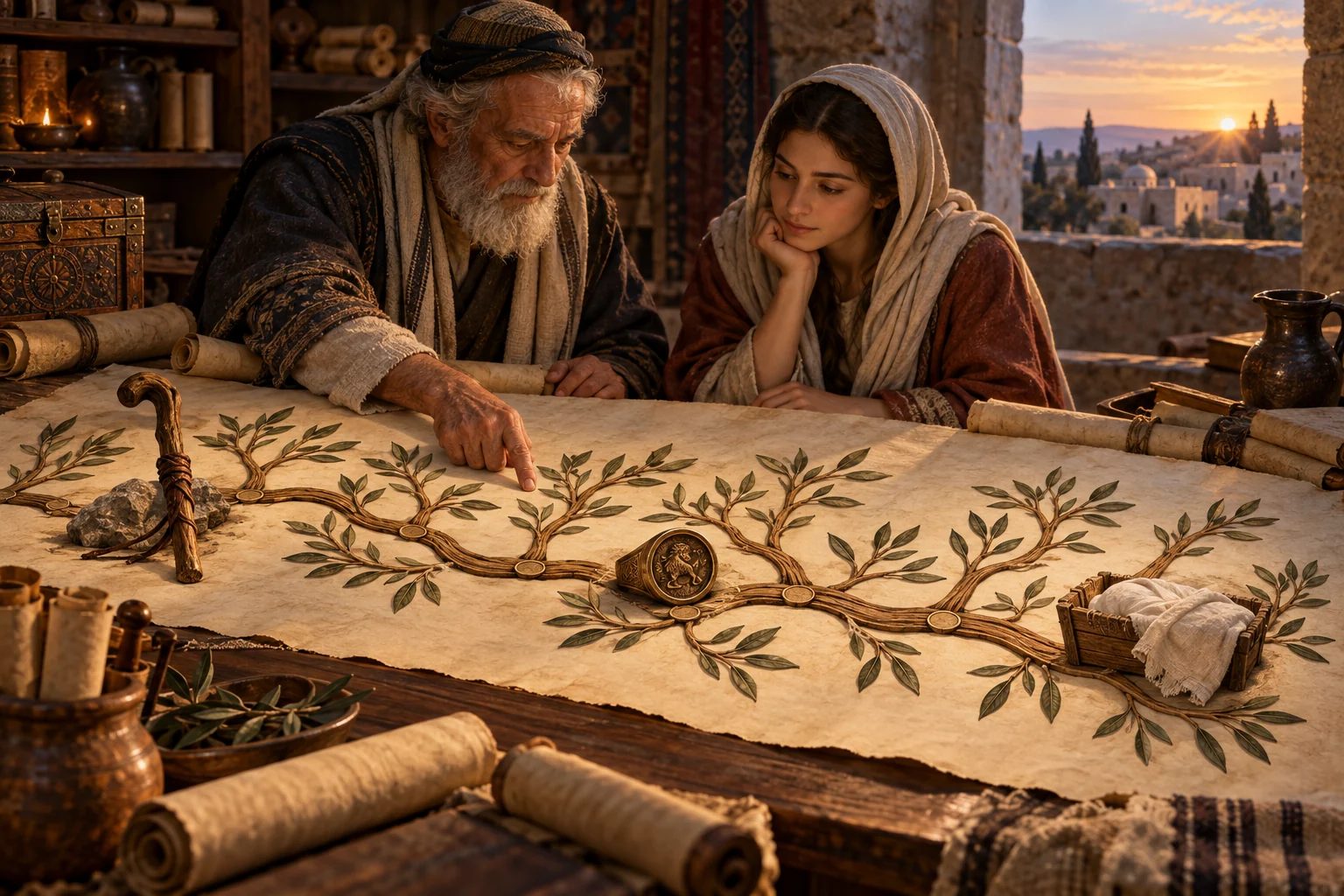
Matthew opens with a “book of genesis,” presenting Jesus’ advent as new creation and the continuation of Israel’s covenant history. The genealogy identifies him as Son of David and Son of Abraham: legitimate royal heir and the promised seed through whom blessing reaches the nations. Its deliberate structure interprets history theologically, placing exile at the center as a crisis Messiah comes to resolve.
The conception narrative explains that Jesus is both legally Davidic through Joseph and uniquely conceived by the Holy Spirit. His name announces that Yahweh saves, while Immanuel declares God’s presence with his people. Matthew thus joins genealogy, virgin conception, covenant promise, and divine presence without treating Jesus as detached from Israel’s concrete story.
Key Claims
- The Genesis heading signals new creation. Matthew’s opening echoes the Septuagint and frames the Gospel as creation renewed in Messiah.
- The genealogy is covenantal and royal. Abrahamic blessing and Davidic kingship govern the Gospel’s identity claim.
- The three fourteens are literary theology. Selective arrangement highlights David and organizes Israel’s movement through exile toward Messiah.
- The named women display providential inclusion. God advances the royal line through danger, irregularity, courage, and Gentile association.
- Jesus embodies Yahweh’s saving presence. “Jesus” and “Immanuel” interpret his mission as divine deliverance among his people.
Interpretive Context
The four women in the genealogy should not be reduced to a single category: their ethnic identities, marital histories, and narrative roles differ, and Bathsheba is pointedly named through Uriah. Likewise, the three groups of fourteen are a mnemonic and Davidic arrangement rather than an exhaustive chronology. Matthew’s selective genealogy makes a theological claim about covenant continuity, exile, and messianic kingship while still functioning as legal ancestry within ancient conventions.
Ancient genealogies established legal identity and could telescope generations without pretending to be modern civil registries. Matthew’s account and Luke’s genealogy serve different literary purposes and should not be forced into a simplistic line-by-line harmonization. Isaiah 7:14 operates through typological escalation: an earlier sign within the Davidic crisis reaches its climactic realization in the virginal conception and enduring Immanuel presence.
Selected Scholarship
- Davies, W. D., & Allison, D. C., Jr. (1988). Matthew 1–7.
- France, R. T. (2007). The Gospel of Matthew.
- Hagner, D. A. (1993). Matthew 1–13.
- Keener, C. S. (2009). The Gospel of Matthew.
- Kaiser, W. C., Jr. (2008). The Promise-Plan of God.
Scripture Connections
Matthew 1; 2 Samuel 7; Genesis 1; Exodus 40:35; Ezekiel 36:29; Isaiah 7:14; Matthew 1:23; Matthew 28:20
Continue on Substack
The complete article remains on Rabbit Room Apologetics at Substack.
Originally published August 10, 2026. This WordPress page is a discovery guide; the complete article is hosted on Substack.