ARTICLE GUIDE
At a Glance
Matthew 2 functions as the crucial transition from the messianic identification of the Christ to the immediate world-historical and spiritual conflict surrounding His manifestation. Where the initial chapter established “who He is”—the Son of David, the Son of Abraham, conceived by the Holy Spirit as Immanuel—Matthew 2 turns to “how He is received” and “what He does” in the world.
Read moreShow less
What This Study Explores
Biblical Theology • Canonical Interpretation • The Promise-Plan of God
How Does Matthew 2 Present Jesus as Israel’s Messiah?
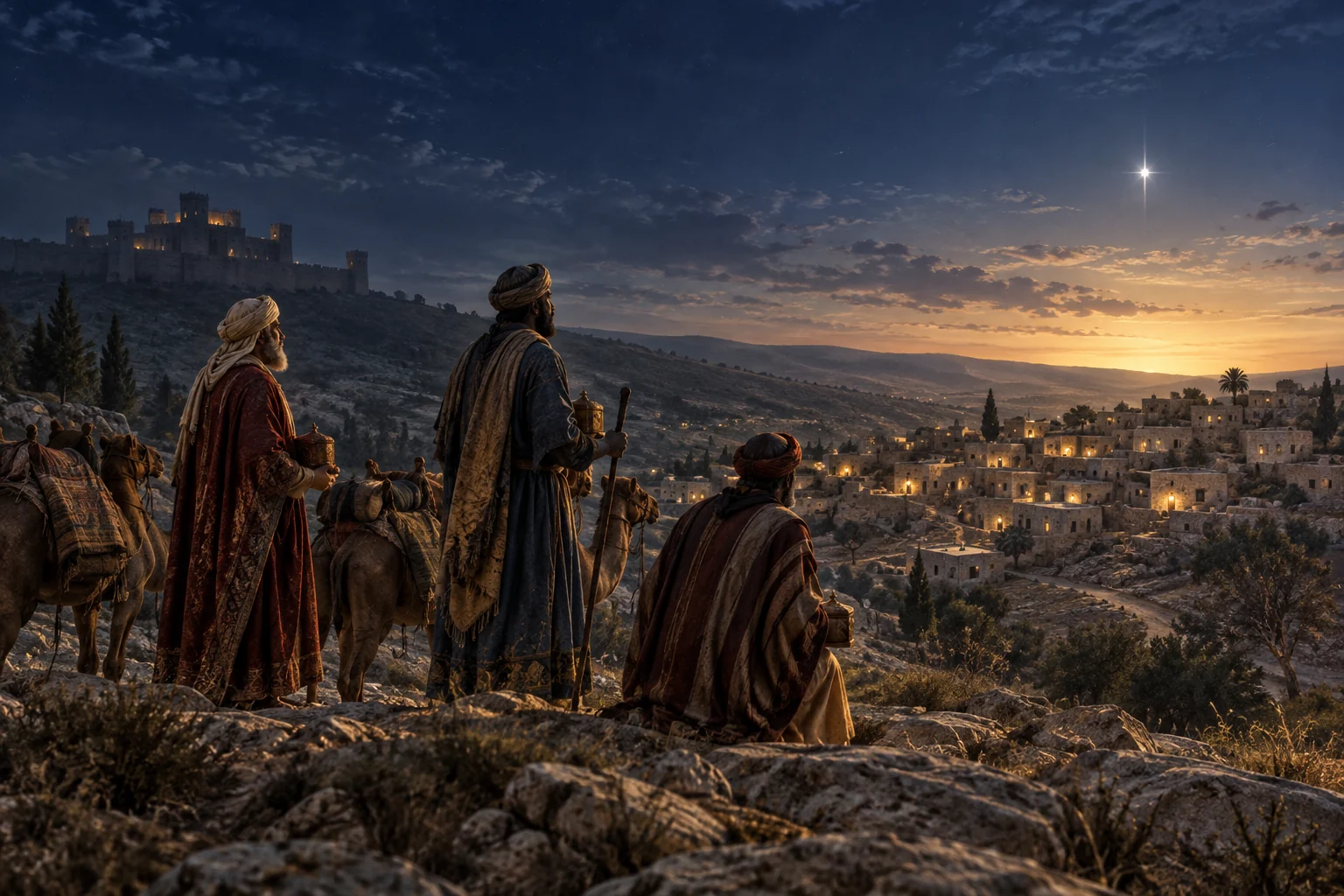
Matthew 2 portrays sharply contrasting responses to Messiah: Gentile Magi recognize and worship the royal child, while Herod seeks his death and Jerusalem’s leaders supply correct biblical information without joining the journey. The Magi’s arrival anticipates the nations streaming toward Israel’s light and Abrahamic blessing reaching the families of the earth through Israel’s King.
Jesus then recapitulates Israel’s story: threatened by a tyrant, preserved in Egypt, called out as God’s son, and brought through exile toward restoration. Matthew’s formula quotations are not isolated predictions mechanically matched to events. They join direct prophecy, typological escalation, corporate solidarity, and thematic fulfillment to show Jesus concentrating Israel’s vocation in himself without canceling Israel.
Key Claims
- The Magi anticipate Gentile worship. Foreign seekers recognize the Davidic King while covenant insiders display knowledge without allegiance.
- Herod reenacts Pharaoh’s violence. The threatened child survives a royal massacre and emerges as a new-Moses figure.
- Jesus embodies representative Israel. Hosea 11:1 is fulfilled typologically as the Son relives and faithfully completes Israel’s story.
- Rachel’s weeping names unresolved exile. Jeremiah’s lament stands within a larger promise of return and restoration.
- Nazorean fulfillment is composite. Matthew likely gathers prophetic themes of humble origin, rejection, branch imagery, and consecrated mission.
Interpretive Context
The star’s precise mechanism—planetary conjunction, comet, supernatural sign, or literary-theological phenomenon—cannot be settled from Matthew alone, and proposed astronomical dates should remain subordinate to the narrative. Matthew’s fulfillment citations use direct prediction, typological recapitulation, and thematic convergence; the concluding “Nazarene” formula is especially debated and should not be reduced to one certain lost proof-text.
Second Temple messianism, Herodian politics, ancient celestial-portent interpretation, and Jewish techniques of scriptural rereading illuminate the narrative. Matthew does not endorse astrology as a normative practice; God meets the Magi within their horizon and directs them to Israel’s Scriptures and King. Fulfillment language operates across multiple dimensions, with the final-form canon supplying patterns deeper than one-to-one prediction.
Selected Scholarship
- Davies, W. D., & Allison, D. C., Jr. (1988). Matthew 1–7.
- France, R. T. (2007). The Gospel of Matthew.
- Hagner, D. A. (1993). Matthew 1–13.
- Keener, C. S. (2009). The Gospel of Matthew.
- Kaiser, W. C., Jr. (2008). The Promise-Plan of God.
Scripture Connections
Matthew 2; Micah 5:2; 2 Samuel 5:2; Psalm 72:10–11; Isaiah 60:6; Hosea 11:1; Exodus 4:22–23; Exodus 1:16
Continue on Substack
The complete article remains on Rabbit Room Apologetics at Substack.
Originally published August 11, 2026. This WordPress page is a discovery guide; the complete article is hosted on Substack.