ARTICLE GUIDE
At a Glance
Matthew 19 opens the narrative sequence of the Gospel’s Fourth Discourse (Matt 18–20), shifting the geographical focus from Galilee to Judea beyond the Jordan as Yeshua begins His final journey toward Jerusalem.
Read moreShow less
What This Study Explores
Gospel Studies
How does Matthew 19 connect creation ethics, grace, and future restoration?
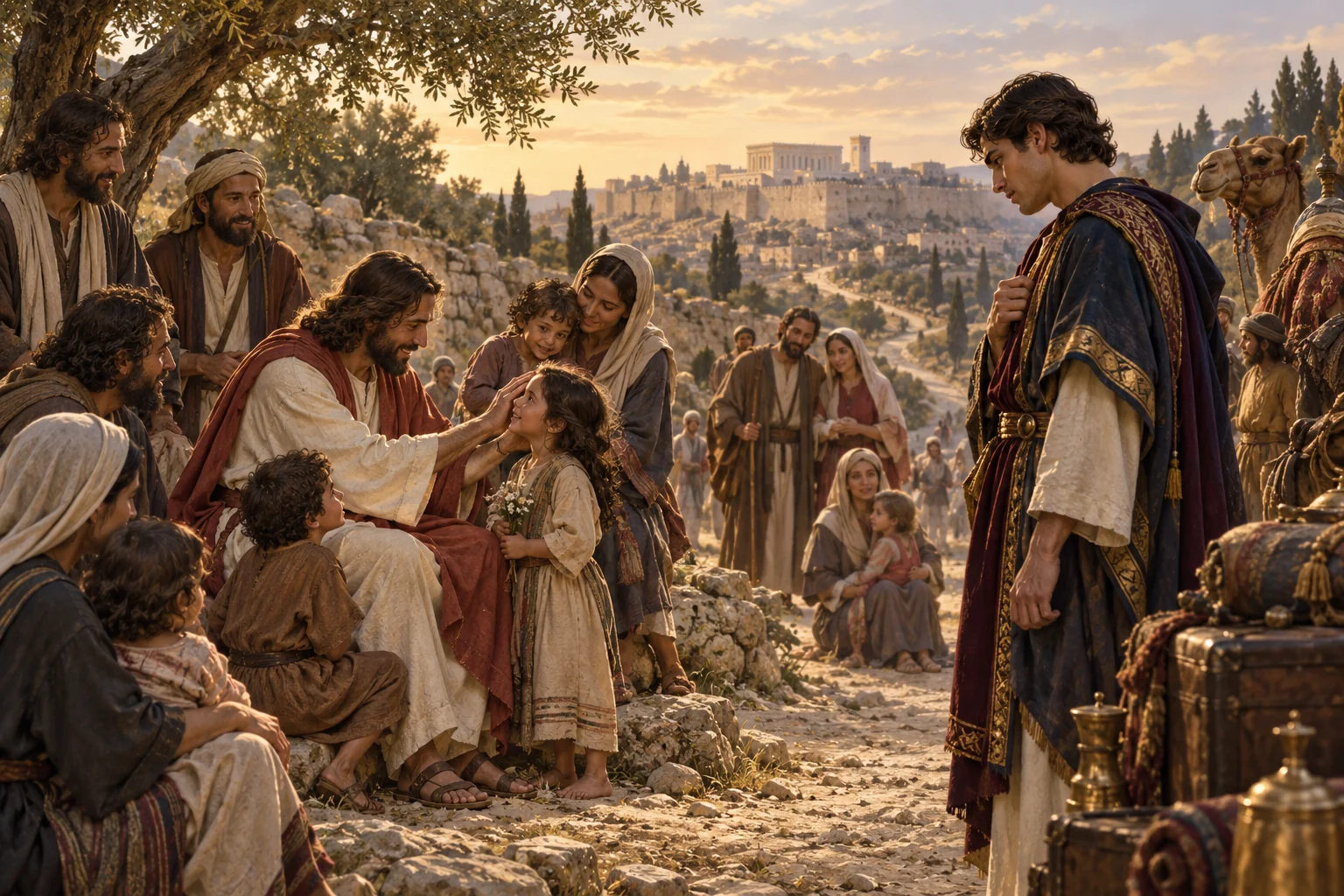
Jesus interprets marriage through Genesis, welcomes socially insignificant children, exposes wealth as a rival allegiance, and grounds salvation in God’s power rather than human achievement. These teachings present kingdom life as restored creation rather than escape from embodied relationships.
The chapter culminates in the palingenesia, the renewal in which the Son of Man reigns and the Twelve judge Israel’s tribes. Personal discipleship and cosmic restoration therefore belong to one promise-plan.
Key Claims
- Jesus reads Deuteronomy’s divorce provision as a concession to hardness of heart beneath the creation ideal of one flesh.
- Celibacy is a kingdom vocation given to some, not a universal command or superior human status.
- Children embody dependence and low status rather than romanticized innocence.
- The rich ruler’s wealth reveals divided allegiance that commandment-keeping claims cannot conceal.
- The promised twelve thrones preserve a concrete future for the twelve tribes of Israel.
Interpretive Context
The divorce controversy belongs to the Hillel–Shammai halakhic world, and Jesus’ ruling protects vulnerable women while directing interpretation from concession back to creation intent.
The chapter is explicitly non-supersessionist: covenant expansion to the nations does not dissolve Israel. The coming renewal restores creation, Israel, and faithful human vocation under the Davidic King.
Selected Scholarship
- R. T. France, The Gospel of Matthew (2007).
- Craig S. Keener, A Commentary on the Gospel of Matthew (1999).
- W. D. Davies and Dale C. Allison Jr., Matthew 19–28 (1997).
- David Instone-Brewer, Divorce and Remarriage in the Bible (2002).
- Walter C. Kaiser Jr., The Promise-Plan of God (2008).
Scripture Connections
Matthew 19; Matthew 18; Deuteronomy 24:1–4; Genesis 1:27; Genesis 2:24; Deuteronomy 24; Leviticus 19:18; Matthew 20:1–16
Continue on Substack
The complete article remains on Rabbit Room Apologetics at Substack.
Originally published August 28, 2026. This WordPress page is a discovery guide; the complete article is hosted on Substack.