ARTICLE GUIDE
At a Glance
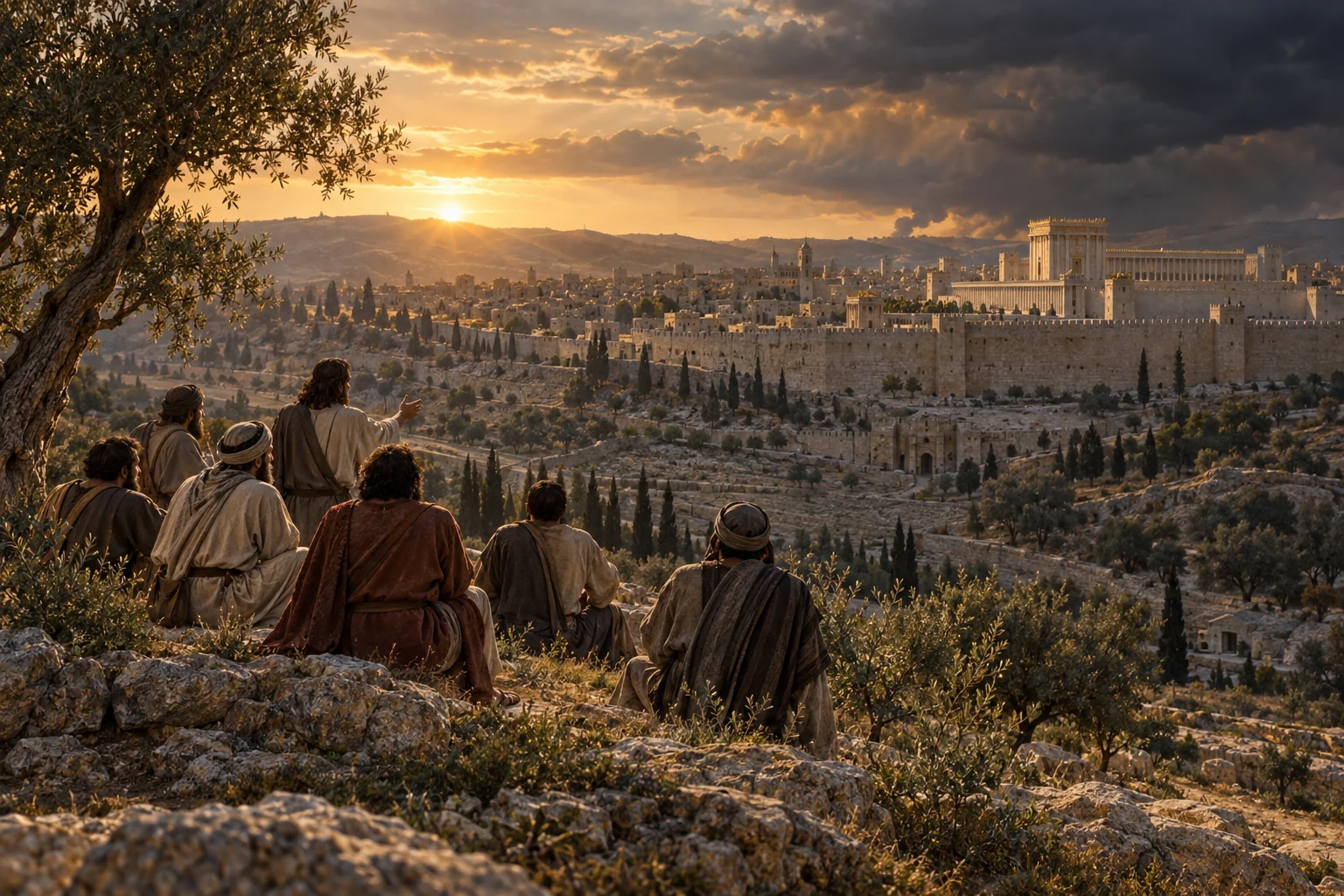
Matthew 24–25 constitutes the fifth and final major teaching discourse in the First Gospel—the Olivet Discourse—deliberately structured within Matthew’s pentateuchal scaffolding to present Yeshua as the Greater Moses and the authoritative Davidic King.
Read moreShow less
What This Study Explores
Gospel Studies
Does Matthew 24 refer to Jerusalem’s fall in 70 CE, the final return of Messiah, or both?
The discourse interweaves a near historical horizon with the final eschatological horizon. Jerusalem’s destruction fulfills Jesus’ covenant-lawsuit warning and publicly vindicates his enthronement, while the unknown final day still calls the church to watchfulness and awaits bodily resurrection and cosmic renewal.
Reading the horizons together honors Jesus’ reference to “this generation” without collapsing every promise into 70 CE. Historical judgments function as types and guarantees of the ultimate public parousia.
Key Claims
- Jesus’ departure from the temple echoes the withdrawal of divine glory in Ezekiel 10–11.
- The birth pains describe recurring interadvent distress rather than a timetable permitting date calculation.
- Luke 21 clarifies the abomination of desolation through Jerusalem’s encirclement by armies.
- Daniel 7 supplies the enthronement background for the Son of Man’s cloud-coming imagery.
- In the Noah analogy, those “taken” are removed in judgment while those left inherit the land.
Interpretive Context
Matthew 23–25 forms a continuous narrative: temple judgment, the Olivet Discourse, and the parables of accountable readiness interpret one another. Apocalyptic cosmic imagery draws on prophetic descriptions of collapsing political and covenantal orders.
Within the promise-plan, the destruction of localized sanctuary does not mean Israel’s replacement. Messiah becomes the living temple, the Spirit-indwelt assembly expands sacred space among the nations, and Israel’s irrevocable calling remains within the one olive tree.
Selected Scholarship
- R. T. France, The Gospel of Matthew (2007).
- W. D. Davies and Dale C. Allison Jr., Matthew 19–28 (1997).
- Craig S. Keener, A Commentary on the Gospel of Matthew (1999).
- N. T. Wright, Jesus and the Victory of God (1996).
- Walter C. Kaiser Jr., The Promise-Plan of God (2008).
Scripture Connections
Matthew 24; Matthew 23; Matthew 24:1; Ezekiel 10; Luke 21:20; Daniel 12:1; Joel 2:10; Daniel 7:13–14
Continue on Substack
The complete article remains on Rabbit Room Apologetics at Substack.
Originally published September 4, 2026. This WordPress page is a discovery guide; the complete article is hosted on Substack.