ARTICLE GUIDE
At a Glance
The Book of Exodus opens not as a detached historical monograph, but as the direct, organic continuation of the primeval and patriarchal narrative of Genesis. In the Hebrew canon, the text begins with the conjunction
Read moreShow less
What This Study Explores
Biblical Theology • Canonical Interpretation • The Promise-Plan of God
How Does Exodus 1 Frame Israel’s Oppression within the Promise-Plan?
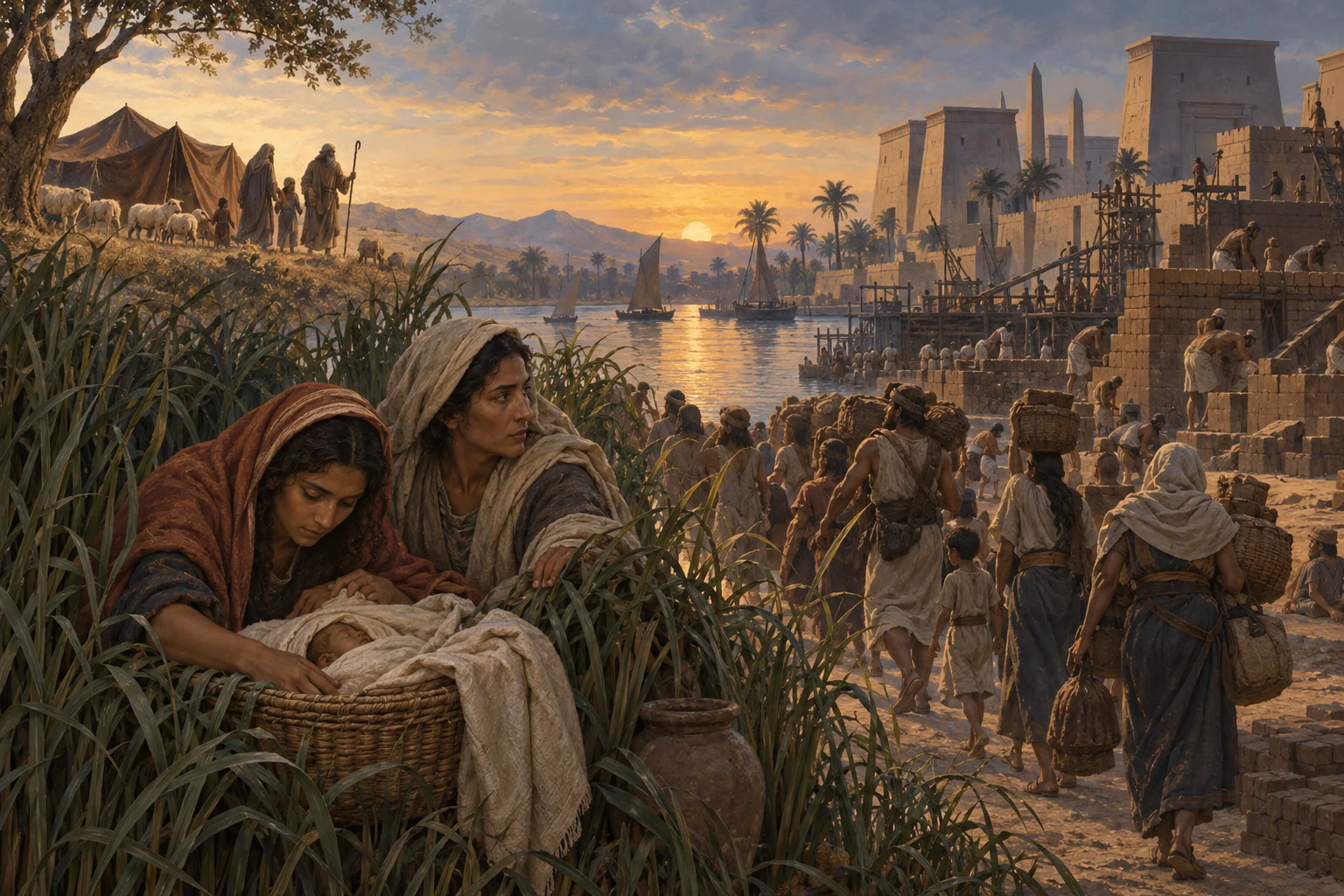
Exodus begins as the direct continuation of Genesis: Jacob’s household has entered Egypt, and the promised seed multiplies with creation-like abundance. Pharaoh interprets this blessing as a political threat and constructs a regime of forced labor and male-child destruction. The conflict is therefore larger than labor policy; imperial power attempts to reverse both the creation mandate and Yahweh’s sworn promise to Abraham.
The more Egypt oppresses Israel, the more the covenant people multiply. Hebrew midwives Shiphrah and Puah fear God above the king, preserving life through courageous resistance and receiving divine favor. Pharaoh’s escalation from labor to genocide prepares the narrative for Yahweh’s intervention and reveals that redemption will arise from covenant fidelity rather than Egyptian permission or Israelite strength.
Key Claims
- Exodus continues Genesis organically. Its opening conjunction and genealogy carry the patriarchal story directly into national formation.
- Israel’s multiplication echoes creation. The dense fertility vocabulary of Exodus 1:7 recalls Genesis 1:28 and 9:1.
- Pharaoh’s policy is anti-creation and anti-promise. Forced labor and infanticide attempt to suppress the life Yahweh has blessed.
- The midwives model covenantal resistance. Fear of God relativizes imperial commands when the state orders the destruction of innocent life.
- Oppression cannot annul the oath. Israel’s growth under affliction demonstrates that the Abrahamic promise advances through apparent historical reversal.
Interpretive Context
The chapter’s literary architecture moves from seventy members of Jacob’s household to a people filling the land, then from political anxiety to increasingly violent suppression. Egypt becomes a house of bondage whose royal ideology conflicts with Yahweh’s identity and claim on his firstborn son.
Acts 7 and Hebrews 11 situate the oppression and midwives within the wider history of promise and faith. Matthew’s infancy narrative later echoes the tyrant-and-threatened-child pattern, identifying Jesus with Israel’s exodus-shaped story without erasing Israel’s historical vocation.
Selected Scholarship
- Childs, B. S. (1974). The Book of Exodus. Westminster Press.
- Durham, J. I. (1987). Exodus. Word Books.
- Kaiser, W. C., Jr. (2008). The Promise-Plan of God. Zondervan.
- Propp, W. H. C. (1999). Exodus 1–18. Doubleday.
- Sarna, N. M. (1991). Exodus. Jewish Publication Society.
Scripture Connections
Exodus 1; Exodus 1:1; Genesis 46:8; Genesis 1:28; Genesis 9:1; Exodus 2; Matthew 2:16–18; Exodus 1:22
Continue on Substack
The complete article remains on Rabbit Room Apologetics at Substack.
Originally published September 9, 2026. This WordPress page is a discovery guide; the complete article is hosted on Substack.