ARTICLE GUIDE
At a Glance
Paul’s statements about women are read within Second Temple Judaism, Roman social conditions, epistolary context, and the shared vocation of image-bearing co-heirs.
Read moreShow less
What This Study Explores
This study integrates creation theology, Paul within Judaism, Roman legal and social context, women’s participation in early assemblies, disputed Pauline texts, and the promise-plan’s shared royal-priestly vocation.
Did Paul Universally Prohibit Women from Teaching or Leading?
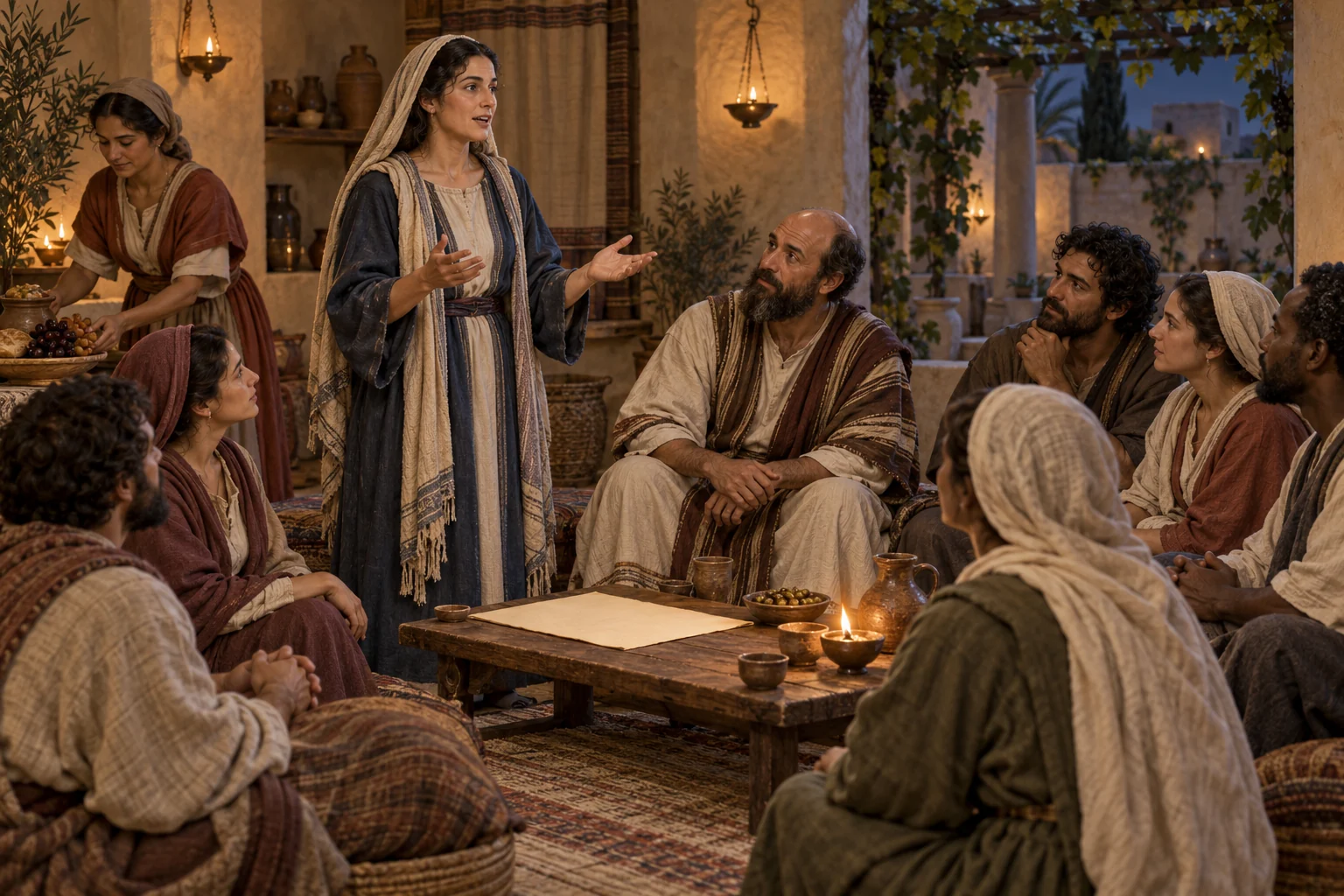
The complete Pauline evidence does not support reading every restrictive sentence as a timeless, context-free gender code. Paul assumes that women pray and prophesy, names Phoebe as diakonos and prostatis, recognizes Prisca as a coworker and teacher, and identifies Junia in apostolic language. Those practices must govern how situational corrective texts are interpreted.
This does not make the difficult passages disappear. It requires reading 1 Corinthians 14 within Corinthian disorder and possible quotation-refutation, and 1 Timothy 2 within an Ephesian crisis involving unformed or deceptive teaching. Creation’s male-and-female image-bearing and the one-family confession of Galatians 3:28 establish shared dignity and vocation while leaving interpreters to evaluate the precise scope of individual instructions.
Key Claims
- Creation grants shared image-bearing vocation. Male and female together receive royal-priestly representation and dominion.
- Paul’s practice includes authoritative female coworkers. Phoebe, Prisca, Junia, and women prophets belong to the interpretive evidence.
- The restrictive texts are epistolary corrections. Their local rhetorical and social settings matter for determining their scope.
- Key Greek terms remain contested. Authenteō and kephalē should not be assigned a single meaning without contextual argument.
- Equality is covenantal and vocational. Galatians 3:28 concerns incorporation into Messiah’s family without erasing embodied difference or Israel’s continuing vocation.
Interpretive Context
Western accounts have often portrayed Christianity as either liberating women from a uniformly patriarchal Judaism or inheriting Jewish restrictions from Paul. Both stories flatten the diversity of Second Temple Judaism and the social world of Roman assemblies. Reconstructing that environment illuminates Paul but does not function as a second canon.
Complementarian and egalitarian readings each identify real textual data, and neither should be dismissed by slogan. The central hermeneutical task is to interpret the prohibitions alongside Paul’s acknowledged female coworkers, prophets, patrons, and teachers. The promise-plan frames the discussion through creation, covenant, Messiah, Spirit, and the restored vocation of image-bearers.
Selected Scholarship
- Nanos, M. D., & Zetterholm, M. (Eds.). (2015). Paul within Judaism.
- Westfall, C. L. (2016). Paul and Gender.
- Payne, P. B. (2009). Man and Woman, One in Christ.
- Peppiatt, L. (2018). Women and Worship at Corinth.
- Thiselton, A. C. (2000). The First Epistle to the Corinthians.
Scripture Connections
Genesis 1:26–28; 2:18; Exodus 19:5–6; Galatians 3:26–29; Romans 11:17–29; 16:1–16; 1 Corinthians 11:2–16; 14:26–40; 1 Timothy 2:8–15
Continue on Substack
The complete article remains on Rabbit Room Apologetics at Substack.
Originally published September 22, 2026. This WordPress page is a discovery guide; the complete article is hosted on Substack.
Leave a Reply