ARTICLE GUIDE
At a Glance
For centuries, Christian theologians and biblical scholars have examined one of the most profound questions in the New Testament: how the death of Jesus the Messiah on a Roman cross affects the salvation of humanity.
Read moreShow less
What This Study Explores
Atonement • Pauline Studies
Direct Answer: What changes when Paul’s account of the cross is read inside Israel’s story?
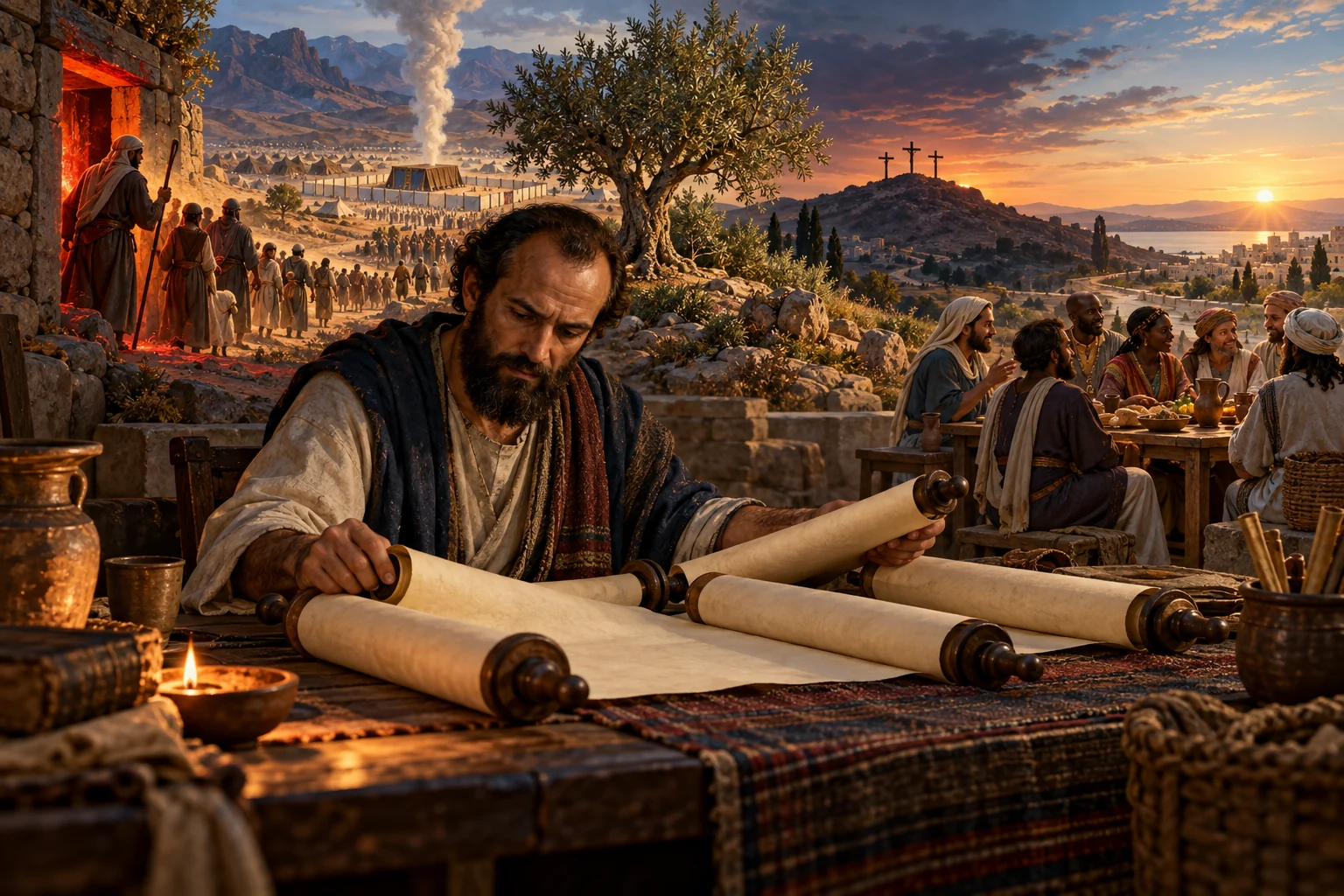
The cross appears as the climax of God’s covenantal promise rather than a detached mechanism. Jesus acts as faithful Messiah and representative of Israel and humanity: he confronts sin and hostile powers, gives himself “for our sins,” fulfills the scriptural story, and opens Abraham’s blessing to the nations through resurrection and the Spirit.
This narrative setting does not eliminate legal, sacrificial, or substitutionary dimensions. It locates them within Paul’s larger grammar of participation, reconciliation, liberation, new creation, and messianic kingship. The result is not one mechanical theory but a mutually interpreting network of claims about what God accomplished in the Messiah.
Key Claims
- Paul’s compressed atonement formulas presuppose Israel’s Scriptures and the story already taught to his communities.
- Jesus’ death and resurrection fulfill the promise-plan concerning Israel, the nations, and renewed creation.
- Representative and participatory language explains how the Messiah’s death and life become his people’s story.
- Forensic, sacrificial, victory, and reconciliation images are complementary dimensions rather than competing gospels.
- Paul’s Jewish context resists separating personal forgiveness from covenant membership, communal transformation, and resurrection hope.
Interpretive Context
Later atonement models can become anachronistic when imposed as exhaustive explanations, but later vocabulary is not automatically illegitimate. Paul uses judicial, cultic, commercial, military, familial, and participatory imagery, and interpreters disagree about how these relate. Historical reconstruction must also avoid replacing the text with a preferred background story. A canonical reading is strongest when it demonstrates its claims from particular letters and passages.
The article’s constructive proposal is best tested in Paul’s own sequence from Abrahamic promise and Israel’s plight to Messiah, resurrection, Spirit, and the nations. Romans and Galatians make the cross inseparable from resurrection and new-creation participation, so the Jewish narrative setting governs rather than merely decorates the atonement vocabulary.
Selected Scholarship
- David A. Brondos, Paul on the Cross — reconstructs Paul’s redemption narrative while criticizing later atonement systems.
- Michael J. Gorman, Apostle of the Crucified Lord — reads Paul through participation, cruciformity, and the scriptural story.
- N. T. Wright, Paul and the Faithfulness of God — situates Paul within Jewish monotheism, election, and eschatology.
- Fleming Rutledge, The Crucifixion — integrates substitution, judgment, liberation, and victory without reducing the cross to one image.
- Richard B. Hays, Echoes of Scripture in the Letters of Paul — demonstrates how Paul’s arguments depend on sustained rereading of Israel’s Scriptures.
Scripture Connections
Romans 4:25; Romans 4; Galatians 3:13–14; Romans 3:25; 2 Corinthians 5:21; Galatians 3:13; Romans 5:12–21; Romans 3:21–26
Continue on Substack
The complete article remains on Rabbit Room Apologetics at Substack.
Originally published May 5, 2026. This WordPress page is a discovery guide; the complete article is hosted on Substack.