ARTICLE GUIDE
At a Glance
For centuries, Christian theology has engaged with the declaration of Genesis 1:27 that humanity—male and female—was created “in the image of God.” Western interpreters, influenced by post-biblical philosophical frameworks, have often abstracted the imago Dei from its ancient Near Eastern context and situated it in structural capacities such as intellect, memory, or free will.
Read moreShow less
What This Study Explores
Imago Dei • Cosmic Temple
Direct Answer: What does it mean for every human being to be the image of God?
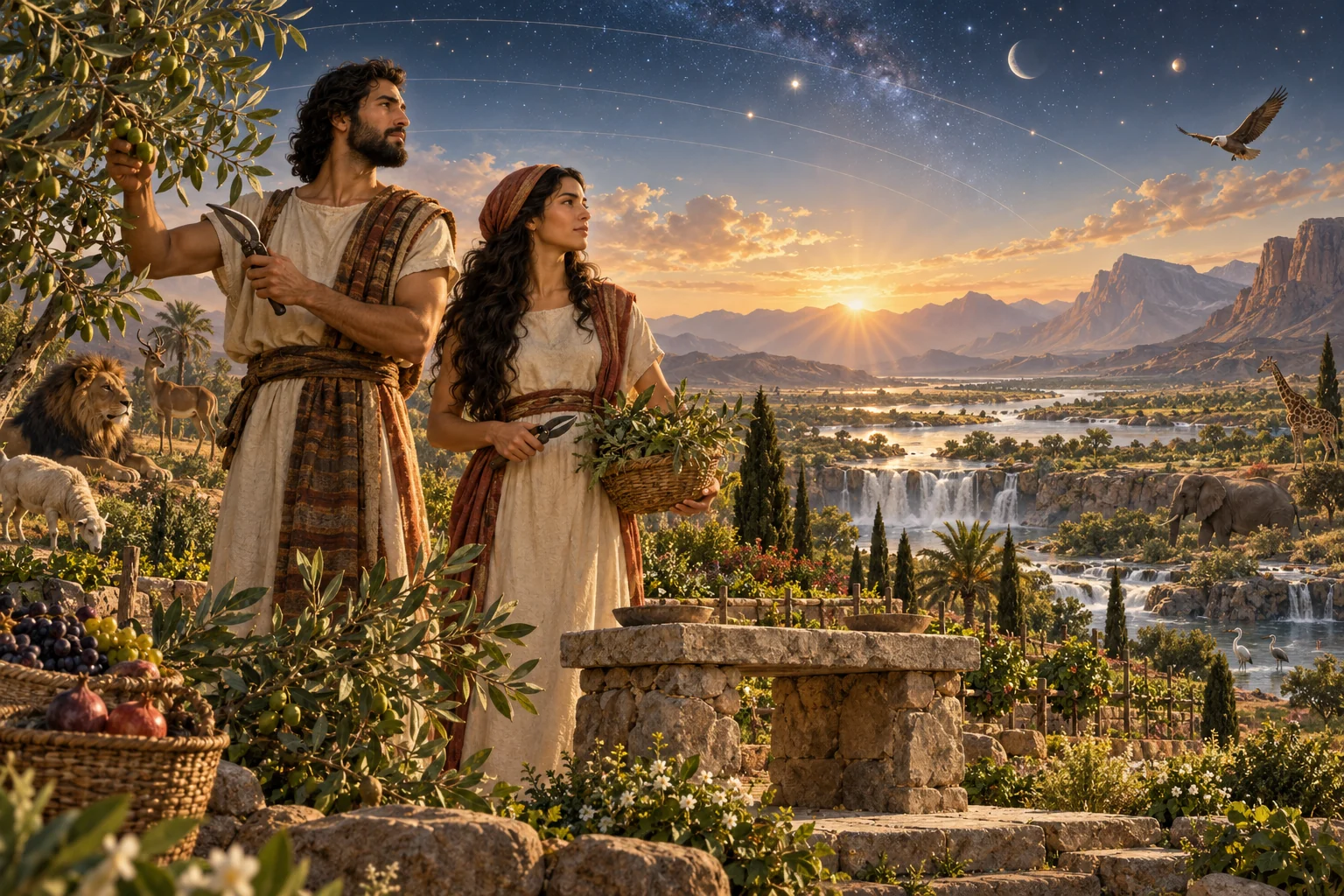
It means that humanity is given a God-established identity as his embodied representative within creation. In Genesis 1, male and female together occupy the royal-priestly place that ancient temples assigned to an image: they make the Creator’s rule visible by cultivating, guarding, and extending ordered sacred space.
The image is therefore not earned through intelligence, autonomy, memory, or productivity. Those capacities may serve the human vocation, but they do not create human worth. The fall damages the faithful exercise of the vocation without revoking the identity, and the promise-plan restores image-bearing through Christ, the true Image, toward renewed creation.
Key Claims
- The image of God is first an endowed identity shared by all human beings, not an achievement based on ability.
- Genesis gives humanity a royal and priestly vocation within creation understood as God’s ordered dwelling.
- Ancient temple imagery helps explain why a living human image replaces the cult statue found in neighboring religions.
- Sin corrupts humanity’s representation of God but does not erase the dignity conferred at creation.
- Christ embodies faithful humanity and restores the image-bearing vocation in the people joined to him.
Interpretive Context
Structural, relational, and functional interpretations of the image need not be mutually exclusive, though the Genesis context strongly emphasizes status and vocation. Ancient Near Eastern parallels illuminate the text without determining it, since Genesis also transforms surrounding royal ideology by extending image-bearing to all humanity. Claims that Greek philosophy alone produced capacity-based accounts should also be qualified; Christian anthropology developed through diverse biblical, philosophical, and pastoral concerns.
Ancient royal and temple imagery explains humanity as God’s living representation rather than a cult statue confined to a shrine, while Genesis extends this status to male and female alike. The canonical development moves from damaged vocation to the true image in Messiah and finally to a resurrected people serving within the renewed creation where divine presence fills sacred space.
Selected Scholarship
- J. Richard Middleton, The Liberating Image — a landmark treatment of the image as humanity’s royal vocation.
- Carmen Joy Imes, Being God’s Image — traces image-bearing identity and vocation across the canon.
- John H. Walton, The Lost World of Adam and Eve — situates human origins and sacred-space themes in ancient context.
- Marc Cortez, Theological Anthropology — surveys major Christian accounts of human identity and the image of God.
- Irenaeus of Lyons, Against Heresies — image, likeness, recapitulation, and the restoration of humanity in the incarnate Son.
Scripture Connections
Genesis 1:27; Genesis 1; Genesis 1:26; Job 1; Genesis 3:15; Revelation 21; Genesis 1:26–28; Genesis 2
Continue on Substack
The complete article and its available video material remain on Rabbit Room Apologetics at Substack.
Originally published May 6, 2026. This WordPress page is a discovery guide; the complete article is hosted on Substack.