ARTICLE GUIDE
At a Glance
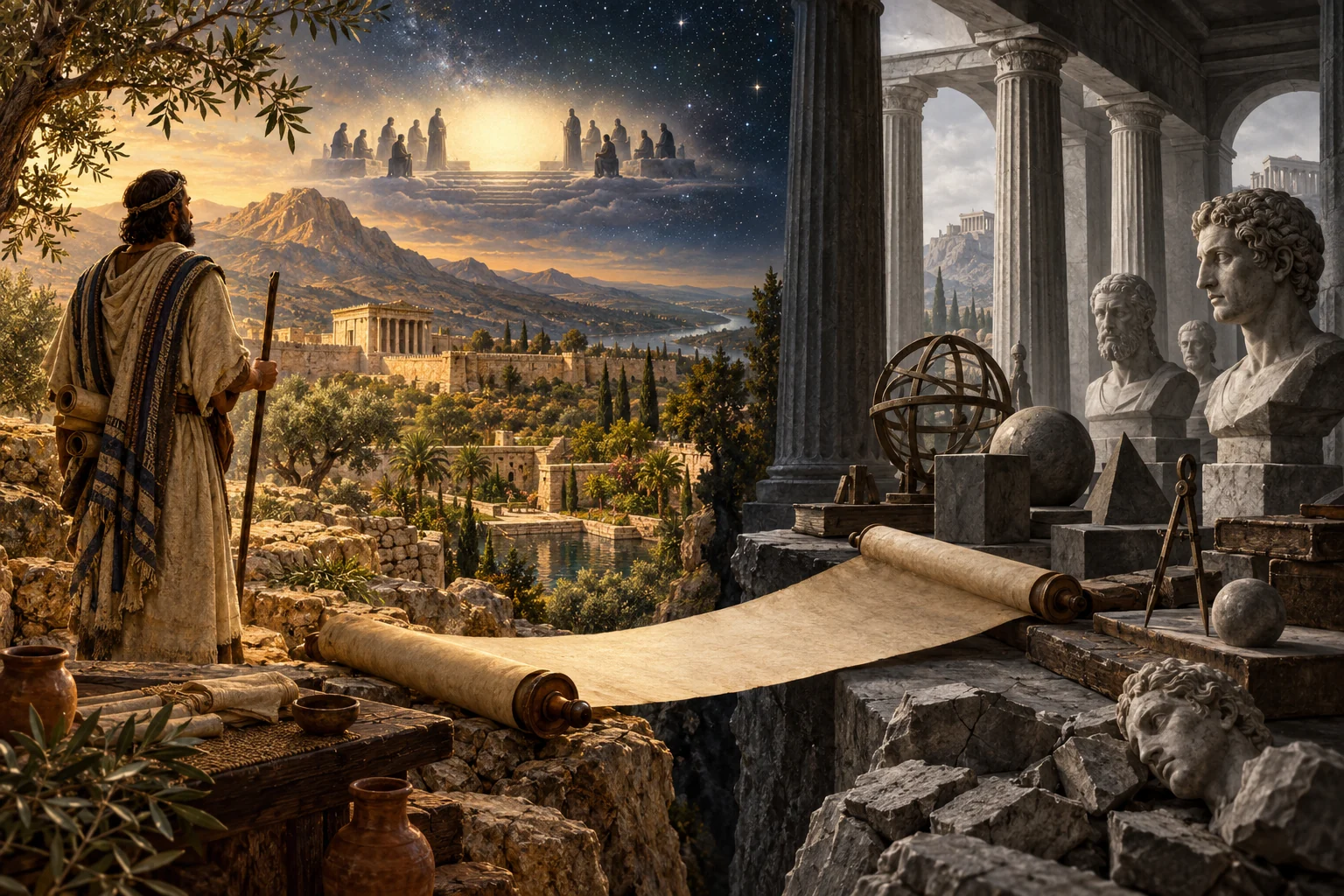
Contemporary academic study of the Scriptures presents a considerable methodological challenge: conceptualizing the spiritual and material worlds of the biblical authors on their own terms. For centuries, Western Christian theology has been mediated through frameworks influenced by post-biblical philosophical systems.
Read moreShow less
What This Study Explores
Divine Council Worldview
Direct Answer: How can modern readers recover Scripture’s ancient supernatural worldview without abandoning critical judgment?
Readers begin by treating the ancient Near Eastern and Second Temple worlds as interpretive context rather than embarrassing residue. Terms such as elohim, scenes such as Psalm 82, and the allotment tradition behind Deuteronomy 32 belong to a populated spiritual cosmos in which Yahweh remains the unique, uncreated Creator and sovereign over every other being.
Recovering that world does not require romanticizing “Hebrew thought” or rejecting careful theology. It requires allowing the text’s literary, historical, and canonical evidence to discipline later systems, while the promise-plan traces how creation, Israel, Messiah, the nations, and new creation belong to one unfolding divine purpose.
Key Claims
- Biblical authors describe a real heavenly administration without treating its members as rivals equal to Yahweh.
- The Hebrew term elohim can name several inhabitants of the unseen realm and does not by itself assign divine attributes.
- Ancient Near Eastern and Second Temple evidence helps readers recognize conceptual assumptions shared by biblical authors and audiences.
- The promise-plan integrates the divine-council worldview with the calling of Abraham, Israel’s vocation, Messiah’s victory, and the recovery of the nations.
- Later theological systems are most useful when they remain accountable to local exegesis and the final canonical witness.
Interpretive Context
The contrast between an “ancient Hebraic mind” and a “Western Greek mind” is useful only as a limited heuristic. James Barr and others showed that languages do not generate uniform modes of thought, and both ancient Jewish and Greek traditions display considerable diversity. Divine-council readings are also debated: some interpreters identify Psalm 82’s figures as human rulers or use agency language more cautiously. The case should therefore rest on the cumulative textual and comparative evidence rather than a rigid cultural binary.
Within the recovered cosmology, elohim describes inhabitants of the unseen realm rather than a shared set of divine attributes; Yahweh alone is uncreated, sovereign, and incomparable. Divine-council scenes, the Deuteronomy 32 allotment, and the biblical conflict with rebellious powers then clarify the Abrahamic mission and Messiah’s reclamation of the nations without compromising monotheism.
Selected Scholarship
- Michael S. Heiser, The Unseen Realm — a wide-ranging evangelical synthesis of the divine-council worldview.
- Mark S. Smith, The Origins of Biblical Monotheism — examines Israelite divine plurality and Yahweh’s uniqueness within ancient context.
- James Barr, The Semantics of Biblical Language — a foundational warning against simplistic Hebrew-versus-Greek thought contrasts.
- Brevard S. Childs, Biblical Theology of the Old and New Testaments — models theological interpretation attentive to the canon’s final form.
- John H. Walton, The Lost World of Genesis One — ancient cosmology and functional ordering as context for Scripture’s supernatural world.
Scripture Connections
1 Samuel 15; Romans 9; Deuteronomy 32:8–9; Psalm 82; 1 Samuel 28:13; Psalm 82:2–4; Exodus 21:6; Psalm 82:6–7
Continue on Substack
The complete article and its available video material remain on Rabbit Room Apologetics at Substack.
Originally published May 8, 2026. This WordPress page is a discovery guide; the complete article is hosted on Substack.